

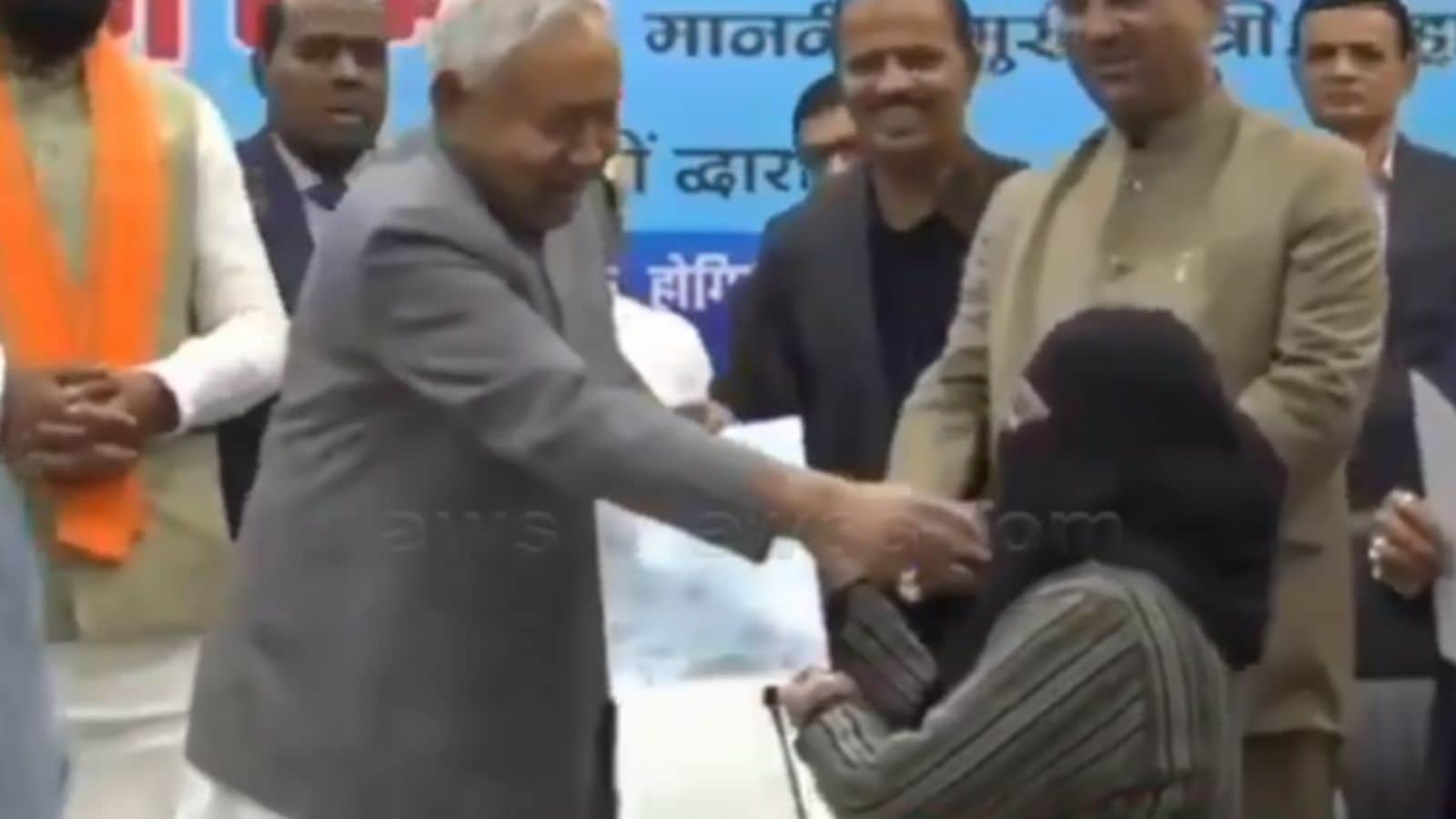


Content unavailable: Bihar doctor, hijab incident, duty failure.
Summary
Due to the unavailability of the article's content, a detailed summary explaining the incident, its significance, and specific exam relevance cannot be provided. The title suggests an incident in Bihar involving a doctor, an alleged act by 'Nitish' concerning a hijab, and the doctor subsequently failing to join duty, indicating a potential social or administrative issue.
Key Points
- 1Specific details regarding the alleged 'hijab pulling' incident, including date and exact location, are not available.
- 2The identity of the doctor involved and the full name of 'Nitish' are not provided in the missing content.
- 3Reasons or circumstances behind the doctor's 'failure to join duty' are not detailed.
- 4No information on any legal, administrative, or social implications of the event can be extracted.
- 5The article lacks specific facts, figures, or constitutional provisions for competitive exam preparation due to content unavailability.
In-Depth Analysis
The news headline, "Bihar doctor whose hijab Nitish pulled down fails to join duty," despite the lack of specific article content, immediately flags several critical issues for competitive exam aspirants. It points towards potential violations of fundamental rights, questions of administrative conduct, and the delicate balance of religious freedom in a secular state. While specific details of the incident remain unknown, a comprehensive analysis can explore the broader themes and constitutional principles that would be at play if such an event occurred.
**Background Context and the Essence of Religious Freedom:**
India, as enshrined in its Preamble, is a secular democratic republic. This means the state is neutral towards all religions and guarantees every citizen the freedom to profess, practice, and propagate their religion. This foundational principle is articulated in **Article 25 of the Indian Constitution**, which grants all persons the right to freedom of conscience and the right freely to profess, practice, and propagate religion, subject to public order, morality, and health. The wearing of a hijab by a Muslim woman is widely considered an essential religious practice by many, falling under the purview of this fundamental right. Any act that interferes with this right, especially by a public figure, immediately raises constitutional concerns. The context of religious attire in public spaces, including educational institutions and workplaces, has been a subject of intense debate and judicial scrutiny in recent years, notably with the Karnataka hijab ban case.
**What Such an Incident Signifies:**
Though the specific incident involving 'Nitish' and the doctor is not detailed, the headline suggests an alleged act of a public figure forcefully removing a religious garment. Such an act, if proven, would not only be a grave violation of an individual's personal liberty and religious freedom but also an assault on dignity. The subsequent 'failure to join duty' by the doctor could be a direct consequence of trauma, protest, or administrative issues stemming from the incident. This highlights the severe psychological and professional repercussions of such actions.
**Key Stakeholders and Their Roles:**
1. **The Doctor:** As an individual and a public servant, the doctor represents the citizen whose fundamental rights are potentially violated. Her 'failure to join duty' might signify a protest against injustice, a demand for accountability, or an inability to perform duties due to the distress caused. Her agency and right to dignified work are paramount.
2. **'Nitish' (Implied Public Figure/Politician):** If 'Nitish' refers to a political leader or a person in authority, their actions would come under intense scrutiny. Public figures are expected to uphold the Constitution and set an example of respectful conduct, particularly towards citizens' fundamental rights. An alleged act of pulling down a hijab would represent a severe dereliction of this duty, potentially amounting to misconduct or even criminal offense, challenging the principles of good governance and political accountability.
3. **The State Government (Bihar):** The state has a constitutional obligation to protect its citizens' rights and ensure law and order. In such a scenario, the Bihar government would be responsible for investigating the matter, taking appropriate action against the perpetrator (if allegations are true), and ensuring justice for the aggrieved party. Its response would reflect its commitment to secularism and rule of law.
4. **Civil Society and Media:** These entities play a crucial role in bringing such incidents to light, advocating for justice, and holding powerful individuals accountable. Their vigilance is vital for a functioning democracy.
**Why This Matters for India: Broader Implications:**
Such incidents have far-reaching implications for India's social fabric, constitutional ethos, and governance:
* **Social Cohesion:** Acts perceived as assaults on religious identity can inflame communal tensions, undermine social harmony, and deepen societal divisions, challenging the pluralistic nature of Indian society.
* **Constitutional Values:** It strikes at the heart of India's secularism and fundamental rights, particularly **Article 21 (Right to Life and Personal Liberty)**, which includes the right to dignity, and **Article 14 (Equality Before Law)**, ensuring no discrimination. It also touches upon **Article 15 (Prohibition of Discrimination)** on grounds of religion, race, caste, sex, or place of birth.
* **Governance and Rule of Law:** It raises serious questions about the conduct of public officials and the accountability mechanisms in place. It underscores the need for sensitivity training, ethical conduct, and adherence to the rule of law by all those in positions of power.
* **Women's Rights:** The incident, involving a woman and her religious attire, also intersects with women's rights to choose, bodily autonomy, and freedom from harassment and discrimination in the workplace and public sphere.
**Future Implications:**
If such allegations are substantiated, it could lead to widespread public outcry, legal challenges, and calls for stricter enforcement of laws protecting religious freedom and personal dignity. It might also prompt a re-evaluation of codes of conduct for public servants and politicians. The incident could contribute to the ongoing national discourse on secularism, individual liberties, and the role of the state in matters of personal faith. Ultimately, how the state and society respond to such an incident would be a litmus test for India's commitment to its constitutional ideals and the protection of its minorities.
In essence, while the specifics are missing, the headline serves as a potent reminder of the constant vigilance required to uphold the foundational principles of justice, liberty, equality, and fraternity that underpin the Indian Constitution.
Exam Tips
This topic falls under GS Paper I (Indian Society, Communalism) and GS Paper II (Polity, Governance, Fundamental Rights, Social Justice). Be prepared for both objective and subjective questions.
Study Articles 14, 15, 21, and 25 of the Constitution thoroughly. Understand the concept of 'essential religious practice' and the 'reasonable restrictions' on fundamental rights. Connect this with cases like the Karnataka Hijab ban and past judgments on religious freedom.
Practice essay questions on topics like 'Secularism in India: Challenges and Prospects' or 'The role of fundamental rights in protecting minority interests.' Also, anticipate case studies on ethical dilemmas involving religious freedom and administrative conduct.
Familiarize yourself with the Code of Conduct for Ministers/Public Servants and the role of institutions like the National Commission for Women (NCW) and National Human Rights Commission (NHRC) in addressing such issues.
Understand the distinction between positive and negative secularism and how the Indian model of secularism accommodates religious diversity while maintaining state neutrality.