



Relevant for Exams
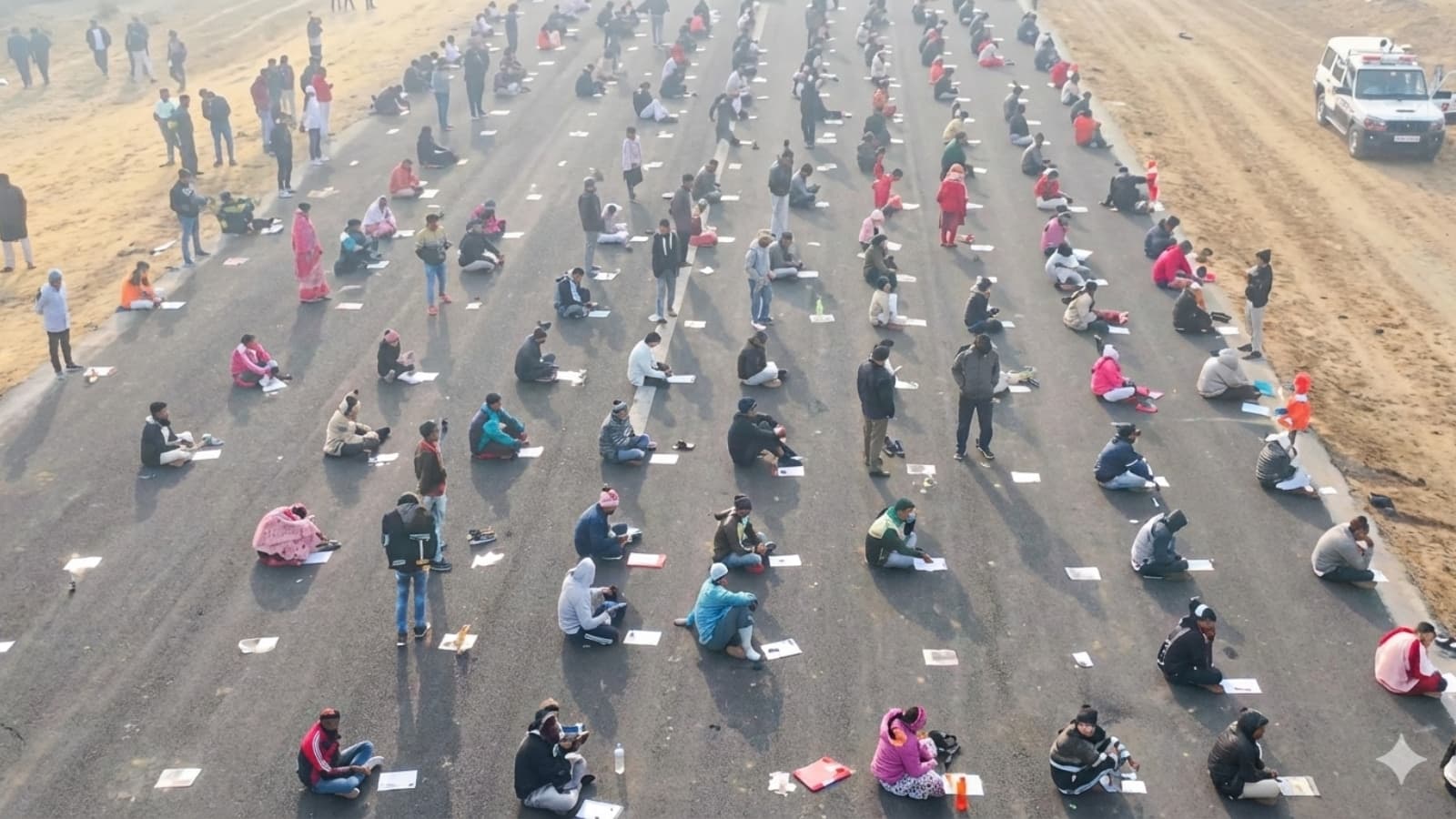
8,000 applicants for 187 Home Guard posts in Odisha; exam held on airstrip.
Summary
This news highlights the intense competition for government jobs, with 8,000 applicants vying for just 187 Home Guard posts in Odisha. The examination was uniquely held on an airstrip, underscoring logistical aspects or the scale of the event. This situation is significant for competitive exams as it illustrates socio-economic trends like unemployment and the high demand for public sector employment in India.
Key Points
- 1A total of 8,000 applicants appeared for the Home Guard recruitment examination.
- 2The recruitment drive was for 187 vacant posts of Home Guards.
- 3The examination was conducted in the Indian state of Odisha.
- 4The unique venue for the recruitment examination was an airstrip.
- 5The applicant-to-post ratio was approximately 43:1, highlighting severe job competition.
In-Depth Analysis
The news of 8,000 applicants vying for merely 187 Home Guard posts in Odisha, with the examination held on an airstrip, serves as a stark and compelling illustration of India's complex socio-economic landscape. This incident is not just a local news item; it's a powerful microcosm of the deep-seated challenges related to unemployment, the overwhelming preference for government jobs, and the administrative hurdles in a populous nation.
**Background Context: The Enduring Allure of Government Jobs**
For decades, government jobs in India have represented more than just employment; they symbolize stability, social security, respect, and often, a guaranteed pension. This preference is deeply ingrained, stemming from a historical context where private sector opportunities were limited and often volatile. Post-liberalization in 1991, while the private sector expanded, the demand for government jobs, particularly at entry-level and semi-skilled positions, has remained exceptionally high. Factors such as a rapidly growing young population, a significant portion of which is educated but lacks industry-relevant skills, and a perceived lack of equitable opportunities in the private sector contribute to this intense competition. The economic uncertainties, especially in the wake of global slowdowns and technological disruptions, further amplify the appeal of secure public sector employment.
**The Odisha Incident: A Microcosm of a National Challenge**
In Odisha, the recruitment drive for 187 Home Guard posts attracted an astonishing 8,000 applicants, leading to an applicant-to-post ratio of approximately 43:1. This is a clear indicator of the severe job scarcity, particularly for positions that, while not high-paying, offer the coveted 'government job' tag. Home Guards are a voluntary auxiliary force, established under the Home Guards Act, 1947, and subsequent state acts, to assist the police in maintaining law and order, traffic control, and disaster relief. Their role is crucial, yet the sheer volume of applicants underscores the desperation for any form of stable income. The unique choice of an airstrip as a venue for the examination likely points to the need for a vast, open space to accommodate such a large number of candidates, possibly for physical endurance tests, highlighting the logistical challenges faced by recruitment agencies.
**Key Stakeholders Involved**
1. **The Applicants:** Primarily young individuals, often from rural or semi-urban backgrounds, many with educational qualifications exceeding the basic requirements for Home Guard posts. Their participation reflects their aspirations for a secure livelihood and their frustration with limited opportunities. This group represents India's demographic dividend, which, if not adequately employed, can turn into a demographic burden.
2. **The Odisha Government (and its various departments):** As the employer and the conducting authority, the state government is responsible for creating employment opportunities, ensuring a fair and transparent recruitment process, and maintaining law and order. The scale of the applications puts immense pressure on administrative machinery and exposes the challenge of balancing demand with capacity.
3. **The Home Guard Organization:** This auxiliary force relies on recruitment to maintain its strength and effectiveness. While it needs personnel, it also faces the administrative burden of managing such large-scale applications and ensuring the selection of suitable candidates.
**Significance for India and Broader Implications**
This incident has profound significance for India. It serves as a stark reminder of the unemployment crisis, particularly among the youth. India's 'demographic dividend' – its large working-age population – is at risk of becoming a challenge if sufficient productive employment opportunities are not created. This can lead to social unrest, increased inequality, and hinder overall economic growth. The incident also highlights regional disparities in economic development and job creation, as states like Odisha often face higher unemployment rates compared to more industrialized regions.
**Constitutional and Policy Relevance**
Several constitutional provisions are relevant here. The **Directive Principles of State Policy (DPSP)**, particularly **Article 38**, mandates the state to secure a social order for the promotion of welfare of the people, striving to minimize inequalities. **Article 39(a)** directs the state to ensure that citizens have the right to an adequate means of livelihood. Most crucially, **Article 41** states that the state shall, within the limits of its economic capacity and development, make effective provision for securing the right to work, to education, and to public assistance in cases of unemployment, old age, sickness, and disablement. The fierce competition for jobs underscores the immense challenge in fulfilling these constitutional mandates. Furthermore, **Article 16** guarantees equality of opportunity in matters of public employment, which recruitment drives like this aim to uphold, albeit under immense competitive pressure.
**Future Implications**
Looking ahead, this situation demands a multi-pronged approach. There is an urgent need for the government to accelerate job creation, not just in the public sector but, more importantly, by fostering a robust private sector. This involves improving the ease of doing business, attracting foreign and domestic investment, and investing in infrastructure. Skill development initiatives, such as the **Skill India Mission**, need to be more effective in bridging the gap between educational qualifications and industry requirements. Vocational training and entrepreneurship promotion can empower youth to become job creators rather than just job seekers. Failure to address this challenge could lead to significant social and economic instability, impacting India's long-term growth trajectory and its ability to harness its demographic potential.
Exam Tips
This topic falls under the 'Indian Economy' (Employment, Poverty, Demographics) and 'Indian Polity' (Directive Principles of State Policy, State Administration) sections of the UPSC, State PSC, SSC, and Railway exam syllabi. Students should also link it to 'Social Issues' concerning youth and unemployment.
Study related government schemes like the Skill India Mission, Make in India, MGNREGA, and various state-specific employment generation programs. Understand their objectives, implementation, and impact on reducing unemployment.
Be prepared for analytical questions on the causes and consequences of unemployment, the role of government in job creation, the significance of the demographic dividend, and the challenges faced by India's youth. Factual questions might include relevant Constitutional Articles (e.g., DPSP related to employment) or specific government initiatives.
Practice essay writing or descriptive answers on topics like 'Unemployment as a National Challenge' or 'The Demographic Dividend: Opportunity or Burden for India,' using such news items as concrete examples to support your arguments.
Understand the distinction between various types of unemployment (structural, cyclical, frictional, disguised, etc.) and how they manifest in the Indian context. This news highlights aspects of structural unemployment and underemployment.