

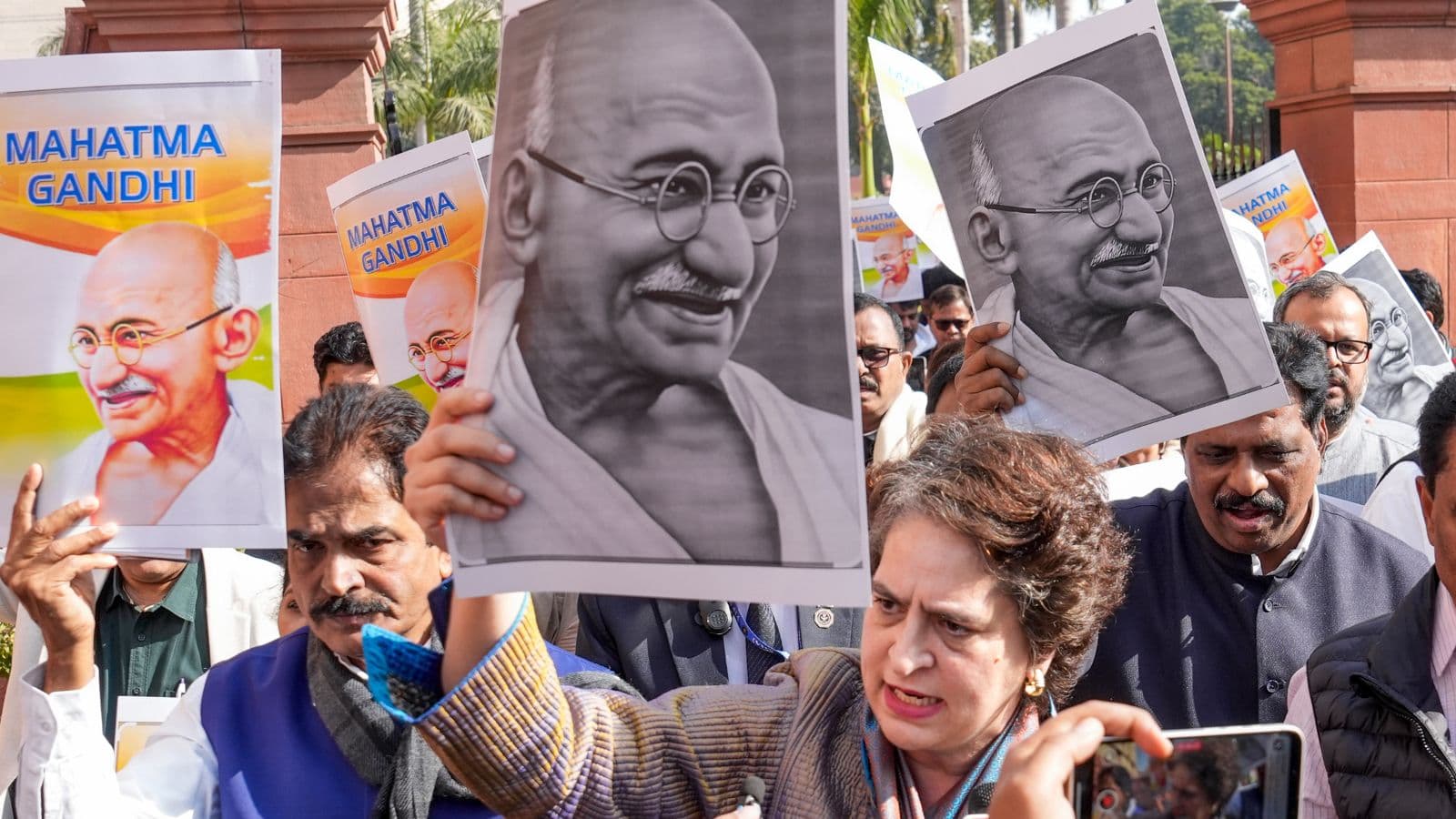


MGNREGA's political framing hinted, but content unavailable for specific details.
Summary
The article title suggests a political discussion around MGNREGA, potentially involving a new naming convention 'VB-G RAM G' and its electoral implications for BJP and Congress. However, the content is unavailable, preventing the extraction of specific details, policy changes, or political strategies. Therefore, precise exam-relevant facts cannot be determined from this entry.
Key Points
- 1Article content is unavailable, precluding extraction of specific facts about MGNREGA's discussed changes.
- 2The proposed 'VB-G RAM G' nomenclature for MGNREGA lacks details due to missing article text.
- 3No specific policy amendments or implementation details regarding MGNREGA are provided.
- 4The political strategies of BJP and Congress concerning MGNREGA's electoral impact are not elaborated.
- 5Exact dates, financial figures, or constitutional provisions related to the topic cannot be identified.
In-Depth Analysis
The article title "MGNREGA becomes VB-G RAM G: Why both BJP, Congress see a winning play" hints at a significant political narrative unfolding around one of India's most crucial social security programmes: the Mahatma Gandhi National Rural Employment Guarantee Act (MGNREGA). While the specific content of the article is unavailable, we can infer a discussion about a potential rebranding or reframing of MGNREGA, possibly with a new nomenclature like 'VB-G RAM G', and the associated political calculations of both the ruling Bharatiya Janata Party (BJP) and the opposition Indian National Congress.
**Background Context: The Genesis and Significance of MGNREGA**
MGNREGA, enacted on August 25, 2005, during the UPA government's tenure, is a landmark legislation aimed at enhancing livelihood security in rural areas by guaranteeing 100 days of wage employment in a financial year to every rural household whose adult members volunteer to do unskilled manual work. It is a demand-driven scheme, meaning employment is provided on demand, ensuring a legal right to work. The Act's primary objectives include providing a social safety net for vulnerable populations, reducing distress migration, strengthening Panchayati Raj Institutions, and creating durable assets like roads, water conservation structures, and irrigation canals in rural areas. It represents a significant step towards realizing the Directive Principles of State Policy, particularly Article 41, which calls for the state to make effective provision for securing the right to work, and Article 39(a), which advocates for adequate means of livelihood.
**What the Title Implies and Key Stakeholders**
The title suggests that MGNREGA, an iconic scheme often associated with the Congress party, might be undergoing a rebranding or a narrative shift, possibly under a new name like 'VB-G RAM G'. This could be a strategic move by the BJP to either appropriate the scheme's success, infuse it with their own ideological flavour, or highlight specific aspects of its implementation under their government. Such a rebranding would allow the ruling party to claim ownership or credit, particularly in the run-up to elections, by presenting it as a renewed or improved initiative. The Congress, on the other hand, would naturally seek to defend its legacy, emphasizing its role in conceiving and implementing the original Act, and likely criticizing any attempt to dilute its spirit or co-opt its achievements. This political tug-of-war highlights the scheme's immense electoral significance, particularly in rural constituencies where its impact on livelihoods is direct and tangible.
Key stakeholders involved in this political play include:
1. **The Central Government (BJP):** Aiming to re-shape the narrative and potentially gain electoral mileage.
2. **The Opposition (Congress):** Seeking to protect its legacy and highlight its foundational role in the scheme.
3. **Rural Workers/Beneficiaries:** Whose access to employment and wages is directly affected by the scheme's implementation and any potential changes.
4. **State Governments and Panchayati Raj Institutions:** Crucial for the ground-level implementation of MGNREGA.
5. **Civil Society Organizations and Activists:** Often act as watchdogs, advocating for workers' rights and transparency in the scheme's execution.
**Significance for India and Future Implications**
MGNREGA holds profound significance for India. It is one of the world's largest public works programmes, directly impacting millions of rural households. Its importance was particularly underscored during the COVID-19 pandemic, when it served as a critical lifeline for migrant workers returning to their villages, providing much-needed employment and income support. The scheme has been instrumental in poverty alleviation, women's empowerment (with significant female participation), and creating rural infrastructure. Any political attempt to rebrand or modify it, therefore, carries substantial social and economic implications. If the 'VB-G RAM G' nomenclature signals a shift in focus or a change in implementation strategy, it could alter the scheme's effectiveness, funding patterns, or even its core demand-driven nature. The political implications are equally significant, as both major parties recognize the scheme's potential to sway rural votes. The future will likely see continued debate over MGNREGA's funding, efficiency, and role in India's broader development strategy, with both parties attempting to frame its narrative to their electoral advantage. This political discourse will shape public perception and potentially influence the scheme's evolution, impacting millions of lives and the trajectory of rural development in India.
**Constitutional & Policy References**
Beyond the **MGNREGA Act, 2005**, the scheme draws its spirit from the **Directive Principles of State Policy (DPSP)** enshrined in Part IV of the Indian Constitution. Specifically:
* **Article 39(a):** Directs the State to secure for all citizens, men and women equally, the right to an adequate means of livelihood.
* **Article 41:** Mandates the State, within its economic capacity, to make effective provision for securing the right to work, to education, and to public assistance in cases of unemployment, old age, sickness, and disablement.
* **Article 43:** Encourages the State to endeavour to secure, by suitable legislation or economic organisation or in any other way, to all workers, agricultural, industrial or otherwise, work, a living wage, conditions of work ensuring a decent standard of life and full enjoyment of leisure and social and cultural opportunities. MGNREGA directly contributes to these constitutional aspirations by providing a legal guarantee for rural employment and ensuring minimum wages, thereby upholding the dignity of labour and promoting socio-economic justice. The potential rebranding or political discussions around it underscore the continuous challenge of balancing welfare provisions with political messaging in a democratic setup.
Exam Tips
This topic falls under GS Paper-II (Governance, Social Justice, Welfare Schemes for Vulnerable Sections) and GS Paper-III (Indian Economy, Rural Development, Employment). Questions often focus on the scheme's features, objectives, challenges, and impact.
Study the history and evolution of MGNREGA, including its key provisions (e.g., 100 days of work, wage payment timelines, role of Gram Panchayats). Also, be prepared to discuss its role during crises like the COVID-19 pandemic.
Common question patterns include analytical essays on MGNREGA's success/failures in poverty alleviation, its contribution to rural asset creation, issues like fund allocation and delayed payments, and its constitutional backing (DPSP). Comparative analysis with other employment generation schemes might also appear.
Understand the political economy surrounding social welfare schemes. Be ready to analyze how political parties leverage such schemes for electoral gain and the implications of rebranding or policy shifts on beneficiaries and implementation efficiency.
Focus on data and reports related to MGNREGA's performance (e.g., budget allocations, person-days generated, women's participation) to substantiate your answers in mains examinations.