



Relevant for Exams
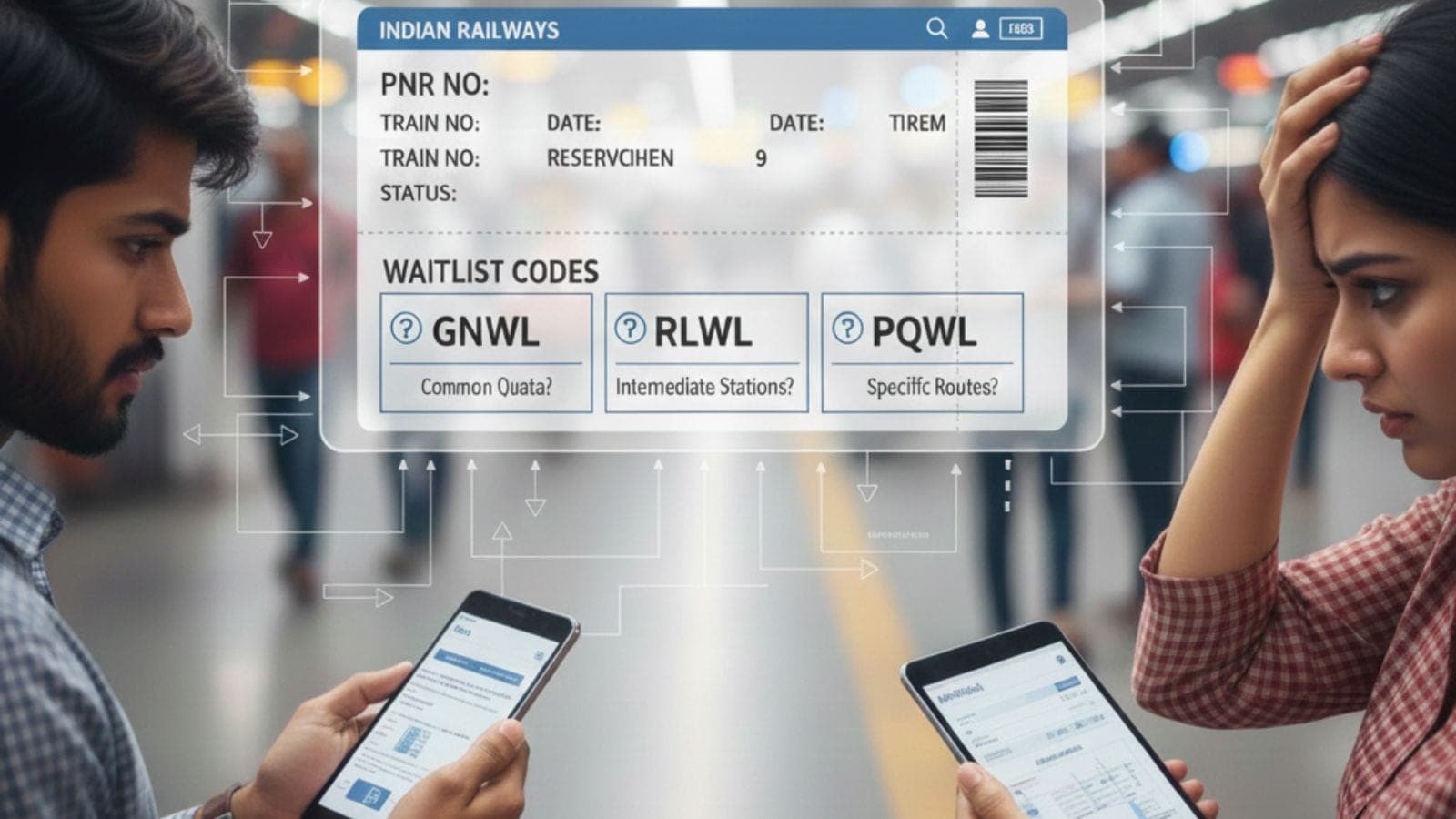
Indian Railways PNR status codes GNWL, RLWL, PQWL explained for passenger clarity.
Summary
The article likely explains the significance and meaning of various PNR (Passenger Name Record) waiting list statuses used by Indian Railways, specifically GNWL, RLWL, and PQWL. Understanding these codes is crucial for passengers to accurately interpret their ticket confirmation status and make informed travel decisions. This topic is important for competitive exams as it falls under general awareness, Indian Railways operations, and transportation knowledge.
Key Points
- 1GNWL stands for General Waiting List, which is the most common type of waiting list issued by Indian Railways.
- 2RLWL denotes Remote Location Waiting List, applicable for tickets booked for intermediate stations on a train's route.
- 3PQWL refers to Pooled Quota Waiting List, a shared quota for several small stations on a specific route.
- 4PNR (Passenger Name Record) is a unique 10-digit number assigned to each booking, containing passenger and journey details.
- 5Understanding these waiting list codes helps passengers gauge the probability of their ticket getting confirmed before travel.
In-Depth Analysis
Indian Railways, often termed the "lifeline of the nation," is one of the world's largest railway networks, playing an indispensable role in India's socio-economic fabric. Given the sheer volume of passengers – millions daily – managing train bookings efficiently is a monumental task. This immense demand often outstrips available seats, leading to the ubiquitous waiting list system. The Passenger Name Record (PNR) system, a 10-digit unique number assigned to each booking, is central to this management, acting as a digital identifier for all passenger and journey details. Understanding the nuances of waiting list statuses like GNWL, RLWL, and PQWL is crucial for passengers and a pertinent topic for competitive exams.
The genesis of the Indian railway system dates back to 1853, with the first passenger train running between Bombay (now Mumbai) and Thane. Initially developed by the British for economic exploitation and military movement, post-independence, Indian Railways was nationalized and transformed into a powerful instrument for national integration and economic development. Its expansion and modernization have been a continuous process, essential for connecting a diverse and vast country. The waiting list system evolved out of necessity to manage the high demand, ensuring a fair allocation of limited resources while also providing a mechanism for last-minute cancellations to be filled.
Let's delve into the specific waiting list statuses:
* **GNWL (General Waiting List)**: This is the most common type of waiting list. Tickets with GNWL status are issued when the general quota of seats for a train has been exhausted. The probability of confirmation for GNWL tickets is generally the highest among all waiting lists, as it gets confirmed against cancellations from the originating station's general quota.
* **RLWL (Remote Location Waiting List)**: This status is assigned to tickets booked for intermediate stations on a train's route. These stations have a separate, smaller quota of seats. RLWL tickets are confirmed against cancellations from this specific remote location quota. The confirmation probability is lower than GNWL due to the limited number of seats allocated to these intermediate stops, designed to ensure connectivity for passengers boarding at smaller, less prominent stations.
* **PQWL (Pooled Quota Waiting List)**: This is the most restrictive waiting list. PQWL is a shared quota that applies to several small stations located along a specific route. For example, if a train runs from Delhi to Mumbai, and tickets are booked from Mathura to Kota, they might fall under PQWL if these stations share a quota. The confirmation probability for PQWL tickets is typically very low because the shared quota is small and cancellations from any station within that pooled quota are few.
The key stakeholders in this intricate system include the **Ministry of Railways**, which formulates policy, and the **Railway Board**, which oversees the administration and operations of the entire network, including fare structures and ticketing rules. The various **Zonal Railways** (e.g., Northern Railway, Western Railway) are responsible for implementing these policies at the ground level. **IRCTC (Indian Railway Catering and Tourism Corporation)**, a public sector undertaking under the Ministry of Railways, serves as the primary online ticketing platform, making the PNR and waiting list status accessible to millions. Passengers are the ultimate beneficiaries and direct stakeholders, whose travel plans are directly impacted by these policies.
This system holds immense significance for India. Economically, Indian Railways is a backbone for freight movement, facilitating trade, industry, and agriculture by connecting production hubs to consumption centers. It also boosts tourism and provides affordable mass transport, contributing significantly to the national GDP. Socially, it acts as a powerful agent of national integration, enabling people from diverse regions to connect and travel. It ensures accessibility, particularly for lower-income groups, and plays a critical role during national emergencies or disasters by transporting relief materials and personnel. From a governance perspective, managing such a vast public service efficiently is a testament to India's administrative capabilities.
Constitutionally, railways fall under the **Union List (Entry 22 of the Seventh Schedule)**, granting the central government exclusive legislative power over the subject. The **Indian Railways Act, 1989**, is the primary legislation governing the construction, maintenance, and operation of railways in India, including aspects of passenger services and tariffs. This ensures a uniform regulatory framework across the country.
Looking ahead, the future of Indian Railways involves significant modernization and digitalization. Initiatives like the introduction of Vande Bharat Express trains, Dedicated Freight Corridors (DFCC), and high-speed rail projects aim to enhance efficiency and speed. Further integration of AI and machine learning for demand forecasting could optimize seat allocation and potentially reduce waiting lists. Dynamic pricing models and flexi-fares, already implemented on some premium trains, might become more widespread, influencing how waiting lists are managed and confirmed. The continuous focus on improving passenger amenities, safety, and real-time information dissemination through digital platforms will further transform the travel experience, making the PNR and its associated statuses even more transparent and user-friendly.
Exam Tips
This topic primarily falls under General Studies Paper III (Economy - Infrastructure, Transportation) for UPSC, and General Awareness/Current Affairs for SSC, Railway, and State PSC exams. Focus on the administrative structure of Indian Railways and its economic impact.
Study related topics like the history of Indian Railways, major projects (e.g., Dedicated Freight Corridors, High-Speed Rail), the structure and role of IRCTC, and the Indian Railways Budget. Understand the difference between various types of coaches (Sleeper, AC, General) and their quotas.
Common question patterns include direct factual questions (e.g., 'What does GNWL stand for?'), conceptual questions comparing different waiting list types (e.g., 'Distinguish between RLWL and PQWL in terms of confirmation probability'), and questions on the administrative body responsible for railways in India (e.g., 'Which ministry governs Indian Railways?').