



Relevant for Exams
President Murmu stresses non-negotiable honesty and integrity for PSCs in recruitment, enhancing governance.
Summary
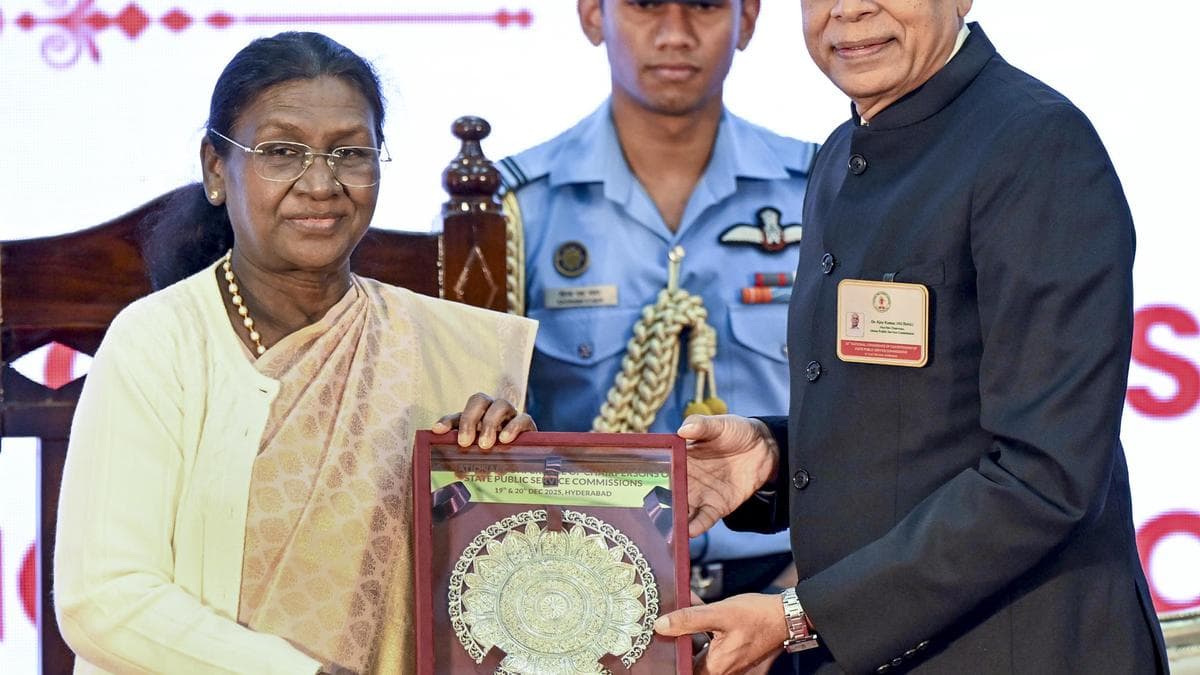
President Droupadi Murmu addressed a conference of Union and State Public Service Commissions, emphasizing "honesty and integrity" as non-negotiable in recruitment. The event aimed to strengthen recruitment systems and enhance PSCs' role in the governance framework. This underscores the constitutional importance of PSCs and ethical public service, vital for UPSC and State PSC exam preparation.
Key Points
- 1President Droupadi Murmu addressed a conference of Public Service Commissions.
- 2The conference brought together chairpersons of the Union Public Service Commission (UPSC) and various State Public Service Commissions (SPSCs).
- 3President Murmu highlighted "honesty and integrity" as non-negotiable principles in the recruitment process.
- 4A key objective of the conference was to deliberate on strengthening recruitment systems.
- 5The discussions also focused on enhancing the role of PSCs within the broader governance framework.
In-Depth Analysis
President Droupadi Murmu's address to the conference of Union and State Public Service Commissions (PSCs), emphasizing "honesty and integrity" as non-negotiable in recruitment, serves as a crucial reminder of the foundational principles underpinning India's administrative framework. This statement is not merely ceremonial; it underscores the constitutional mandate and the vital role PSCs play in ensuring good governance and public trust.
**Background Context and Historical Evolution:**
Public Service Commissions are the bedrock of India's merit-based bureaucracy. Their genesis can be traced back to British India, primarily to counter patronage and ensure a competent administrative class. The Lee Commission of 1923 recommended the establishment of a Public Service Commission, leading to the creation of the first Public Service Commission in India in 1926. The Government of India Act, 1935, further solidified this by providing for a Federal Public Service Commission and Provincial Public Service Commissions, acknowledging the need for independent bodies to recruit civil servants. Post-independence, the framers of the Indian Constitution recognized the critical importance of these bodies in a democratic setup, enshrining their existence and functions in Part XIV of the Constitution (Articles 315-323). This constitutional backing grants them autonomy and insulates them from political interference, aiming to uphold impartiality in recruitment.
**The President's Message and its Significance:**
The President's call for "honesty and integrity" directly addresses the challenges that often plague recruitment processes, such as corruption, favoritism, and paper leaks. These issues erode public faith, demoralize deserving candidates, and ultimately compromise the quality of public service. By highlighting these principles, the President, as the constitutional head, reinforces the government's commitment to clean administration and the imperative for PSCs to act as guardians of merit. The conference's objective to strengthen recruitment systems and enhance PSCs' role in governance reflects a proactive approach to address contemporary challenges.
**Key Stakeholders Involved:**
Several key stakeholders are central to this discussion. Firstly, the **President of India** serves as the moral compass and constitutional guardian, her pronouncements carrying significant weight. Secondly, the **Union Public Service Commission (UPSC)** and **State Public Service Commissions (SPSCs)** are the primary executive bodies responsible for conducting examinations and interviews for appointment to services. Their independence, enshrined in **Article 315**, is paramount. Thirdly, the **Government of India and respective State Governments** rely on these commissions to staff their administrative machinery with competent individuals. Fourthly, millions of **aspiring candidates** are directly impacted by the fairness and transparency of these processes. Finally, the **general public** is the ultimate beneficiary or victim of the quality of governance delivered by the recruited civil servants.
**Why This Matters for India:**
This emphasis on integrity is crucial for India's socio-economic and political fabric. A bureaucracy recruited solely on merit and integrity is essential for effective policy implementation, efficient public service delivery, and fostering economic growth. When recruitment processes are perceived as fair, it builds public trust in institutions, which is fundamental for a stable democracy. Conversely, a compromised recruitment system leads to an inefficient and corrupt administration, hindering development, exacerbating social inequalities, and fueling public discontent. The presence of honest and capable civil servants, selected through transparent means, directly contributes to achieving national goals, improving India's global standing, and enhancing Ease of Doing Business by reducing red tape and corruption.
**Constitutional Provisions and Broader Themes:**
Articles 315 to 323 of the Indian Constitution delineate the composition, appointment, removal, functions, and powers of PSCs. For instance, **Article 320** outlines the functions of PSCs, including conducting examinations for appointments and advising the government on all matters relating to methods of recruitment. **Article 317** provides for the removal of a member of a PSC only by order of the President on the ground of misbehavior, after an inquiry by the Supreme Court, highlighting their protected status. The President's address ties into broader themes of good governance, ethical leadership, administrative reforms, and the fight against corruption. Reports by the Second Administrative Reforms Commission (ARC), particularly those on "Ethics in Governance" and "Refurbishing of Personnel Administration," have consistently highlighted the need for robust recruitment systems and ethical conduct in public service.
**Future Implications:**
The President's message is a call to action for continuous reform. Future implications include greater adoption of technology to enhance transparency and security in examinations (e.g., online proctoring, secure question paper delivery, biometric verification), expedited recruitment cycles, and a focus on competency-based assessments rather than rote learning. There might be renewed efforts to address issues like paper leaks more stringently and to ensure accountability of all involved parties. Furthermore, the deliberations at such conferences often lead to policy recommendations aimed at making PSCs more responsive, efficient, and resilient against external pressures, thereby strengthening the steel frame of India's administration for decades to come.
Exam Tips
This topic falls under GS Paper II (Polity and Governance) for UPSC Civil Services Exam and similar sections in State PSCs. Focus on the constitutional provisions (Articles 315-323) related to Public Service Commissions.
Study the functions, powers, and independence of UPSC and SPSCs. Understand the difference between constitutional bodies and statutory bodies, and how PSCs fit into India's administrative structure.
Prepare for analytical questions on the role of PSCs in good governance, challenges faced by them (e.g., corruption, delays), and suggested reforms (e.g., recommendations of ARC reports). Mains questions often ask about the importance of integrity in public service and how to strengthen recruitment systems.
For Prelims, factual questions on the historical background (Lee Commission, GoI Act 1935) and specific constitutional articles are common. For Mains, be ready to discuss ethical dilemmas in recruitment and the impact of technology on examination processes.
Relate the concept of integrity in recruitment to broader themes like 'Ethics in Public Administration' (GS Paper IV for UPSC) and 'Accountability and Transparency in Governance'.
Related Topics to Study
Full Article
Conference brings together chairpersons of the Union and State Public Service Commissions to deliberate on strengthening recruitment systems, enhancing role of PSCs in governance framework