

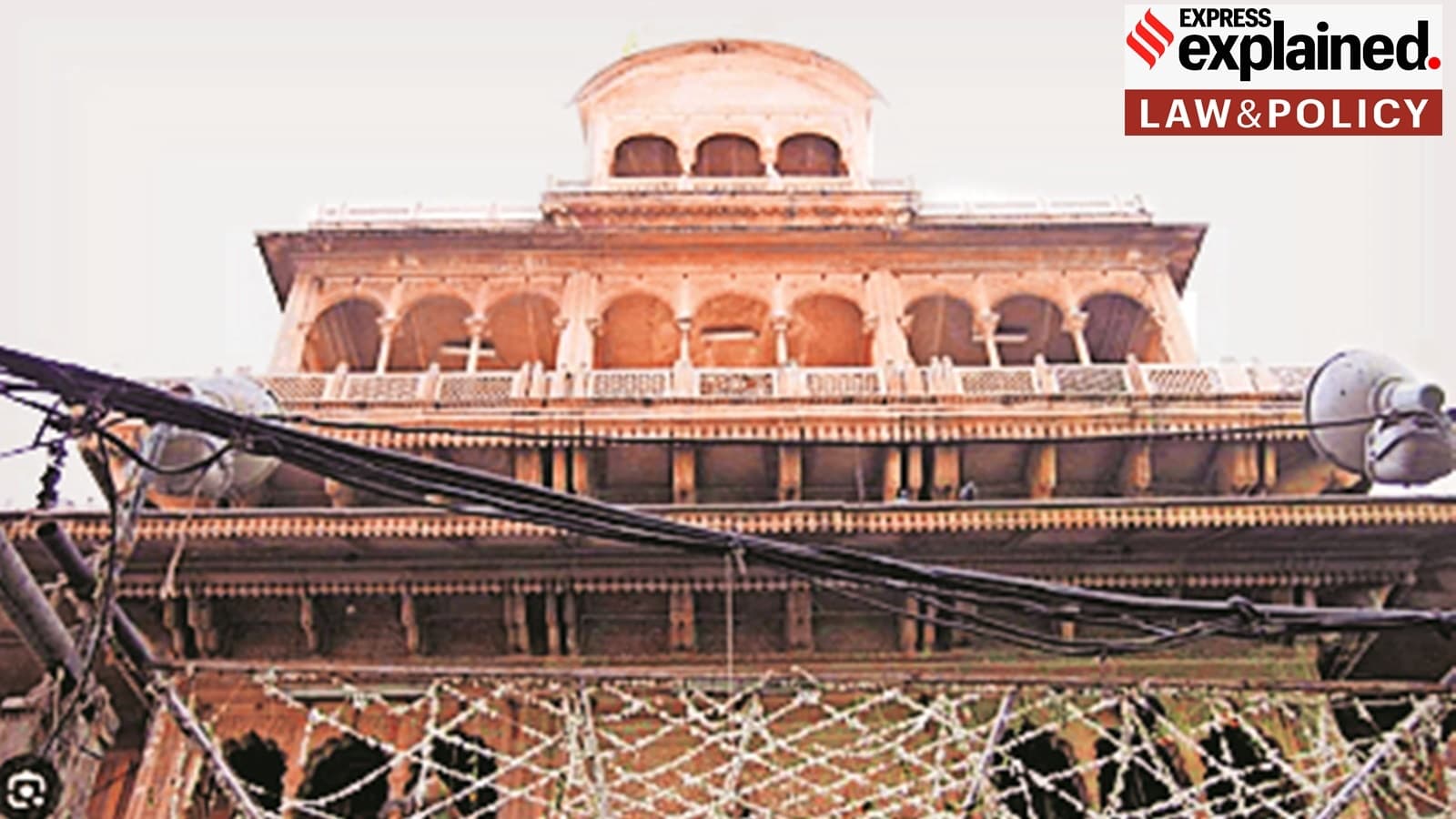


Vrindavan Bankey Bihari Ji temple dispute: No content provided for analysis.
Summary
The article titled 'Vrindavan’s Bankey Bihari Ji Maharaj temple dispute back in court' lacks content. Consequently, a detailed summary explaining the dispute's specifics, its current status, or its significance for competitive exams cannot be provided. Key facts, legal provisions, and implications remain unknown without the article's text.
Key Points
- 1No article content was provided for analysis.
- 2Specific details regarding the Vrindavan Bankey Bihari Ji Maharaj temple dispute are unavailable.
- 3Key facts such as dates, involved parties, or specific court rulings cannot be extracted.
- 4The legal or constitutional provisions relevant to the dispute are unknown.
- 5Therefore, exam-focused MCQs cannot be formulated from the given input.
In-Depth Analysis
The dispute surrounding Vrindavan's revered Bankey Bihari Ji Maharaj temple, a prominent Hindu shrine dedicated to Lord Krishna, frequently resurfaces in public discourse and the judiciary. While the specific details of the latest court hearing were not provided in the article, such disputes typically revolve around the fundamental issues of temple management, property rights, financial transparency, and devotee access, often pitting traditional 'sevaits' (priests/managers) against state authorities or public interest litigants.
**Background Context and What Happened:**
Vrindavan, in Uttar Pradesh, is one of the most significant pilgrimage sites for Vaishnavites, believed to be the place where Lord Krishna spent his childhood. The Bankey Bihari temple, established in 1864, is a central spiritual hub, attracting millions of devotees annually. Its immense popularity, however, also brings significant challenges related to crowd management, infrastructure, and safety. Historically, the temple's administration has been managed by a body of 'sevaits' or 'goswamis' who claim hereditary rights to perform rituals and oversee its affairs. This traditional management structure, while deeply rooted in custom, has often faced scrutiny regarding its ability to handle the complexities of a modern pilgrimage site with massive footfall.
The recent resurgence of the dispute in court likely stems from persistent issues that culminated in tragic events, such as the stampede during Janmashtami celebrations in August 2022, which resulted in two deaths and several injuries. This incident intensified calls for a more robust and professional management system, including better crowd control, emergency services, and infrastructure development. Petitions were subsequently filed in the Allahabad High Court, seeking state intervention to improve the temple's administration, potentially through the formation of a dedicated board or trust, similar to those governing other major temples like Tirupati or Puri.
**Key Stakeholders Involved:**
1. **The Sevaits/Goswamis:** These are the traditional priestly families who claim hereditary rights to manage the temple, perform rituals, and control its assets. They often resist external intervention, viewing it as an infringement on their religious freedom and ancestral rights.
2. **Devotees and Public Interest Litigants:** Concerned about safety, transparency, accessibility, and the overall sanctity of the temple, devotees and public interest groups often petition courts for improved management and accountability.
3. **Uttar Pradesh Government and Local Administration:** The state government, through district authorities, is responsible for maintaining law and order, public safety, and ensuring proper administration of public places, including religious institutions. They are often the target of petitions seeking intervention and may propose new administrative frameworks.
4. **The Judiciary (Allahabad High Court, Supreme Court):** The courts play a crucial role in adjudicating these disputes, balancing religious freedom with public interest, and interpreting constitutional provisions and existing laws related to religious endowments.
**Significance for India and Constitutional Provisions:**
This dispute holds significant implications for India, touching upon the delicate balance between religious freedom and state regulation. India, a secular state, guarantees religious freedom under **Article 25** (freedom of conscience and free profession, practice, and propagation of religion) and **Article 26** (freedom to manage religious affairs). However, these rights are not absolute and are subject to 'public order, morality, and health.' The state's power to regulate the secular aspects of religious institutions, including financial administration and property management, is well-established through judicial precedents.
Many states, including Uttar Pradesh, have enacted **Hindu Religious and Charitable Endowments Acts** (though UP's specific act like the U.P. Hindu Public Religious Institutions (Prevention of Dissipation of Properties) Act, 1962, might not cover all management aspects comprehensively, leading to demands for a specific act for Bankey Bihari). The core of the legal battle often lies in defining what constitutes 'matters of religion' (protected under Article 26(b)) versus 'secular aspects' (which the state can regulate under Article 26(d)). The Supreme Court, in various judgments, has affirmed the state's power to intervene to ensure proper administration of public trusts, prevent mismanagement, and protect public safety. The Bankey Bihari dispute, therefore, is a test case for how these constitutional principles are applied in practice.
**Historical Context and Broader Themes:**
Historically, many prominent Hindu temples in India have transitioned from private/hereditary management to state-controlled or state-supervised trusts. Examples include the Jagannath Temple in Puri and the Tirupati Balaji Temple, both managed by state-established boards. These transitions often involve intense legal battles and public debates. The Bankey Bihari dispute fits into this broader theme of modern governance interacting with traditional religious institutions, aiming to balance ancient customs with contemporary demands for transparency, efficiency, and public safety. It also highlights the economic significance of pilgrimage centers, which contribute substantially to local economies through tourism and related services.
**Future Implications:**
The court's decision could have far-reaching implications. It might lead to the formation of a new administrative body for the Bankey Bihari temple, potentially a state-appointed trust or board, which could bring about significant changes in its management, financial oversight, and infrastructure development. This could set a precedent for other temples facing similar issues. Conversely, a ruling favoring the traditional 'sevaits' might reinforce existing structures, though likely with strict judicial directives on public safety and financial transparency. Regardless of the outcome, the dispute underscores the ongoing challenge of modernizing the administration of ancient religious institutions while respecting their unique spiritual and cultural heritage. The focus will remain on ensuring the safety and spiritual experience of millions of devotees, especially during peak pilgrimage seasons.
Exam Tips
This topic falls under GS Paper I (Indian Heritage and Culture) and GS Paper II (Polity and Governance - specifically fundamental rights, state intervention, and religious institutions).
Study related topics like the history of temple management in India, the role of various state-level Hindu Religious and Charitable Endowments Acts, and landmark Supreme Court judgments on Articles 25 and 26 (e.g., Shirur Mutt case, Sabarimala verdict).
Common question patterns include: analyzing the balance between religious freedom and state regulation, identifying key constitutional articles related to religious institutions, discussing the challenges of managing large pilgrimage sites, and evaluating the role of the judiciary in such disputes. Be prepared for both factual and analytical questions.