



Relevant for Exams
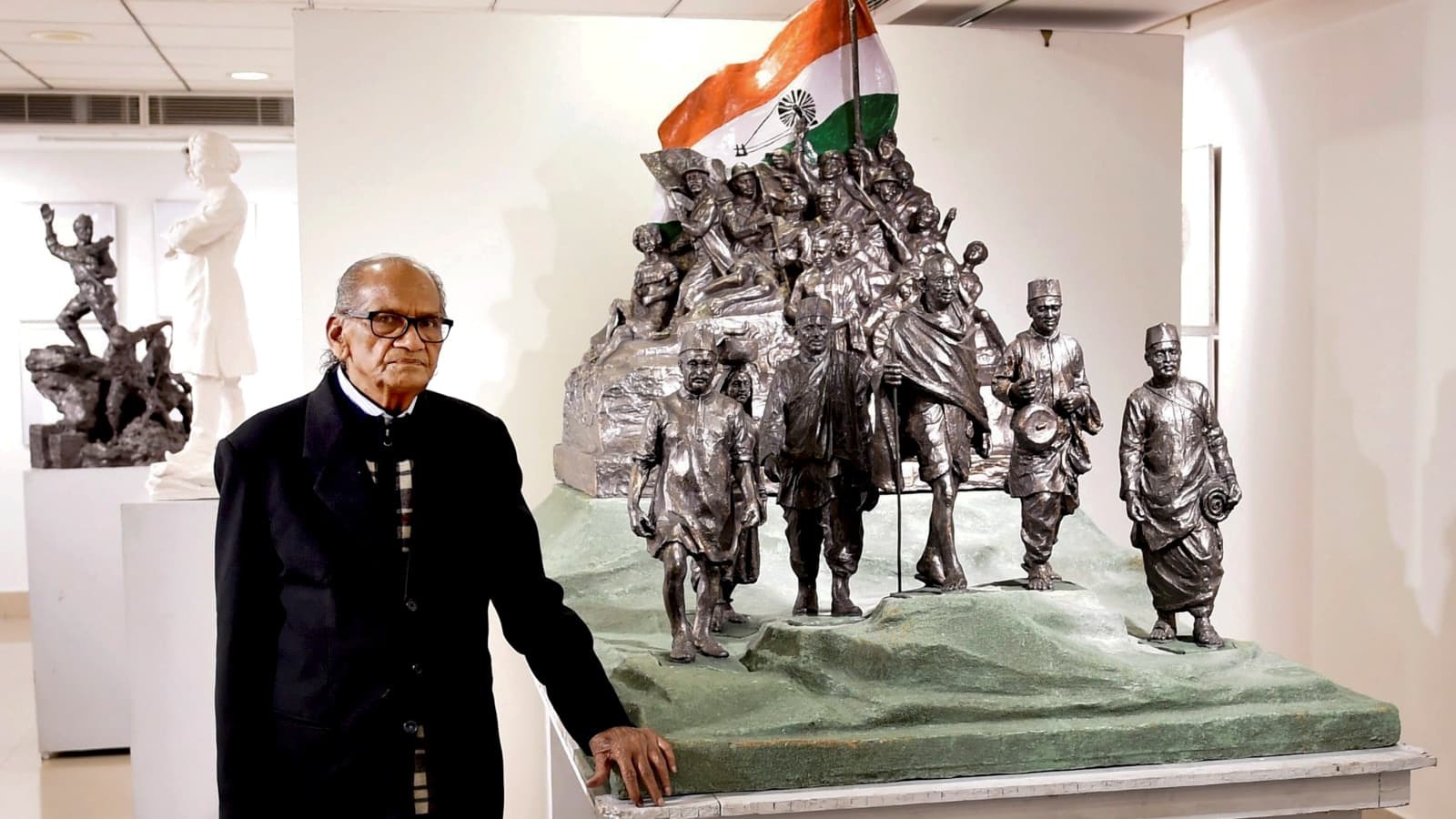
Statue of Unity sculptor Ram Vanji Sutar dies at 100, leaving a monumental legacy.
Summary
Ram Vanji Sutar, the acclaimed sculptor behind the monumental Statue of Unity, passed away at the age of 100. His demise marks a significant moment in Indian art history, as his works have left an indelible mark across the nation, from Gujarat to Assam. This event is crucial for competitive exams, as questions often focus on prominent personalities, their contributions to national heritage, and major artistic projects like the Statue of Unity.
Key Points
- 1Ram Vanji Sutar, a renowned Indian sculptor, passed away at the age of 100.
- 2He is prominently known for sculpting the Statue of Unity, the world's tallest statue.
- 3The Statue of Unity depicts Sardar Vallabhbhai Patel and is located in Kevadia, Gujarat.
- 4Sutar's extensive artistic career saw his works installed in various locations across India, from Gujarat to Assam.
- 5His contributions to monumental sculpture include numerous statues of national leaders, making him a significant figure in Indian art and culture.
In-Depth Analysis
The passing of Ram Vanji Sutar at the age of 100 marks the end of an era for monumental sculpture in India. Sutar was not merely a sculptor; he was a visionary artist whose creations have become integral to India's national landscape and collective memory. His most celebrated work, the Statue of Unity, stands as a towering testament to his skill and a profound symbol of national integration.
**Background Context: The Vision of Unity**
The idea for the Statue of Unity was conceived by then-Chief Minister of Gujarat, Narendra Modi, in 2010. The ambitious project aimed to honor Sardar Vallabhbhai Patel, India's first Deputy Prime Minister and Home Minister, who played a pivotal role in the integration of over 560 princely states into the Indian Union after independence in 1947. This monumental task, often referred to as the 'Iron Man of India's' legacy, was crucial for shaping India's geographical and political map, as enshrined in **Article 1** of the Constitution, which defines India as a 'Union of States'. The project was formally announced in 2013 and funded by the Sardar Vallabhbhai Patel Rashtriya Ekta Trust (SVPRET), which also collected contributions from across the nation, symbolizing collective ownership. The objective was not just to build a statue but to create a national icon that would inspire unity, patriotism, and serve as a major tourist destination.
**What Happened: A Legacy Endures**
Ram Vanji Sutar, born in 1925, was a distinguished Indian sculptor with a career spanning several decades. His demise at 100 years old brought to light his immense contributions to public art. While the Statue of Unity remains his most globally recognized work, Sutar's artistic footprint is vast, encompassing over 50 monumental sculptures of national leaders, including Mahatma Gandhi, Jawaharlal Nehru, Indira Gandhi, and others, installed in various cities from Gujarat to Assam, and even abroad. His style often combined traditional Indian aesthetics with modern techniques, allowing him to create works of grand scale and intricate detail. The Statue of Unity, inaugurated on October 31, 2018, on Sardar Patel's 143rd birth anniversary, stands at 182 meters (597 feet), making it the world's tallest statue. Its construction involved advanced engineering and meticulous artistic execution, with Sutar personally overseeing the design and sculpting of the bronze cladding.
**Key Stakeholders Involved:**
Several entities were instrumental in bringing the Statue of Unity to fruition. **Ram Vanji Sutar and his son, Anil Sutar**, were the primary artistic visionaries and executors. The **Government of India and the Government of Gujarat** were the main patrons and facilitators of the project, providing political will, administrative support, and significant funding. **Larsen & Toubro (L&T)**, an Indian multinational conglomerate, was awarded the contract for the design, construction, and maintenance of the statue, demonstrating India's engineering prowess. The **people of India** were also crucial stakeholders, through their emotional investment and financial contributions to the SVPRET, underscoring the monument's status as a national endeavor.
**Significance for India:**
The Statue of Unity, sculpted by Sutar, holds multifaceted significance for India. Firstly, it serves as a powerful symbol of **national integration and unity**, reflecting Sardar Patel's tireless efforts to consolidate the diverse princely states. This aligns with the Preamble's commitment to the 'unity and integrity of the Nation'. Secondly, it has significantly boosted **tourism and local economy** in the Kevadia region (now Ekta Nagar) in Gujarat. It has generated employment opportunities, promoted local businesses, and spurred infrastructure development around the site, demonstrating the economic potential of cultural heritage projects. Thirdly, it showcases India's capability to execute **mega-scale infrastructure and artistic projects**, enhancing its global image and soft power. Moreover, it reinforces **Article 51A(f)** of the Constitution, a Fundamental Duty, which mandates citizens 'to value and preserve the rich heritage of our composite culture'.
**Historical Context and Future Implications:**
The tradition of erecting statues of national heroes is an ancient one, prevalent across cultures to commemorate leaders and inspire future generations. In India, this practice gained prominence post-independence, with statues serving as reminders of the freedom struggle and nation-building efforts. The Statue of Unity, however, represents a modern iteration of this tradition, leveraging advanced technology and global scale. Looking ahead, Sutar's legacy and the success of the Statue of Unity project could inspire more such large-scale public art initiatives, potentially leading to further development in monumental sculpting and heritage tourism. However, such projects also spark debates regarding resource allocation – balancing cultural preservation and national pride with other pressing developmental needs. The long-term implications include sustained tourism growth for Ekta Nagar, continued focus on Sardar Patel's legacy, and a potential benchmark for future public-private partnerships in cultural infrastructure. The monument's ongoing maintenance and visitor management will be crucial for its sustained impact.
**Related Constitutional Articles, Acts, or Policies:**
While no single act solely governs the Statue of Unity, several constitutional provisions and policies are relevant:
* **Article 1 (Union of States):** Directly relates to Sardar Patel's role in integrating princely states.
* **Preamble:** Emphasizes Unity and Integrity of the Nation.
* **Article 51A(f) (Fundamental Duty):** Encourages citizens to value and preserve the rich heritage of our composite culture.
* **National Tourism Policy:** Provides a framework for developing tourist destinations like Ekta Nagar.
* **Archaeological Survey of India (ASI) Act, 1958:** While the Statue of Unity is a modern monument, the act governs the protection of ancient and historical monuments and archaeological sites, providing a broader context for heritage preservation.
* **Public-Private Partnership (PPP) Model:** Often utilized for large-scale infrastructure projects, including those with cultural significance.
Exam Tips
**UPSC/State PSC (GS Paper I - Art & Culture, Post-Independence History, Current Events of National Importance):** Focus on Sardar Vallabhbhai Patel's role in post-independence integration, the significance of the Statue of Unity as a national symbol and tourist destination, and Ram Vanji Sutar's contribution to Indian art. Questions can be factual (e.g., height, location, sculptor) or analytical (e.g., impact on tourism, symbolism).
**SSC/Banking/Railway (General Awareness/Current Affairs):** Expect direct factual questions on the Statue of Unity (location: Kevadia/Ekta Nagar, Gujarat; height: 182m; depicts: Sardar Vallabhbhai Patel; sculptor: Ram Vanji Sutar) and his recent demise. Also, be aware of the date of inauguration (October 31, 2018) as it coincides with National Unity Day.
**Related Topics to Study Together:** Delve into the life and contributions of Sardar Vallabhbhai Patel, particularly his role in the integration of princely states. Study other significant Indian monuments and their architects/sculptors. Understand government initiatives related to tourism promotion and cultural preservation (e.g., 'Dekho Apna Desh' initiative).