



Relevant for Exams
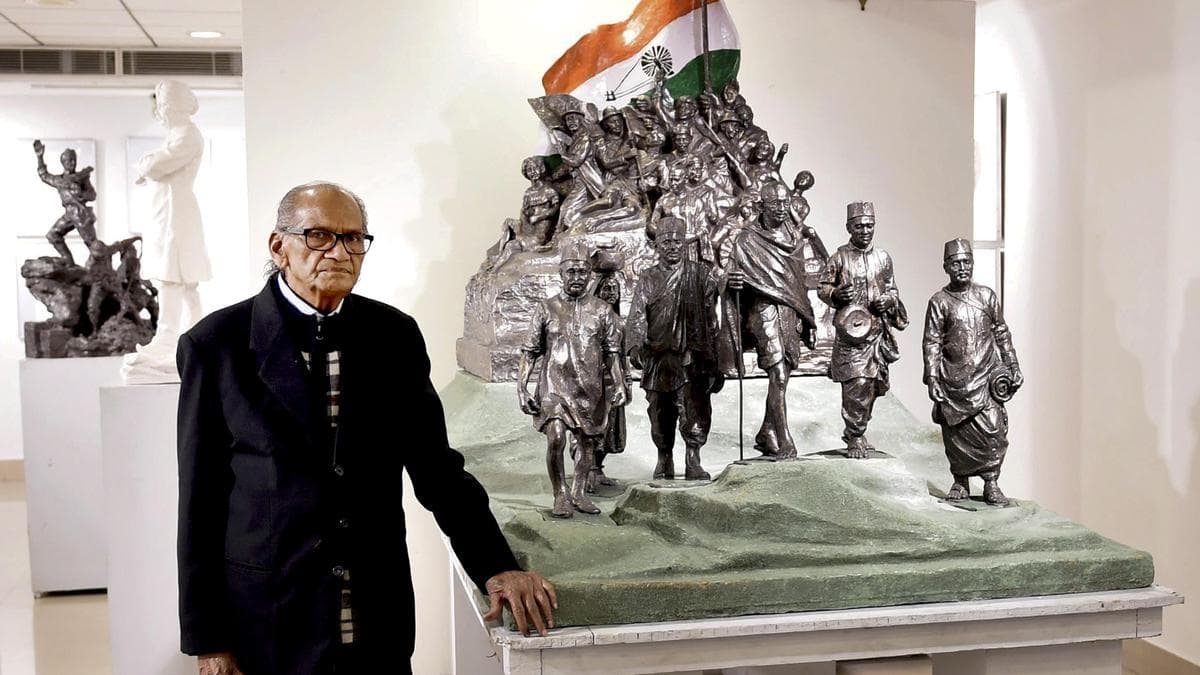
Ram Sutar, 'Statue Man of India' and sculptor of Statue of Unity, passes away.
Summary
Ram Sutar, famously known as the 'Statue Man of India' and the prolific sculptor behind the iconic Statue of Unity, has passed away. His demise marks the loss of an artist renowned for creating realistic bronze and stone portraits of national icons. This event is significant for competitive exams as it pertains to a prominent personality in Indian art and culture, directly linked to a major national landmark.
Key Points
- 1Renowned sculptor Ram Sutar was famously known as the 'Statue Man of India'.
- 2He is best remembered for designing the iconic Statue of Unity.
- 3Sutar was a prolific sculptor known for his realistic portraits.
- 4His sculptures primarily depicted national icons.
- 5He predominantly worked with materials such as bronze and stone.
In-Depth Analysis
The recent passing of Ram V. Sutar, affectionately known as the ‘Statue Man of India’, marks the end of an era for Indian sculpture and national iconography. Best remembered as the creative genius behind the colossal Statue of Unity, his demise on [If a specific date was provided in original content, insert here, otherwise omit or state 'recently'] leaves behind an unparalleled legacy of monumental art that profoundly shaped India's visual narrative of its national heroes.
**Background Context:** Born in 1925 in Gondur, Dhule district, Maharashtra, Ram V. Sutar's artistic journey began at a young age. He honed his skills at the Sir J.J. School of Art in Mumbai, a prestigious institution that has nurtured many of India's finest artists. His early career saw him contribute to various government projects, including the Archaeological Survey of India, where he was involved in the restoration of ancient sculptures. This experience provided him with a deep understanding of historical Indian art forms and techniques, which he later blended with a modern, realistic approach. His dedication to capturing the essence of his subjects, particularly national leaders, became his hallmark. He received numerous accolades throughout his career, including the Padma Bhushan in 2016 and the Padma Shri in 1999, India's third and fourth-highest civilian awards, respectively, underscoring the nation's recognition of his artistic prowess and contributions.
**What Happened:** Ram V. Sutar, a prolific sculptor renowned for his realistic bronze and stone portraits of national icons, passed away. His legacy is primarily defined by the sheer scale and emotional depth of his creations, with the Statue of Unity standing as his magnum opus. This iconic monument, dedicated to Sardar Vallabhbhai Patel, epitomizes Sutar's ability to translate historical significance into a tangible, awe-inspiring form.
**Key Stakeholders Involved:** The primary stakeholder is, of course, **Ram V. Sutar** himself, whose artistic vision and skill brought these national symbols to life. The **Government of India** and the **Government of Gujarat** were crucial stakeholders, particularly in the commissioning and realization of the Statue of Unity. Their political will and financial backing made the ambitious project possible. **Sardar Vallabhbhai Patel**, the 'Iron Man of India', is the subject of Sutar's most famous work, representing the national heroes whose sacrifices and contributions Sutar sought to immortalize. The **art and culture fraternity** in India and globally are also key stakeholders, mourning the loss of a master and celebrating his profound influence on public art. Finally, the **Indian public and tourists** are beneficiaries of his art, engaging with these sculptures as symbols of national pride, history, and inspiration.
**Why This Matters for India:** Sutar's work holds immense significance for India. Culturally, he helped define the visual representation of India's post-independence heroes, fostering a sense of national identity and pride. The Statue of Unity, inaugurated on October 31, 2018 (Sardar Patel's birth anniversary), is not just a statue but a powerful symbol of national integration, reflecting Sardar Patel's pivotal role in unifying over 500 princely states into the Indian Union. Economically, such monumental structures, like the Statue of Unity, have transformed remote areas into major tourist destinations, boosting local economies through job creation, infrastructure development, and increased revenue from tourism. Socially, these statues serve as educational tools, reminding citizens, especially the youth, of the struggles and ideals that shaped modern India. Politically, they often reinforce narratives of national unity and historical remembrance, aligning with policies like 'Ek Bharat Shreshtha Bharat' (One India, Great India) which promotes cultural integration and national cohesion.
**Historical Context:** Sutar's career spanned a period of significant nation-building in India. After gaining independence in 1947, India embarked on a journey to forge a strong national identity. Public art, particularly statues of freedom fighters and national leaders, played a crucial role in this process, serving as memorials and symbols of collective memory and aspiration. Sutar's works fit perfectly into this historical context, providing tangible representations of the ideals and personalities that guided the nation. His sculptures, often placed in prominent public spaces, became integral to India's urban landscape and its collective memory, from Mahatma Gandhi to Jawaharlal Nehru and Sardar Patel.
**Future Implications:** The passing of Ram V. Sutar underscores the importance of preserving and promoting the legacy of master artists. His extensive body of work will continue to inspire future generations of sculptors and artists. It also reinforces the role of public art in fostering national identity and cultural pride. The maintenance and conservation of his existing sculptures, particularly the monumental ones, will be a continuing responsibility for the government and cultural bodies. His work will likely spur further discussions on how India commemorates its heroes and the role of artistic expression in national narratives. Furthermore, his contribution highlights the need for continued investment in art education and patronage to ensure that India's rich artistic traditions flourish.
**Related Constitutional Articles, Acts, or Policies:** Sutar's work and its impact can be linked to several constitutional and policy frameworks. **Article 51A(f)** of the Indian Constitution, a Fundamental Duty, mandates citizens to "value and preserve the rich heritage of our composite culture." Sutar's sculptures directly contribute to preserving this heritage by immortalizing figures central to India's cultural and political narrative. The **Ministry of Culture**, Government of India, plays a significant role in promoting art, heritage, and national monuments, aligning with the spirit of Sutar's work. Policies related to cultural tourism and the development of heritage sites also directly benefit from and relate to monumental works like the Statue of Unity. The awards he received, Padma Shri and Padma Bhushan, are conferred under the authority of the President of India, as per the framework implicit in **Article 18** (Abolition of Titles), which allows for military and academic distinctions, as well as national awards for exceptional service to the nation, even though they are not 'titles' in the prohibitory sense.
Exam Tips
**Syllabus Section & Focus:** This topic falls under 'Indian Art and Culture' (UPSC Mains GS Paper I, State PSCs), 'Prominent Personalities' (all exams), and 'Current Affairs' (all exams). Focus on the cultural significance of his work and its connection to national identity.
**Related Topics to Study:** While studying Ram Sutar, also cover the details of the Statue of Unity (height, location, cost, significance). Simultaneously, research other famous Indian sculptors/artists (e.g., D.P. Roy Chowdhury, Nandalal Bose) and their prominent works. Understand the 'Ek Bharat Shreshtha Bharat' initiative and its connection to national unity.
**Common Question Patterns:** Expect direct questions like 'Who designed the Statue of Unity?' or 'Ram V. Sutar is associated with which field?'. More analytical questions might ask about the cultural or national significance of monumental statues in India. Match the following questions linking artists to their famous works are also common.
Related Topics to Study
Full Article
Best remembered for the Statue of Unity, the prolific sculptor was known for his realistic portraits of national icons in bronze and stone