



Relevant for Exams
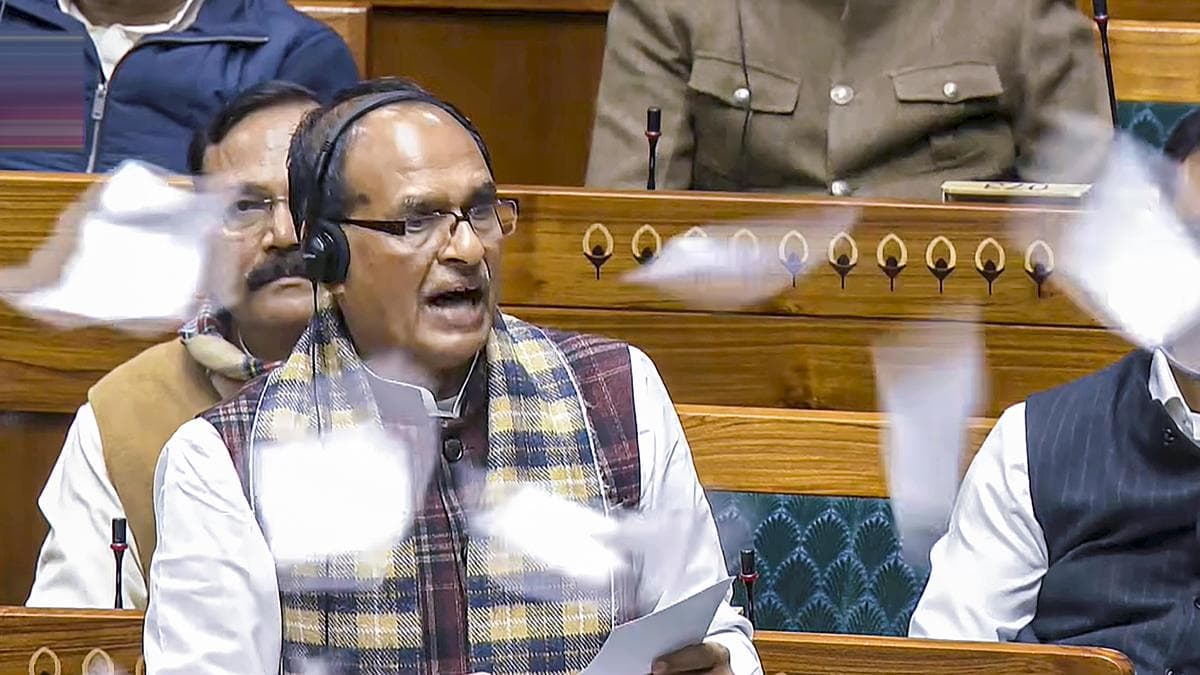
Lok Sabha adjourned in Winter Session after passing 'VB-G RAM G Bill' amid opposition uproar.
Summary
The Lok Sabha was adjourned for the day during the Parliament Winter Session after passing the 'VB-G RAM G Bill' amidst significant opposition uproar. This event highlights the dynamic nature of legislative proceedings and the challenges in parliamentary functioning, where important discussions like air pollution in Delhi-NCR were deferred. For competitive exams, it's crucial to understand parliamentary procedures, bill passage, and the roles of the ruling and opposition parties.
Key Points
- 1The Lok Sabha was adjourned for the day during the Parliament Winter Session.
- 2The adjournment occurred after the passage of the 'VB-G RAM G Bill'.
- 3The passage of the 'VB-G RAM G Bill' was met with significant opposition uproar.
- 4A discussion on air pollution in the Delhi-NCR region was scheduled but could not be taken up.
- 5The event underscores the legislative process and parliamentary dynamics in India's lower house.
In-Depth Analysis
The recent adjournment of the Lok Sabha during the Parliament Winter Session, following the passage of the 'VB-G RAM G Bill' amidst significant opposition uproar and the deferral of a crucial discussion on Delhi-NCR's air pollution, offers a vivid illustration of the complex dynamics of India's parliamentary democracy. This incident is more than just a procedural note; it encapsulates the challenges of legislative functioning, the role of the opposition, and the government's agenda-setting power.
**Background Context of Parliamentary Sessions:**
Parliamentary sessions are the bedrock of India's democratic governance, providing a platform for law-making, deliberation, and accountability. India typically has three sessions annually: the Budget Session (February-May), the Monsoon Session (July-September), and the Winter Session (November-December). These sessions are crucial for the government to introduce and pass legislation, discuss matters of national importance, and seek parliamentary approval for its policies and finances. The Lok Sabha, as the directly elected House of the People, holds immense power in law-making and financial matters. However, parliamentary proceedings are often characterized by robust debates, and at times, disruptions, as opposition parties seek to hold the government accountable and voice public concerns.
**What Transpired in the Lok Sabha:**
On the day in question, the Lok Sabha passed the 'VB-G RAM G Bill'. While the specific details of this bill are not provided in the summary, its passage was marked by 'significant opposition uproar'. This suggests that the opposition either strongly disagreed with the bill's provisions, felt its concerns were not adequately addressed, or perhaps protested the manner of its passage. Amidst this commotion, the House was subsequently adjourned for the day. A critical scheduled discussion on air pollution in the Delhi-NCR region, a perennial and life-threatening issue for millions, was consequently deferred. This deferral highlights how parliamentary disruptions can impede the discussion of urgent public matters, pushing them off the legislative agenda.
**Key Stakeholders and Their Roles:**
Several key stakeholders are central to this event. The **Ruling Party (the Government)**, through its majority, aims to pass its legislative agenda. Its responsibility is to govern effectively and ensure smooth parliamentary functioning. The **Opposition Parties** play a vital role in a democracy by scrutinizing government policies, raising public issues, and providing an alternative viewpoint. Their uproar, though sometimes seen as disruptive, is often a tool to draw attention to perceived government excesses or to protest the lack of adequate debate. The **Speaker of the Lok Sabha** is the presiding officer, responsible for maintaining order, regulating debates, and ensuring that parliamentary procedures are followed. The Speaker's decisions on adjourning the House or allowing the passage of a bill are crucial. Finally, **the Citizens of India** are the ultimate stakeholders, whose lives are directly impacted by the laws passed and the issues discussed (or not discussed) in Parliament, such as air pollution.
**Significance for India:**
This incident carries significant implications for India's democratic health. Firstly, it touches upon **legislative efficiency**. Frequent adjournments and uproars can slow down the law-making process, leading to a backlog of important legislation. Secondly, it questions the **accountability mechanism**. While the opposition's role is to hold the government accountable, persistent disruptions can sometimes be counterproductive, preventing constructive debate. The deferral of the air pollution discussion is a stark reminder of how critical public issues can be sidelined amidst political sparring. Air pollution in Delhi-NCR is not merely an environmental problem but a public health crisis, impacting the fundamental 'Right to Life' (Article 21) of its residents. The inability to discuss such issues effectively erodes public trust in parliamentary institutions.
**Historical Context and Broader Themes:**
Parliamentary disruptions are not a new phenomenon in India. Since its inception, the Indian Parliament has witnessed periods of intense debate and occasional stalemates. However, in recent decades, there has been a growing concern about the increasing frequency and intensity of disruptions, leading to reduced legislative output and quality of debate. This trend links to broader themes of **governance** and the **functioning of democratic institutions**. A healthy democracy thrives on constructive dialogue, consensus-building, and mutual respect between the treasury and opposition benches. When these elements are diminished, the very essence of parliamentary democracy is challenged.
**Constitutional Provisions and Policies:**
Several constitutional articles underpin parliamentary functioning. **Article 79** establishes the Parliament of India, comprising the President and the two Houses. **Article 85** deals with the President's power to summon, prorogue, and dissolve Parliament, while **Article 100** addresses voting, quorum, and the power of the Houses to act despite vacancies. More pertinently, **Article 118** empowers each House of Parliament to make rules for regulating its procedure and the conduct of its business. These 'Rules of Procedure and Conduct of Business in Lok Sabha' govern everything from the introduction of bills to debates, motions, and adjournments. The Speaker's authority to adjourn the House stems from these rules. The issue of air pollution, though not directly a constitutional article, relates to **Article 21 (Right to Life and Personal Liberty)**, which has been interpreted by the Supreme Court to include the right to a clean and healthy environment. Government policies like the National Clean Air Programme (NCAP) are direct responses to this challenge.
**Future Implications:**
The implications of such incidents are multi-faceted. Continued parliamentary logjams could lead to a perception of legislative inefficiency, potentially pushing the government towards ordinance raj (governing through ordinances), which bypasses detailed parliamentary scrutiny. It could also further polarize political discourse, making consensus-building more difficult. For critical issues like air pollution, repeated deferrals mean delayed action and continued suffering for citizens. The long-term health of India's parliamentary democracy depends on all stakeholders finding a balance between robust opposition and constructive legislative work, ensuring that Parliament remains a vibrant forum for discussion and law-making rather than a battleground of political brinkmanship.
Exam Tips
This topic falls under the 'Indian Polity and Governance' section of the UPSC Civil Services Exam (GS Paper II), State PSCs, and is relevant for General Awareness in SSC, Banking, and Railway exams. Focus on the structure, functioning, and conduct of business in Parliament.
Study related topics such as types of parliamentary sessions, the legislative process (how a bill becomes an act), the role and powers of the Speaker of Lok Sabha, various motions (adjournment motion, no-confidence motion), and the functions of the opposition in a democracy. Also, link environmental issues like air pollution to fundamental rights (Article 21) and relevant government policies.
Common question patterns include direct questions on constitutional articles related to Parliament (e.g., Article 79, 85, 100, 118), the process of bill passage, the role of the Speaker, and the significance of parliamentary debates. Expect analytical questions on the challenges to parliamentary functioning and the impact of disruptions on governance and public policy.
Related Topics to Study
Full Article
A discussion on air pollution in the Delhi-NCR was to be taken up later during the day