



Relevant for Exams
Opposition MPs stage 12-hour Parliament protest against "bulldozing" of VB-G RAM G Bill.
Summary
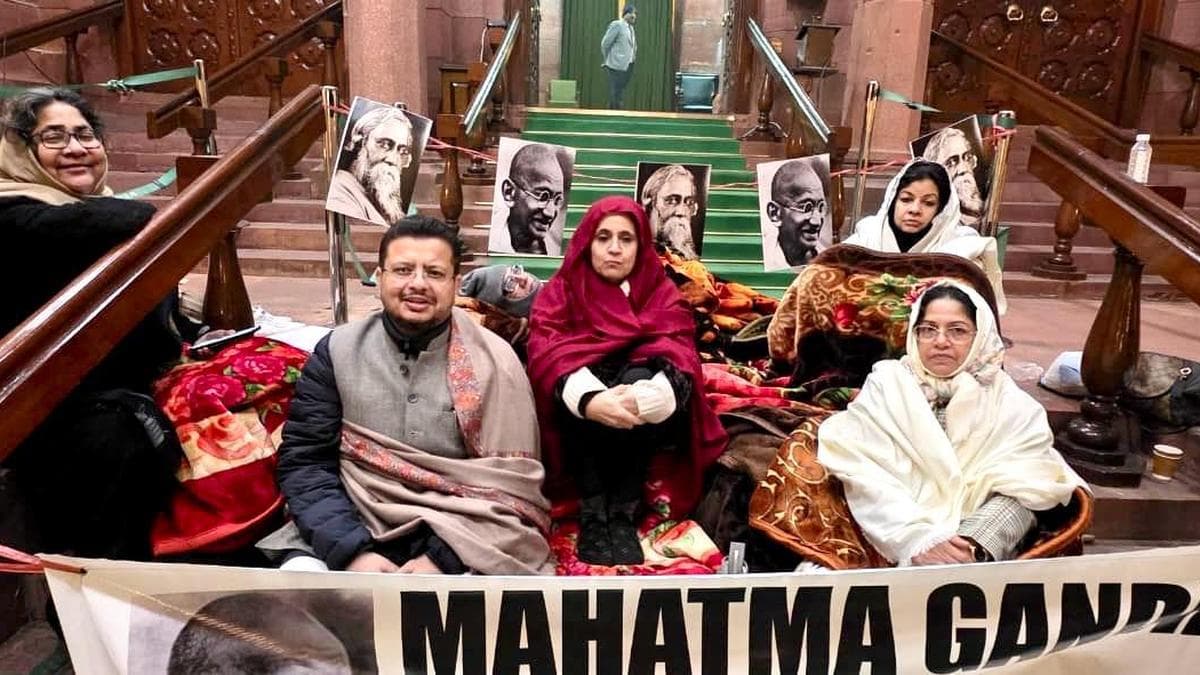
Opposition MPs staged a 12-hour overnight protest (dharna) in the Parliament complex, led by Trinamool Congress Rajya Sabha deputy leader Sagarika Ghose. The protest was against the Union government's alleged "bulldozing" of the VB-G RAM G Bill through Parliament. This event is significant for competitive exams as it illustrates parliamentary dissent, legislative procedures, and the role of the opposition in India's democratic framework.
Key Points
- 1Opposition MPs conducted a 12-hour overnight dharna (protest) in the Parliament complex.
- 2The protest was specifically against the passage of the "VB-G RAM G Bill".
- 3Trinamool Congress Rajya Sabha deputy leader Sagarika Ghose was a key figure in the protest.
- 4Ghose accused the Union government of "bulldozing" the VB-G RAM G Bill.
- 5The protest highlights parliamentary dynamics and the legislative process in India.
In-Depth Analysis
The overnight protest by Opposition MPs in Parliament against the alleged 'bulldozing' of the VB-G RAM G Bill by the Union government is a significant event that underscores critical aspects of India's parliamentary democracy, legislative process, and the role of the opposition. Led by Trinamool Congress Rajya Sabha deputy leader Sagarika Ghose, this 12-hour dharna highlights the ongoing friction between the ruling dispensation and the opposition, a recurring feature in modern Indian politics.
**Background Context: The Legislative Arena and Growing Dissent**
India's Parliament is the supreme legislative body, designed to be a forum for robust debate, scrutiny, and law-making. The Constitution of India, particularly **Article 79**, establishes the Parliament consisting of the President and the two Houses – the Lok Sabha (House of the People) and the Rajya Sabha (Council of States). The legislative process involves several stages, from the introduction of a Bill to its passage, requiring careful consideration and debate in both Houses. However, recent decades have seen an increasing trend of parliamentary disruptions, walkouts, and accusations of the government bypassing proper scrutiny, especially when it holds a significant majority. The term 'bulldozing' a bill implies that the government pushed through legislation without adequate discussion, referring a bill to a parliamentary committee, or addressing the concerns raised by the opposition. This often leads to the opposition resorting to various forms of protest, including dharnas, to draw public attention and register their dissent.
**The Incident: A Standoff in Parliament**
The specific incident involved Opposition MPs staging a 12-hour overnight protest within the Parliament complex. This form of protest, a 'dharna,' is a common tactic to physically demonstrate opposition and commitment to a cause. The central grievance was the passage of the 'VB-G RAM G Bill,' which the Opposition, particularly Sagarika Ghose, claimed was pushed through without due parliamentary process. Such protests serve multiple purposes: they express strong disapproval, pressure the government to reconsider, and inform the public about perceived legislative overreach or procedural irregularities. The fact that it was an overnight protest also signifies the depth of their concern and their willingness to go to extended lengths to make their point.
**Key Stakeholders and Their Interplay**
Several key stakeholders are involved in such parliamentary events. Firstly, the **Opposition Parties** (like the Trinamool Congress in this case) play a crucial role as a check on the government. Their primary function is to hold the executive accountable, scrutinize legislation, and voice alternative perspectives. Their tools include debate, amendments, no-confidence motions, and various forms of protest. Secondly, the **Union Government (the ruling party)**, with its majority, has the mandate to govern and pass laws. However, it also bears the responsibility to ensure democratic functioning, facilitate debate, and build consensus. The **Presiding Officers** of Parliament (the Speaker of Lok Sabha and the Chairman of Rajya Sabha) are critical in maintaining order, ensuring adherence to the Rules of Procedure and Conduct of Business, and facilitating productive debate. Lastly, the **citizens of India** are the ultimate beneficiaries or sufferers of legislative actions, and their awareness and engagement are vital for a healthy democracy.
**Significance for Indian Democracy and Constitutional Principles**
This protest is significant for India as it highlights the continuous struggle to maintain the balance between legislative efficiency and democratic deliberation. The alleged 'bulldozing' raises concerns about the erosion of parliamentary norms and the weakening of legislative scrutiny. Robust debate and committee review are essential for good law-making, ensuring that bills are thoroughly examined, potential flaws are identified, and public feedback is considered. When these processes are curtailed, it can lead to laws that are less effective, less equitable, or face legal challenges later. **Article 105** guarantees freedom of speech in Parliament, allowing members to express their views without fear, and this includes the right to protest within parliamentary rules. However, the effectiveness of protest needs to be balanced against the need for orderly functioning of the House, as outlined in the Rules of Procedure. This incident also underscores the importance of the opposition's role in a vibrant democracy, providing a voice for dissenting opinions and acting as a crucial element of the system of checks and balances.
**Historical Context and Broader Themes**
Parliamentary protests have a long history in India, dating back to the early years of independence. From walkouts to slogan shouting and even boycotts, opposition parties have historically used various methods to express dissent. This practice reflects the dynamic and often contentious nature of Indian politics, where ideological differences and policy disagreements frequently spill over into parliamentary disruptions. The broader theme here is parliamentary effectiveness and reforms. There's an ongoing debate about how to ensure both productivity and democratic debate in Parliament, preventing frequent stalemates while also ensuring bills are not passed hastily.
**Future Implications**
The incident signals continued confrontation between the government and the opposition, potentially impacting the smooth functioning of future parliamentary sessions. It might lead to further demands for referring contentious bills to parliamentary committees for detailed scrutiny. If such legislative practices become a norm, it could further strain government-opposition relations, hinder legislative consensus-building, and potentially diminish public trust in parliamentary institutions. Conversely, it could also galvanize the opposition to unite on common issues and force the government to adopt a more conciliatory approach. Ultimately, the effectiveness of parliamentary democracy hinges on respectful dialogue, adherence to procedural norms, and a collective commitment to serving the public interest.
Exam Tips
This topic falls under 'Indian Polity and Governance' for UPSC Civil Services (GS-II), State PSCs, SSC CGL, and other competitive exams. Focus on the structure, functioning, and conduct of Parliament.
Study related topics such as the legislative process (how a bill becomes a law), types of bills (Ordinary, Money, Financial, Constitutional Amendment), parliamentary committees (Standing, Ad-hoc), role of the Speaker/Chairman, and the powers and privileges of MPs.
Common question patterns include direct questions on constitutional articles related to Parliament (e.g., Article 79, 100, 105, 110), analytical questions on the role of the opposition, reasons for parliamentary disruptions, and the importance of legislative scrutiny. Be prepared for questions that require understanding of both factual details and conceptual implications.
Understand the difference between various forms of parliamentary protests (e.g., walkouts, dharnas, shouting slogans, moving specific motions) and their implications for parliamentary decorum and effectiveness.
Familiarize yourself with the Rules of Procedure and Conduct of Business in both Lok Sabha and Rajya Sabha, as these rules govern how legislative business is conducted and how disruptions are handled.
Related Topics to Study
Full Article
Trinamool Congress Rajya Sabha deputy leader Sagarika Ghose accused the Union government of bulldozing the VB- G RAM G Bill, as Opposition MPs sat on a 12-hour dharna in the Parliament complex.