



Relevant for Exams
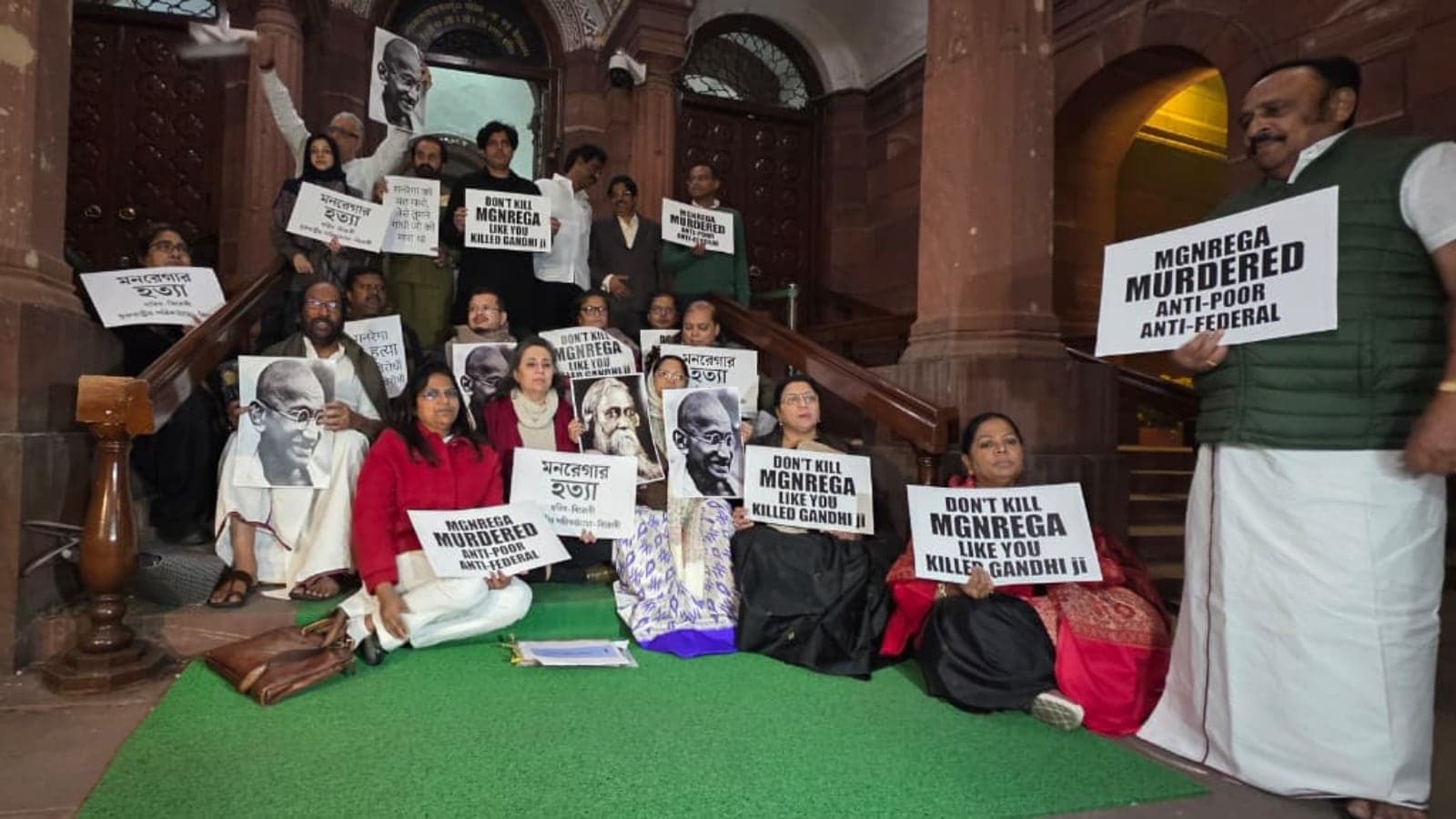
Opposition warns government, citing farm law protests and potential public agitation.
Summary
The opposition has invoked the past Farm Law protests to caution the government, suggesting potential public unrest if certain policies are pursued. This highlights the enduring political sensitivity surrounding agricultural issues and the significant influence of public movements in India, making the history and impact of the farm law protests relevant for competitive exams.
Key Points
- 1The statement refers to the major Farm Laws protests that occurred in India primarily from 2020 to 2021.
- 2The three controversial Farm Laws were repealed by the Indian Parliament on November 29, 2021.
- 3The protests involved large numbers of farmers, mainly from Punjab, Haryana, and parts of Uttar Pradesh.
- 4The opposition's warning implies potential public agitation similar to the scale of the farm law movement.
- 5This event underscores the significant role of farmer movements and political opposition in influencing government policy decisions in India.
In-Depth Analysis
The recent caution from the opposition, invoking the spectre of the past Farm Law protests, serves as a powerful reminder of the deep-seated sensitivities surrounding agricultural policy in India. This allusion is not merely a political tactic; it underscores the significant influence of public movements and the enduring challenges in reforming a sector that employs a substantial portion of India's workforce.
**Background Context: The Genesis of the Farm Laws and Farmer Discontent**
In September 2020, the Indian Parliament passed three contentious agricultural laws: the Farmers' Produce Trade and Commerce (Promotion and Facilitation) Act, 2020; the Farmers (Empowerment and Protection) Agreement on Price Assurance and Farm Services Act, 2020; and the Essential Commodities (Amendment) Act, 2020. The government's stated aim was to modernize India's agricultural sector, boost farmers' incomes by allowing them to sell produce outside regulated 'mandis' (Agricultural Produce Market Committees - APMCs), and attract private investment. It argued that these laws would break the cartelization of APMCs, reduce intermediaries, and give farmers more choices.
However, a large section of farmers, primarily from Punjab, Haryana, and Western Uttar Pradesh, viewed these laws with deep suspicion and apprehension. Their fears centered on the potential dismantling of the Minimum Support Price (MSP) system, the corporatization of agriculture, and the eventual weakening of the APMC mandis, which they saw as crucial safety nets. They feared that without the protection of MSP and APMCs, they would be at the mercy of large corporations, leading to exploitation and diminished bargaining power. The lack of robust dispute resolution mechanisms and a legal guarantee for MSP further fueled their concerns.
**What Happened: A Year of Sustained Protest**
What began as localized protests quickly escalated into one of the largest and most sustained farmer movements in India's recent history. Thousands of farmers, under the banner of various farmer unions, most notably the Samyukt Kisan Morcha (SKM), embarked on the 'Delhi Chalo' (March to Delhi) protest in November 2020. They set up prolonged sit-ins at the borders of Delhi – Singhu, Tikri, and Ghazipur – enduring harsh weather conditions, including the peak of winter and summer. Multiple rounds of negotiations between the farmer unions and the central government failed to break the deadlock. The Supreme Court of India intervened in January 2021, staying the implementation of the laws and forming a committee to facilitate talks. Despite this, the protests continued steadfastly. Finally, bowing to the immense public pressure and in a significant political reversal, Prime Minister Narendra Modi announced the repeal of the three farm laws on November 19, 2021, on the auspicious occasion of Guru Nanak Jayanti. The Farm Laws Repeal Act, 2021, was subsequently passed by Parliament on November 29, 2021.
**Key Stakeholders and Their Roles**
1. **Farmers and Farmer Unions**: The primary stakeholders and driving force behind the protests. They articulated their grievances, organized the movement, and maintained unity despite internal differences.
2. **Central Government**: Introduced the laws, initially defended them vigorously, but eventually conceded to the farmers' demands and repealed them, citing national interest.
3. **Opposition Parties**: Largely supported the farmers' cause, using the issue to criticize the government's handling of policy and its perceived authoritarian approach.
4. **Supreme Court of India**: Played a crucial role by staying the laws and attempting mediation, upholding its constitutional duty to resolve disputes.
5. **State Governments**: Some states, particularly Punjab and Rajasthan, openly supported the farmers, even passing their own bills to counter the central laws, highlighting federal tensions.
**Significance for India: A Multifaceted Impact**
1. **Democracy and Dissent**: The farm law protests demonstrated the immense power of sustained, largely peaceful democratic dissent in shaping government policy, even against a strong parliamentary majority. It reaffirmed the constitutional right to protest under Article 19(1)(b) of the Indian Constitution (right to assemble peacefully).
2. **Federalism**: The laws sparked a significant debate on federalism, as agriculture falls primarily under the State List (Entry 14, List II, Seventh Schedule). The Centre legislated using entries from the Concurrent List (Entry 33, List III, related to trade and commerce in foodstuffs), which raised questions about legislative overreach and state autonomy. This event highlighted the delicate balance of power between the Centre and states.
3. **Agricultural Reforms**: The protests stalled significant agricultural reforms, but also brought critical issues like MSP, APMC reforms, and farmer welfare to the national forefront. It underscored the need for extensive consultation and consensus-building before implementing large-scale reforms in a sensitive sector.
4. **Political Landscape**: The repeal was a major political setback for the ruling party and boosted the morale of the opposition, setting a precedent for future political challenges. It highlighted the electoral consequences of ignoring public sentiment.
**Historical Context and Broader Themes**
India has a rich history of farmer movements, from the Indigo Revolt in the colonial era to various post-independence agitations for land rights and better prices. The Green Revolution, particularly in Punjab and Haryana, created a strong dependency on MSP and government procurement, making any perceived threat to this system deeply unsettling for farmers in these regions. The protests also connected to broader themes of economic liberalization, the role of the state in protecting vulnerable populations, and the challenges of balancing economic growth with social justice.
**Future Implications**
The farm law protests have left an indelible mark on India's policy-making landscape. Governments are likely to be more cautious in introducing major reforms, especially in sensitive sectors like agriculture, without thorough consultation and broad stakeholder consensus. The episode has strengthened the hand of civil society and organized groups in influencing policy. It also keeps the focus on farmer welfare, MSP, and agricultural market reforms, with the government having formed a committee to address these issues post-repeal. The opposition's recent warning indicates that the memory of these protests will continue to be a powerful tool in political discourse, ensuring that public agitation remains a potent force in India's vibrant democracy.
Exam Tips
This topic falls under GS Paper-II (Polity & Governance, Federalism, Centre-State Relations, Government Policies & Interventions, Social Justice) and GS Paper-III (Indian Economy, Agriculture, Food Processing).
Study the constitutional provisions related to federalism (Seventh Schedule - Union, State, Concurrent Lists), fundamental rights (Article 19 on freedom of speech, assembly), and the legislative process in Parliament. Understand the debate around whether agriculture is a state or concurrent subject.
Be prepared for analytical questions on the impact of farmer protests on policy-making, the role of dissent in a democracy, the economic implications of agricultural reforms, and the challenges of federal governance in India. Questions might also compare the Farm Laws with previous agricultural policies.
Understand the key terms: MSP (Minimum Support Price), APMC (Agricultural Produce Market Committee), Essential Commodities Act, contract farming, corporatization of agriculture. Know the arguments for and against the repealed laws and the government's stated objectives.
Practice essay writing on topics like 'The role of civil society in shaping government policy' or 'Balancing economic reforms with social welfare in India', using the Farm Law protests as a case study.