



Relevant for Exams
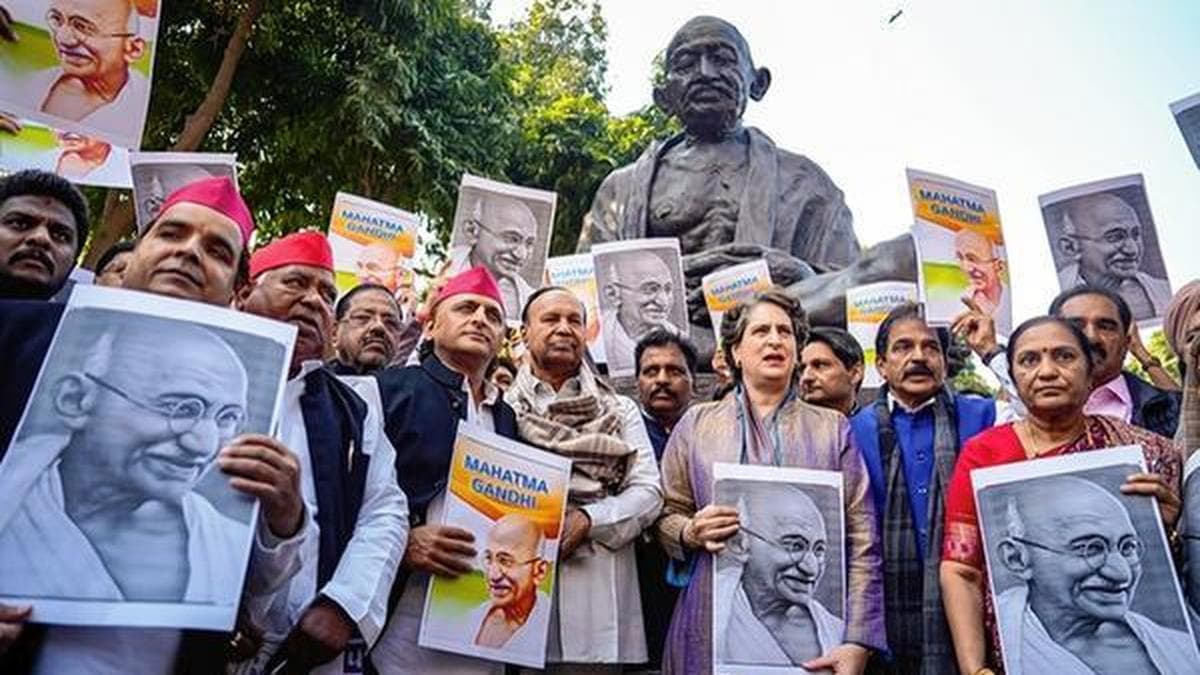
Opposition MPs protest new VB-G RAM G Bill in Parliament, demanding withdrawal of MGNREGA replacement.
Summary
Opposition MPs are protesting in the Parliament complex, demanding the withdrawal of the proposed Viksit Bharat Guarantee for Rozgar and Ajeevika Mission (Gramin) (VB-G RAM G) Bill. This bill aims to replace the UPA-era Mahatma Gandhi National Rural Employment Guarantee Act (MGNREGA). The debate over replacing a flagship rural employment scheme is highly significant, impacting rural livelihoods and government policy, making it crucial for competitive exam preparation on social sector schemes and legislative developments.
Key Points
- 1The proposed legislation is named the Viksit Bharat Guarantee for Rozgar and Ajeevika Mission (Gramin) (VB-G RAM G) Bill.
- 2This VB-G RAM G Bill is intended to replace the existing Mahatma Gandhi National Rural Employment Guarantee Act (MGNREGA).
- 3MGNREGA, which the new bill seeks to replace, was a flagship scheme introduced during the UPA-era.
- 4Opposition Members of Parliament (MPs) are holding a protest march within the Parliament complex.
- 5The primary demand of the protesting Opposition MPs is the immediate withdrawal of the VB-G RAM G Bill.
In-Depth Analysis
The proposed Viksit Bharat Guarantee for Rozgar and Ajeevika Mission (Gramin) (VB-G RAM G) Bill, intended to replace the Mahatma Gandhi National Rural Employment Guarantee Act (MGNREGA), has ignited a significant political debate and protest within the Indian Parliament. This development is crucial for competitive exam aspirants as it touches upon fundamental aspects of social welfare, rural development, legislative processes, and constitutional provisions.
**Background Context: The Genesis of MGNREGA**
To understand the significance of the VB-G RAM G Bill, one must first grasp the context of MGNREGA. Originally enacted as the National Rural Employment Guarantee Act (NREGA) in 2005 and later renamed MGNREGA in 2009, it stands as one of the world's largest social welfare programs. Born out of a commitment to the 'right to work', MGNREGA guarantees 100 days of wage employment in a financial year to every rural household whose adult members volunteer to do unskilled manual work. Its primary objectives were to enhance livelihood security in rural areas, create durable assets (like roads, ponds, wells), reduce distress migration, and empower local self-governance through Panchayati Raj Institutions. The Act is demand-driven, meaning that local authorities must provide work within 15 days of a demand, failing which unemployment allowance must be paid. Over the years, MGNREGA has been lauded for its role in poverty alleviation, especially during economic downturns and crises like the COVID-19 pandemic, providing a crucial safety net for millions of rural poor.
**What Happened: The Proposed Replacement and Opposition**
The current government has introduced the VB-G RAM G Bill, aiming to replace MGNREGA. While the specifics of the new bill are under scrutiny, the very idea of replacing a landmark, rights-based legislation has drawn strong opposition. Opposition Members of Parliament have staged protest marches within the Parliament complex, vociferously demanding the withdrawal of the proposed bill. Their primary concern is that the new legislation might dilute the 'right to work' entitlement, reduce the scope of guaranteed employment, alter wage structures, or shift the focus away from a demand-driven model, potentially weakening the social safety net for rural populations. The government, on its part, might be looking to streamline the scheme, enhance asset quality, improve efficiency, reduce leakages, or align it more closely with its 'Viksit Bharat' vision, which emphasizes a developed India by 2047.
**Key Stakeholders Involved**
Several key stakeholders are deeply invested in this legislative development:
1. **The Central Government (Ruling Party):** As the proposer of the VB-G RAM G Bill, it aims to reform or replace the existing framework, possibly to address perceived inefficiencies or to introduce a new programmatic approach.
2. **Opposition Parties:** They are staunchly opposing the bill, advocating for the continuation and strengthening of MGNREGA, viewing it as a critical social security measure and a symbol of their past governance.
3. **Rural Labourers and Beneficiaries:** These are the most directly impacted group. Any changes to the scheme will directly affect their access to employment, wages, and livelihood security.
4. **State Governments:** Responsible for implementing the scheme, they are stakeholders due to the financial implications, administrative burden, and potential shifts in central-state responsibilities.
5. **Civil Society Organizations and Activists:** Groups working on labour rights, rural development, and poverty alleviation often monitor such legislative changes closely and advocate for the rights of the marginalized.
**Significance for India: Economic, Social, and Political Impact**
The debate surrounding the VB-G RAM G Bill holds profound significance for India. Socially, any alteration to MGNREGA could impact poverty levels, rural distress, women's economic empowerment (as a significant portion of MGNREGA workers are women), and patterns of internal migration. Economically, MGNREGA has been a crucial tool for injecting purchasing power into rural economies, stimulating demand, and creating rural infrastructure. A new bill could change the fiscal burden on the exchequer, the nature of asset creation, and the overall rural economic landscape. Politically, this issue is a major flashpoint between the ruling and opposition parties, shaping narratives around welfare, governance, and the efficacy of social sector programs, potentially influencing future electoral outcomes. It also reflects a broader philosophical debate on the role of the state in providing social security and employment guarantees.
**Historical Context and Constitutional Provisions**
MGNREGA's journey from NREGA in 2005 marked a significant shift towards a rights-based approach to welfare. Its roots can be traced to the Directive Principles of State Policy (DPSP) in the Indian Constitution. Specifically, **Article 41** directs the State to make effective provision for securing the right to work, to education, and to public assistance in cases of unemployment, old age, sickness, and disablement. **Article 43** mandates the State to endeavour to secure, by suitable legislation or economic organisation or in any other way, to all workers, a living wage and conditions of work ensuring a decent standard of life. MGNREGA was a legislative embodiment of these constitutional ideals. The proposed VB-G RAM G Bill will be scrutinized against these constitutional aspirations and the established precedent of a rights-based entitlement.
**Future Implications**
The passage or withdrawal of the VB-G RAM G Bill will have lasting implications. If passed, the new legislation could redefine rural employment guarantees, potentially introducing a more targeted approach, greater emphasis on specific types of asset creation, or a different funding mechanism. It might also leverage technology further for transparency and efficiency, building on initiatives like Direct Benefit Transfer (DBT) and Aadhaar linkage already prevalent in MGNREGA. Conversely, if the bill is withdrawn or significantly modified due to opposition, it would underscore the political power of a united opposition and the public's attachment to established welfare programs. The outcome will shape the future of rural livelihoods, social security architecture, and the broader narrative of 'Viksit Bharat' in India for years to come, making it a critical area of study for aspiring civil servants.
Exam Tips
This topic falls under GS Paper II (Polity & Governance, Social Justice) and GS Paper III (Indian Economy, Rural Development) for UPSC Civil Services Exam. For SSC, Banking, and State PSCs, it's relevant for General Awareness, Government Schemes, and Indian Polity sections.
Study MGNREGA in detail: its objectives, features (wage guarantee, asset creation, women's participation), challenges (wage delays, corruption), and impact. Compare and contrast its provisions with potential changes in the proposed VB-G RAM G Bill (if details become available).
Familiarize yourself with the legislative process in India (how a bill becomes an act). Understand the role of Parliament, opposition, and committees. Also, focus on the constitutional basis of welfare schemes, particularly Directive Principles of State Policy (Articles 38, 39, 41, 43). Common questions include direct queries on MGNREGA features, constitutional articles, or analytical questions on the effectiveness of such schemes.
Related Topics to Study
Full Article
The Viksit Bharat Guarantee for Rozgar and Ajeevika Mission (Gramin) (VB-G RAM G) Bill to replace the UPA-era MGNREGA (Mahatma Gandhi National Rural Employment Guarantee Act) is being debated in Parliament