



Relevant for Exams
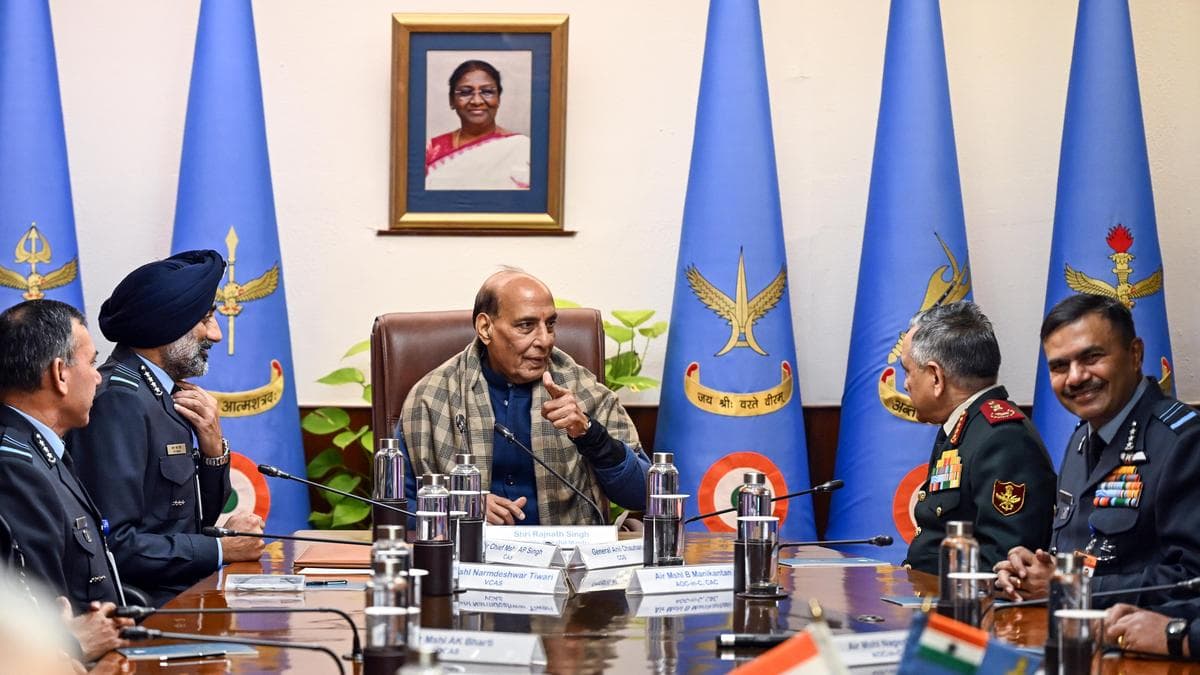
Rajnath Singh: "Operation Sindoor" affirmed India's decisive air power; IAF is advanced & confident.
Summary
Defence Minister Rajnath Singh emphasized that "Operation Sindoor" showcased India's decisive air power. Speaking at a Commanders' Conclave in New Delhi, he lauded the Indian Air Force as a technologically advanced, operationally agile, and strategically confident force. This highlights the nation's robust defense capabilities and is crucial for competitive exams focusing on national security and military affairs.
Key Points
- 1Defence Minister Rajnath Singh highlighted "Operation Sindoor" as demonstrating India’s decisive air power.
- 2The statement was made concerning the capabilities and characteristics of the Indian Air Force (IAF).
- 3Rajnath Singh described the IAF as technologically advanced, operationally agile, strategically confident, and future-oriented.
- 4The remarks were delivered during a Commanders’ Conclave.
- 5The Commanders’ Conclave where the statement was made took place in New Delhi.
In-Depth Analysis
The statement by Defence Minister Rajnath Singh, highlighting "Operation Sindoor" as a demonstration of India's decisive air power and praising the Indian Air Force (IAF) at a Commanders' Conclave in New Delhi, underscores the nation's robust defence capabilities and its strategic posture in a complex geopolitical landscape. This assessment is not just a ceremonial appreciation but a significant pronouncement reflecting India's ongoing efforts to bolster its national security.
To understand the gravity of this statement, one must consider the background context. India operates in a challenging neighbourhood, with long-standing border disputes with China and Pakistan. The Doklam standoff in 2017, the Balakot airstrikes in 2019, and the ongoing military build-up along the Line of Actual Control (LAC) with China have all underscored the critical importance of a strong and agile air force. While the specifics of "Operation Sindoor" are not widely publicized, such mentions by the Defence Minister typically refer to successful deployments, exercises, or strategic operations that validate the IAF's preparedness and operational prowess. These operations serve as critical tests of equipment, personnel training, and strategic doctrine, ensuring the force remains combat-ready.
Key stakeholders involved in this narrative include, first and foremost, the **Ministry of Defence (MoD)**, led by Rajnath Singh, which formulates and implements defence policy. The **Indian Air Force (IAF)** itself, as the primary subject, is responsible for air defence and offensive air operations. Its leadership, including the Chief of Air Staff and the Air Commanders, play a pivotal role in maintaining operational readiness. **Defence Public Sector Undertakings (DPSUs)** like Hindustan Aeronautics Limited (HAL) and various private defence manufacturers are crucial in providing the technological backbone, contributing to the 'technologically advanced' aspect mentioned. Ultimately, the **citizens of India** are the beneficiaries of this strengthened national security, which ensures peace and stability for economic growth and societal development.
This matters immensely for India. A 'decisive air power' acts as a potent deterrent against external aggression, safeguarding India's territorial integrity and national interests. In the geopolitical arena, a strong air force enhances India's leverage and influence, reinforcing its position as a responsible regional power and a significant global player. Economically, the continuous modernization of the IAF, involving procurement of advanced aircraft like the Rafale and indigenous development of platforms like the LCA Tejas, fuels the 'Make in India' initiative in the defence sector, creating jobs and fostering technological self-reliance under the 'Atmanirbhar Bharat Abhiyan'. This also reduces dependence on foreign suppliers, ensuring strategic autonomy.
Historically, the IAF has played a crucial role in every major conflict India has faced, from the 1965 and 1971 Indo-Pak wars to the Kargil conflict in 1999 and the Balakot airstrikes in 2019. Its evolution from a nascent force at independence to a modern, multi-role air arm capable of sophisticated operations reflects decades of strategic planning, investment, and dedication. The emphasis on being 'operationally agile' and 'strategically confident' stems from these experiences, where quick response times and calculated deployments often dictated outcomes.
From a constitutional perspective, the defence of India falls squarely under the Union List (Entry 1, Seventh Schedule), making it the exclusive responsibility of the central government. **Article 53(2)** of the Constitution states that the President of India is the Supreme Commander of the Armed Forces, signifying civilian control over the military. Policies like the **Defence Acquisition Procedure (DAP)**, periodically updated (e.g., DAP 2020), guide the procurement process, prioritizing indigenous content and technology transfer. The annual **Defence Budget** allocation reflects the government's commitment to maintaining and modernizing the armed forces.
Looking ahead, the future implications are clear. India will continue to invest in cutting-edge technology, including advanced fighter jets, drones, cyber warfare capabilities, and space-based assets, to maintain its air superiority. The focus will also be on enhancing 'jointmanship' – better coordination among the Army, Navy, and Air Force – to achieve synergistic effects in future conflicts. This continuous evolution is vital for India to navigate emerging threats, such as hybrid warfare and challenges in the Indo-Pacific region, ensuring its national security remains uncompromised and its strategic interests are protected on the global stage. The Defence Minister's remarks serve as a powerful affirmation of this commitment and a message to both domestic and international audiences about India's unwavering resolve to protect itself.
Exam Tips
This topic falls under the 'Internal Security and Disaster Management' and 'General Studies Paper-III (Security)' sections for UPSC CSE. For SSC, Banking, Railway, and State PSC exams, it's relevant for 'General Awareness' and 'Current Affairs' sections, particularly under 'Defence News' or 'National Security'.
When studying, connect this with India's defence modernization programs (e.g., 'Make in India' in defence, Defence Corridors, specific defence procurements like Rafale, S-400), India's strategic partnerships (e.g., Quad, defence agreements with France, Russia, USA), and regional security challenges (e.g., China border issues, Pakistan terrorism).
Common question patterns include: direct questions on major defence procurements, roles and responsibilities of different defence forces, key defence policies (e.g., DAP), and the significance of indigenous defence production. For UPSC, analytical questions on India's strategic autonomy, deterrence capabilities, and the role of air power in modern warfare are frequent. Be prepared for questions on the structure of the Ministry of Defence and the armed forces.
Related Topics to Study
Full Article
The Indian Air Force is a technologically advanced, operationally agile, strategically confident and future-oriented force, he says at Commanders’ Conclave in New Delhi