

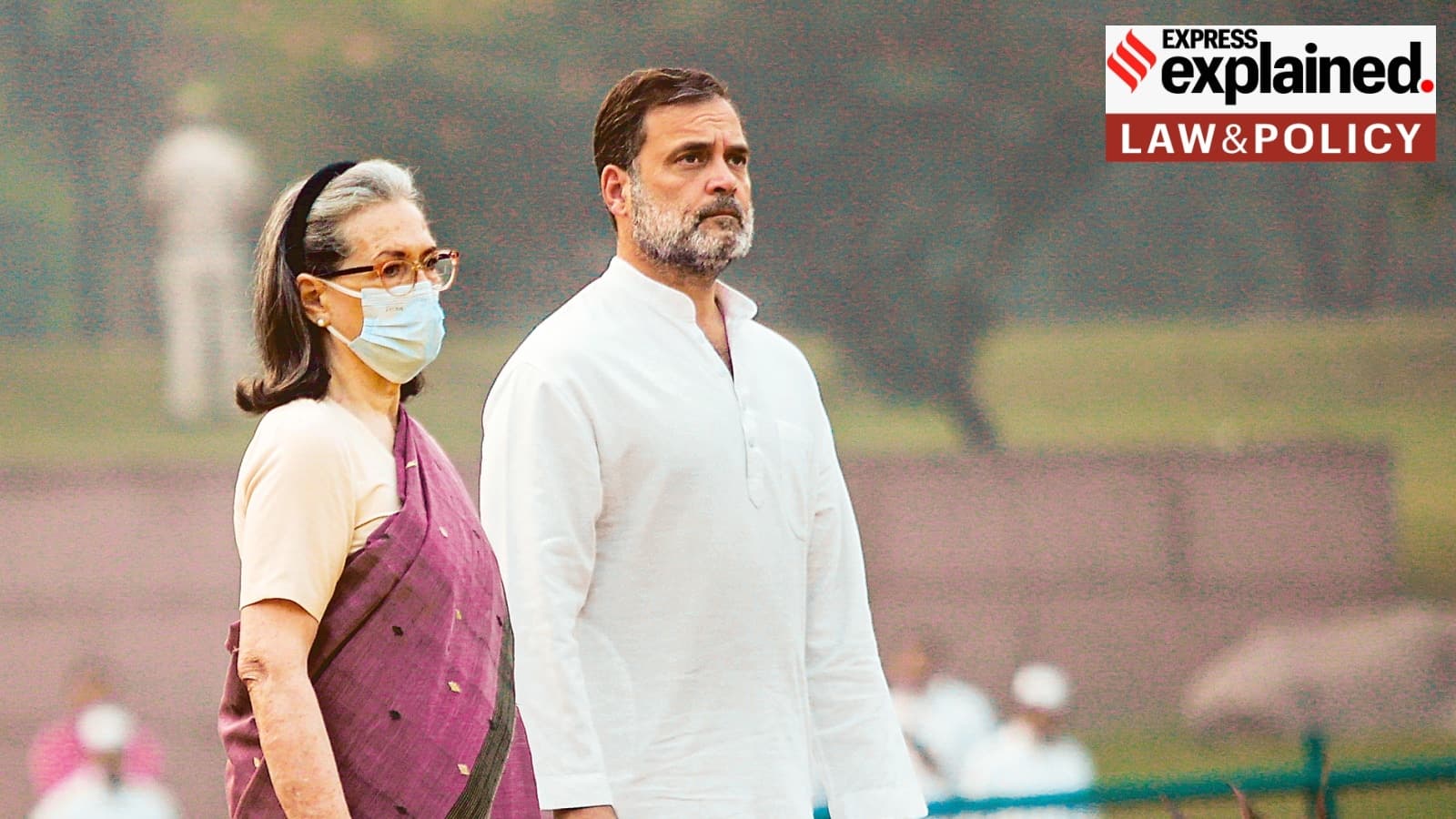


Content unavailable: Cannot summarize National Herald case ruling against ED.
Summary
The provided article content is unavailable. Therefore, a detailed summary explaining the National Herald case, the special court's ruling against the ED, its significance, or specific exam-relevant facts cannot be accurately generated. Information extraction requires textual content to identify key events, legal provisions, and their implications for competitive exam preparation.
Key Points
- 11. No specific facts regarding the National Herald case or the special court's ruling against ED can be extracted.
- 22. The article content required for detailed analysis is explicitly marked as 'No content available'.
- 33. Without content, specific dates, names, numbers, or legal provisions related to the case cannot be identified.
- 44. The implications or significance of this development for competitive exams cannot be assessed without textual information.
- 55. Accurate MCQ-style questions cannot be formulated from an empty content source.
In-Depth Analysis
The National Herald case, despite its complex legal and political nuances, is a critical topic for competitive exam aspirants as it intertwines aspects of corporate law, money laundering, political funding, and the functioning of investigative agencies. At its core, the case revolves around the acquisition of Associated Journals Limited (AJL), the publisher of the National Herald newspaper, by Young Indian (YI) Private Limited.
**Background Context:**
Associated Journals Limited (AJL) was founded in 1937 by India's first Prime Minister, Jawaharlal Nehru, with the objective of publishing nationalist newspapers, including the National Herald, Navjivan, and Qaumi Awaz. It was envisioned as a non-profit company, largely supported by Congress party funds and public donations, playing a significant role in the freedom struggle. Over decades, AJL accumulated considerable assets, primarily real estate, across various cities. However, by the early 2000s, AJL faced severe financial distress, accumulating a debt of over Rs. 90 crore, primarily owed to the Indian National Congress party.
**What Happened:**
In 2010, a new company, Young Indian (YI) Private Limited, was incorporated with a share capital of Rs. 5 lakh. Key shareholders and directors of YI included prominent Congress leaders, notably Sonia Gandhi and Rahul Gandhi, who each held a 38% stake. The Congress party then assigned AJL's debt of Rs. 90.25 crore to YI for a mere Rs. 50 lakh. Subsequently, AJL's shares were transferred to YI, effectively giving Young Indian control over AJL and its valuable assets. The complainant, Subramanian Swamy, alleged that this transaction amounted to a 'land grab' and 'criminal misappropriation of property' worth thousands of crores, as YI, a Section 25 company (now Section 8 under the Companies Act, 2013, for non-profit objectives), was supposedly formed to acquire valuable assets for a minimal sum. The Enforcement Directorate (ED) initiated an investigation into the matter, alleging money laundering under the Prevention of Money Laundering Act (PMLA), 2002.
Regarding the special court's ruling against the ED, while the specific details of the 'no content available' article are unknown, such rulings typically occur when the court finds that the ED's actions (e.g., attachment of properties, summons, or findings) lack sufficient legal basis, evidence, or procedural adherence. This could involve quashing an attachment order, questioning the validity of summons, or rejecting the ED's arguments on a particular aspect of the alleged money laundering.
**Key Stakeholders Involved:**
1. **Associated Journals Limited (AJL):** The original company, publisher of National Herald, holding significant assets.
2. **Young Indian (YI) Private Limited:** The company formed to acquire AJL's debt and shares, with Sonia Gandhi and Rahul Gandhi as major stakeholders.
3. **Indian National Congress (INC):** The political party that lent funds to AJL and subsequently assigned the debt to YI.
4. **Sonia Gandhi and Rahul Gandhi:** Directors and major shareholders of YI, facing allegations of misappropriation.
5. **Subramanian Swamy:** The original complainant who brought the case to court in 2012.
6. **Enforcement Directorate (ED):** The central investigative agency probing the case under the PMLA, 2002.
7. **The Judiciary:** Various courts, including the special court, that hear the case and scrutinize the actions of the ED and the accused.
**Why This Matters for India:**
This case has significant political ramifications, particularly for the Indian National Congress, as it involves its top leadership. It fuels debates on political ethics, transparency in political funding, and the use of 'non-profit' entities for commercial gains. Legally, it tests the provisions of the Prevention of Money Laundering Act (PMLA), 2002, and Company Law, particularly Section 8 companies. It also highlights the independence and powers of investigative agencies like the ED, and the judiciary's role in overseeing their actions. For governance, it raises questions about corporate governance standards, especially for entities with political affiliations.
**Historical Context:**
The National Herald's legacy as a voice of the freedom movement and its association with Jawaharlal Nehru adds a historical layer to the controversy. The perceived 'takeover' of such a historically significant entity by a private company, even if controlled by political descendants, stirs emotions and provides fodder for political narratives.
**Future Implications:**
The outcome of the National Herald case could set precedents for how corporate transactions involving political parties and their assets are scrutinized. It will have a direct bearing on the political careers of the involved leaders and could influence future political discourse on corruption and accountability. The court's rulings against the ED, if sustained, might lead to a re-evaluation of the agency's investigative methods or the legal interpretations of PMLA provisions. Conversely, if the allegations are proven, it could strengthen the resolve to reform political funding and corporate governance norms.
**Related Constitutional Articles, Acts, or Policies:**
* **Prevention of Money Laundering Act (PMLA), 2002:** This is the primary law under which the ED is investigating the case, focusing on the generation of 'proceeds of crime' and their laundering.
* **Companies Act, 2013 (formerly Companies Act, 1956):** Relevant provisions concerning Section 8 companies (formerly Section 25), corporate governance, share transfers, and financial reporting are crucial.
* **Indian Penal Code (IPC):** Sections related to criminal breach of trust (Section 406), cheating (Section 420), and criminal conspiracy (Section 120B) were initially invoked in the private complaint.
* **Article 20(3) of the Constitution:** Guarantees the right against self-incrimination, often invoked by accused persons during investigations.
* **Right to Property (no longer a fundamental right, but a constitutional right under Article 300A):** Indirectly relevant in discussions of alleged 'land grabbing' and asset transfers.
This case underscores the complex interplay between law, politics, and governance in India, making it a multifaceted subject for competitive exam preparation.
Exam Tips
**Syllabus Section:** This topic primarily falls under 'Indian Polity & Governance' (UPSC Mains GS-II) and 'Current Events of National Importance' (Prelims & Mains GS-I/II). Aspects of corporate law might touch upon 'Indian Economy' (Mains GS-III).
**Related Topics to Study:** Focus on the Prevention of Money Laundering Act (PMLA) 2002, the powers and functions of the Enforcement Directorate (ED), the Companies Act 2013 (especially Section 8 companies), and electoral reforms related to political funding and transparency.
**Common Question Patterns:** Expect questions on the objectives and provisions of PMLA, the role of investigative agencies like ED, the concept of 'proceeds of crime', and the legal framework for corporate governance. Factual questions about the case's timeline or key stakeholders are also possible in prelims. Analytical questions on political ethics and accountability can appear in mains.