



Relevant for Exams
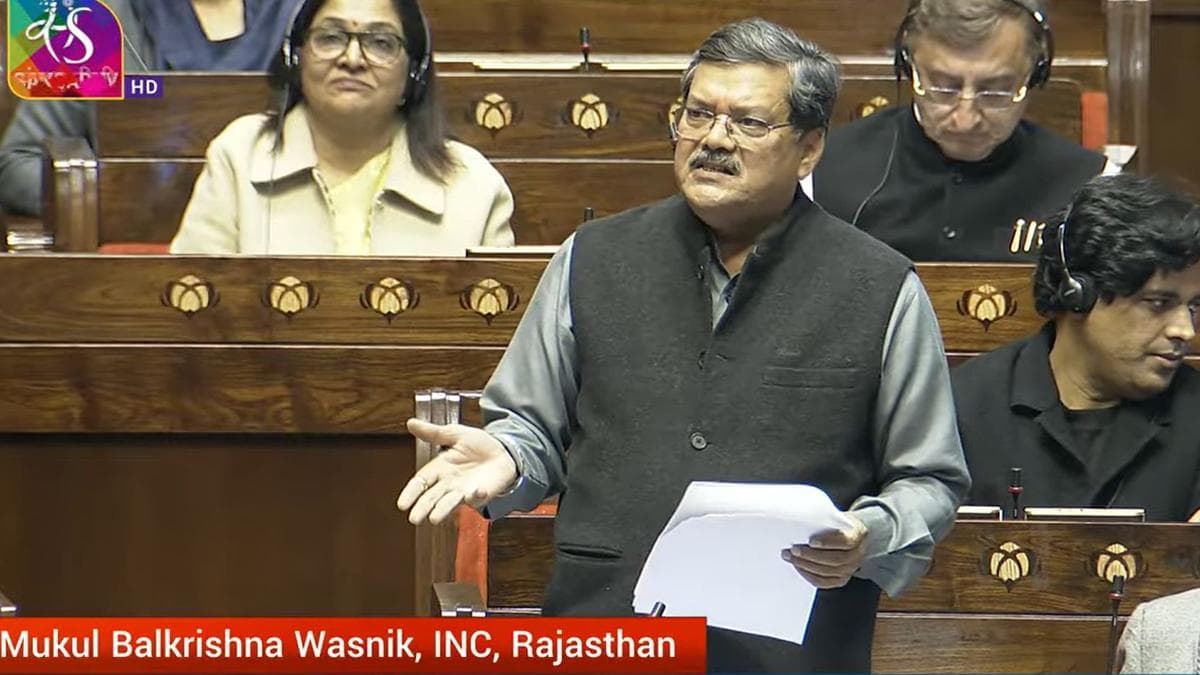
Opposition flags lack of consultation for new rural jobs Bill in Rajya Sabha, citing repealed farm laws.
Summary
Opposition members in Rajya Sabha expressed strong reservations about a new rural jobs Bill, citing a lack of prior consultations. They drew a parallel to the three controversial farm laws, which were eventually withdrawn after widespread protests, highlighting concerns over the government's legislative approach without adequate stakeholder engagement. This underscores the importance of parliamentary procedures and public consultation in policymaking for competitive exams.
Key Points
- 1The Opposition raised concerns in the Rajya Sabha regarding a new rural jobs Bill.
- 2A primary objection cited by the Opposition was the alleged lack of consultations before the Bill's tabling.
- 3Opposition members invoked the example of the three farm laws to highlight procedural concerns.
- 4The three farm laws were previously withdrawn after a prolonged farmers' agitation.
- 5The Opposition predicted a similar fate for the new rural jobs Bill due to the absence of proper consultations.
In-Depth Analysis
The recent objection raised by Opposition members in the Rajya Sabha regarding a new rural jobs Bill, citing a lack of prior consultations and drawing parallels to the controversial farm laws, brings to the forefront critical aspects of India's legislative process, democratic governance, and socio-economic policy. This incident is not merely a parliamentary skirmish; it underscores deeper issues concerning legislative transparency, stakeholder engagement, and the efficacy of public policy in a diverse democracy.
**Background Context and What Happened:**
India's parliamentary democracy thrives on debate, discussion, and deliberation. The legislative process, as enshrined in the Constitution, involves multiple stages, from introduction to passage, providing opportunities for scrutiny. However, recent trends have seen concerns raised about the speed with which certain Bills are introduced and passed, sometimes bypassing extensive committee review or public consultation. The context for the Opposition's current objection is rooted in the government's perceived tendency to introduce significant legislation without what they deem adequate prior engagement with relevant stakeholders or opposition parties. The specific incident involved Opposition members flagging a new rural jobs Bill in the Rajya Sabha, expressing strong reservations because they felt there was a lack of consultations before its tabling. This immediately invoked the precedent of the three farm laws.
**Historical Context: The Farm Laws Precedent:**
To truly understand the Opposition's concerns, one must look back at the three farm laws – The Farmers' Produce Trade and Commerce (Promotion and Facilitation) Act, 2020; The Farmers (Empowerment and Protection) Agreement on Price Assurance and Farm Services Act, 2020; and The Essential Commodities (Amendment) Act, 2020. These laws were passed in September 2020 amidst significant controversy and without extensive prior consultation with farmer unions or state governments. This perceived lack of consultation, coupled with fears about the impact on Minimum Support Price (MSP) and traditional mandis, led to widespread and prolonged protests, primarily by farmers from Punjab, Haryana, and Uttar Pradesh, lasting over a year. Despite initial government resistance, the laws were eventually repealed by the Parliament in November 2021, a significant political reversal. The Opposition is now warning that the new rural jobs Bill could face a similar fate if the government does not engage in proper consultations.
**Key Stakeholders Involved:**
1. **The Government (Ruling Party):** Responsible for initiating legislation and steering it through Parliament. Their objective is to implement their policy agenda. In this case, they believe the new rural jobs Bill is necessary for rural development.
2. **The Opposition Parties:** Their role is to scrutinize government policies, hold the executive accountable, and represent alternative viewpoints. They are advocating for greater transparency and consultation.
3. **Parliament (Rajya Sabha):** The upper house of Parliament, where the Bill was flagged. It plays a crucial role in legislative review and can act as a check on the executive. Its procedures, like referring Bills to standing committees, are vital.
4. **Potential Beneficiaries/Affected Parties of the Rural Jobs Bill:** These would include rural laborers, farmers, local communities, and Panchayati Raj institutions, whose livelihoods and economic well-being would be directly impacted by the provisions of any new rural jobs legislation. Their voice, often channeled through advocacy groups, is critical.
**Significance for India and Constitutional Provisions:**
This issue holds immense significance for India's democratic fabric and governance. Firstly, it highlights the importance of **parliamentary procedures and legislative due diligence**. While the Constitution lays down the procedure for law-making (Articles 107-111 for ordinary Bills), the spirit of democratic law-making demands robust debate, committee scrutiny, and public consultation. The lack of consultation can erode public trust in institutions. Secondly, the discussion around a rural jobs Bill directly relates to **social welfare and economic development**. India already has a flagship rural employment scheme, the Mahatma Gandhi National Rural Employment Guarantee Act (MGNREGA), enacted in 2005, which guarantees 100 days of wage employment in a financial year to adult members of any rural household willing to do unskilled manual work. Any new rural jobs Bill would likely either amend, replace, or complement MGNREGA. Therefore, its implications for rural livelihoods, poverty alleviation, and state finances are enormous. The subject of 'Rural Development' falls under the State List (Entry 5, List II) to some extent, and concurrent list subjects (List III) also play a role, making consultation with states crucial if the Bill touches upon these areas, adhering to the principles of **federalism**.
**Future Implications:**
The immediate implication is potential legislative deadlock or sustained opposition within Parliament. If the government proceeds without addressing concerns, it risks alienating stakeholders and possibly triggering public protests similar to the farm laws agitation. This could further strain government-opposition relations, impacting the smooth functioning of Parliament and the legislative agenda. For the quality of legislation, a lack of consultation often leads to laws that are ill-suited for ground realities, difficult to implement, or prone to legal challenges. For competitive exams, understanding this dynamic is key to analyzing governance, policy-making, and constitutional functioning in India.
Exam Tips
This topic falls under GS Paper II (Polity & Governance) and GS Paper III (Indian Economy, Rural Development) for UPSC Civil Services. Focus on the legislative process, role of Parliament, government policies for rural employment (like MGNREGA), and federalism.
Study related topics like the functions of Parliament, types of Bills, legislative process, the role of parliamentary committees, the concept of public consultation in law-making, and specific details of MGNREGA (objectives, funding, challenges, impact).
Common question patterns include: 'Critically analyze the importance of public consultation in India's legislative process, citing recent examples.' 'Discuss the role of the Opposition in a parliamentary democracy, with reference to legislative scrutiny.' 'Examine the socio-economic impact of rural employment schemes like MGNREGA and potential implications of new legislation.'
Pay attention to the specific articles related to parliamentary procedures (e.g., Articles 107-111 for ordinary bills) and the distribution of legislative powers between the Union and States (Seventh Schedule).
Understand the difference between a Bill and an Act, and the various stages a Bill goes through before becoming law. This foundational knowledge is crucial for analyzing such current events.
Related Topics to Study
Full Article
They also invoked the example of the three farm laws, which they said were passed under similar circumstances and later withdrawn after a prolonged farmers’ agitation. This Bill will also face the same fate, they said.