



Relevant for Exams
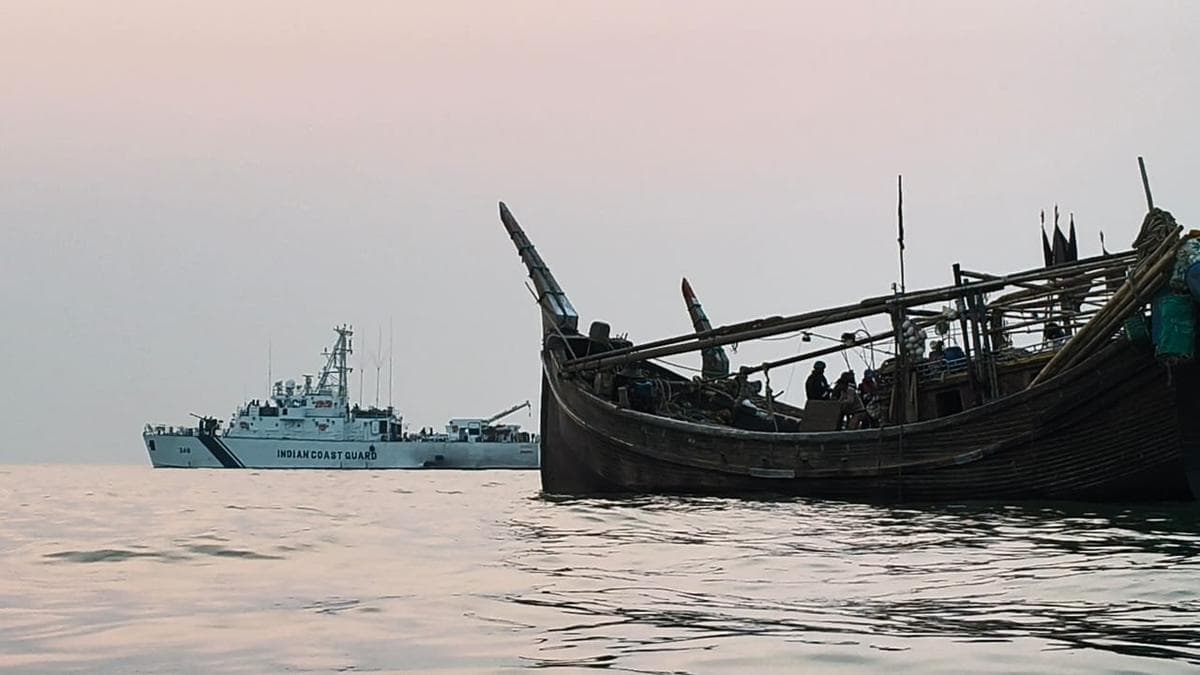
ICG Ship Anmol apprehends two Bangladeshi fishing boats in India's EEZ, Bay of Bengal.
Summary
The Indian Coast Guard Ship Anmol apprehended two Bangladeshi fishing boats illegally operating within India's Exclusive Economic Zone (EEZ) in the northern Bay of Bengal. This action underscores India's vigilance in protecting its maritime sovereignty and natural resources from foreign exploitation. The incident is significant for competitive exams covering national security, maritime law, and the operational role of the Indian Coast Guard.
Key Points
- 1The Indian Coast Guard (ICG) Ship involved in the apprehension was ICG Ship Anmol.
- 2Two Bangladeshi fishing boats were apprehended for illegal fishing in India's Exclusive Economic Zone (EEZ).
- 3The apprehension took place during routine surveillance operations in the northern Bay of Bengal.
- 4The apprehended boats were found to be carrying 35 crew members.
- 5Approximately 500 kilograms of fish catch was discovered on board the seized boats.
In-Depth Analysis
The apprehension of two Bangladeshi fishing boats by the Indian Coast Guard Ship Anmol in India's Exclusive Economic Zone (EEZ) in the northern Bay of Bengal is a significant event that underscores India's commitment to safeguarding its maritime sovereignty and natural resources. This incident, involving 35 crew members and 500 kg of fish catch, is not an isolated occurrence but a recurring challenge in India's vast maritime domain, particularly with its South Asian neighbours.
**Background Context and What Happened:**
India's Exclusive Economic Zone extends 200 nautical miles (approximately 370 kilometers) from its baseline, a right enshrined under the United Nations Convention on the Law of the Sea (UNCLOS), 1982, which India ratified in 1995. Within this zone, India has sovereign rights for the purpose of exploring and exploiting, conserving and managing natural resources, whether living or non-living, of the seabed and subsoil and the superjacent waters. The incident involved the ICG Ship Anmol conducting routine surveillance operations, detecting and apprehending two Bangladeshi fishing boats operating illegally within India's EEZ. These boats were not only trespassing but actively engaged in fishing, evidenced by the active gear and substantial catch onboard. This act directly violates India's sovereign rights over its marine resources.
**Key Stakeholders Involved:**
Several key stakeholders are involved in such incidents. Primarily, the **Indian Coast Guard (ICG)**, operating under the Ministry of Defence, is the frontline agency responsible for maritime law enforcement, search and rescue, and environmental protection in India's maritime zones. Their proactive surveillance and apprehension demonstrate their crucial role in national security. The **Ministry of External Affairs (MEA)** becomes involved in handling the diplomatic aspects, including communication with the Bangladeshi government regarding the apprehended crew and vessels. The **Bangladesh Government** is a significant stakeholder, as its citizens and vessels are involved; they are responsible for their maritime boundaries and regulating their fishing fleet. Finally, **Indian fishing communities** are indirectly but profoundly affected, as illegal fishing by foreign vessels depletes shared fish stocks, impacting their livelihoods and the sustainability of marine ecosystems.
**Why This Matters for India:**
This incident holds multi-faceted significance for India. From a **national security perspective**, it highlights the need for constant vigilance against any unauthorized entry into India's maritime zones, which could potentially be exploited for nefarious activities beyond just illegal fishing. Economically, India's EEZ is rich in marine resources, supporting millions of livelihoods along its extensive coastline. Illegal fishing by foreign vessels leads to over-exploitation of these resources, causing significant economic losses to Indian fishermen and jeopardizing the long-term sustainability of fish stocks. Politically, upholding the sanctity of its EEZ reinforces India's adherence to international maritime law (UNCLOS) and its sovereign rights. Such incidents, while common, can also strain bilateral relations if not handled with diplomatic maturity, especially with a neighbour like Bangladesh with whom India shares a complex history and ongoing cooperation.
**Historical Context and Legal Framework:**
The framework for India's maritime zones is primarily derived from **UNCLOS, 1982**. Domestically, India enacted **The Territorial Waters, Continental Shelf, Exclusive Economic Zone and Other Maritime Zones Act, 1976**, which defines these zones and India's rights within them. Specifically addressing fishing, **The Maritime Zones of India (Regulation of Fishing by Foreign Vessels) Act, 1981**, prohibits foreign vessels from fishing in India's EEZ without authorization. Furthermore, **Article 297 of the Indian Constitution** explicitly states that all lands, minerals, and other things of value underlying the ocean within the territorial waters, or the continental shelf, or the exclusive economic zone of India, vest in the Union and are held for the purposes of the Union. This constitutional provision provides the foundational legal backing for India's assertion of rights over its marine resources. Historically, illegal fishing by Bangladeshi fishermen has been a persistent issue, driven by perceived resource scarcity in their own waters and the rich fishing grounds in the Bay of Bengal, necessitating continuous enforcement efforts by the ICG.
**Future Implications:**
Looking ahead, such apprehensions will likely continue as long as the economic disparities and resource pressures persist in neighbouring countries. India will need to maintain and enhance its maritime surveillance capabilities, investing in advanced technologies and increasing the operational reach of the ICG. Diplomatically, India and Bangladesh have mechanisms for dialogue, and such incidents often lead to calls for greater bilateral cooperation on maritime boundary management, information sharing, and joint patrolling to curb illegal fishing. There's also a broader implication for the 'Blue Economy' concept, emphasizing sustainable use of ocean resources. Effective enforcement is crucial for India to realize the full potential of its Blue Economy while ensuring environmental sustainability. The incident reinforces the continuous challenge of balancing national security, economic interests, and good neighbourly relations in the complex maritime domain.
Exam Tips
This topic falls under UPSC GS Paper III (Internal Security, Disaster Management) and GS Paper II (International Relations, Indian Polity - specifically maritime zones and international law). For SSC/State PSC exams, it's relevant for General Awareness (Current Affairs, Indian Geography, Polity).
Study the definitions and extent of India's maritime zones (Territorial Waters, Contiguous Zone, EEZ, Continental Shelf) as defined by UNCLOS and Indian laws. Also, understand the structure, mandate, and key operations of the Indian Coast Guard.
Common question patterns include factual questions (e.g., 'What is the extent of India's EEZ?', 'Which international convention governs maritime zones?', 'Under which ministry does the ICG operate?'), analytical questions (e.g., 'Discuss the challenges to India's maritime security and the role of the ICG.', 'Analyze the economic and diplomatic implications of illegal fishing in India's EEZ.'), and potentially map-based questions related to the Bay of Bengal or maritime boundaries.
Pay attention to the specific Acts and Constitutional Articles mentioned (e.g., UNCLOS 1982, Territorial Waters Act 1976, Maritime Zones of India (Regulation of Fishing by Foreign Vessels) Act 1981, Article 297). Memorize the years and key provisions.
Related Topics to Study
Full Article
The boats were apprehended during routine surveillance operations in the northern Bay of Bengal and were found to be carrying 35 crew members, along with active fishing gear and approximately 500 kilograms of fish catch on board