

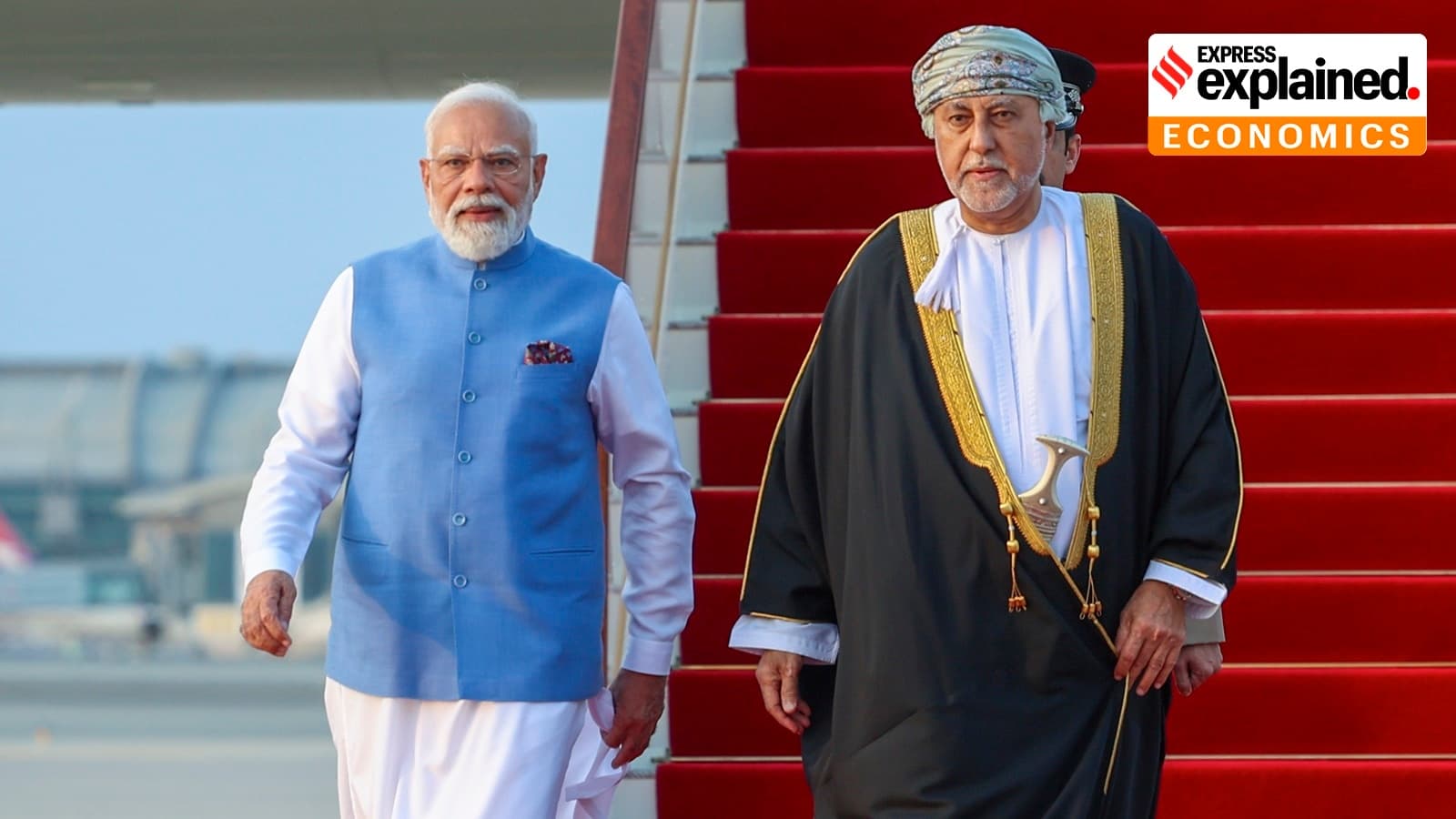


No article content available; unable to summarize Oman deal's impact on India's West Asia trade strategy.
Summary
The provided article content is explicitly stated as 'No content available'. Therefore, no specific details regarding the Oman deal or India's West Asia trade strategy can be extracted or summarized. This prevents any meaningful analysis of its significance for competitive exam preparation, as no facts, figures, or policy implications are present.
Key Points
- 1No specific details regarding the 'Oman deal' or its terms are available in the provided content.
- 2Information on India's West Asia trade strategy, including specific initiatives or agreements, cannot be extracted.
- 3The article explicitly states 'No content available', precluding the identification of key facts, dates, or figures.
- 4Without content, the precise nature of 'rising trade curbs in the West' and their influence remains unknown.
- 5No exam-relevant facts, such as names of officials, trade volumes, or specific policy changes, can be identified.
In-Depth Analysis
Despite the absence of specific content regarding the 'Oman deal' in the provided article, the title itself offers a robust framework for understanding a critical facet of India's evolving foreign policy and economic strategy: its intensified engagement with West Asia amidst growing global trade protectionism. This analysis will delve into the broader implications suggested by the title, focusing on India's strategic imperatives, historical context, and future trajectory in the region.
India's relationship with West Asia, particularly the Gulf Cooperation Council (GCC) countries including Oman, is deeply rooted in history, geography, and cultural exchange. For centuries, trade routes connected the Indian subcontinent with the Arabian Peninsula, fostering vibrant economic and social ties. In the post-independence era, this relationship gained new dimensions, primarily driven by India's burgeoning energy needs and the large Indian diaspora seeking employment opportunities in the oil-rich Gulf states. West Asia currently accounts for approximately 60% of India's crude oil imports and is a significant source of natural gas. Furthermore, the region hosts over 9 million Indian expatriates, whose remittances are a vital component of India's foreign exchange earnings, contributing tens of billions of dollars annually.
The implied 'Oman deal' in the title signifies a deepening of India's 'Look West' policy, which has evolved into a more proactive 'Act West' approach. This strategic pivot is driven by several factors. Firstly, the traditional reliance on Western markets for trade and investment is facing challenges due to 'rising trade curbs in the West.' These curbs manifest as increased protectionism, tariff barriers, non-tariff barriers, stricter regulatory frameworks, and geopolitical realignments that complicate global supply chains. The US-China trade war, Brexit, and various trade disputes have highlighted the vulnerability of over-reliance on a few major markets, pushing India to diversify its economic partnerships. Secondly, West Asia is not merely an energy supplier but a rapidly growing market for Indian goods and services, and a significant source of investment. Countries like Saudi Arabia, UAE, and Oman are undertaking massive economic diversification projects (e.g., Vision 2030 in Saudi Arabia, Vision 2040 in Oman), creating immense opportunities for Indian businesses in sectors like infrastructure, technology, healthcare, and education.
Key stakeholders in this evolving relationship include the Indian government (Ministry of External Affairs, Ministry of Commerce and Industry), Indian public and private sector enterprises, the Omani government (Ministry of Foreign Affairs, Ministry of Commerce, Industry and Investment Promotion), Omani businesses, and the Indian diaspora. For India, engaging with Oman is particularly strategic. Oman, situated at the mouth of the Strait of Hormuz, holds significant geopolitical importance for maritime security and trade routes. India and Oman elevated their relationship to a Strategic Partnership in 2008, followed by robust defence cooperation, including naval exercises (Naseem Al Bahr) and joint military training. Economic ties are substantial, with bilateral trade reaching approximately USD 12.38 billion in FY 2022-23. Indian companies have invested significantly in Oman, and Oman has invested in India, particularly in infrastructure and energy sectors.
This matters immensely for India's economic resilience and strategic autonomy. Diversifying trade away from potentially volatile Western markets enhances India's economic security. Deeper ties with West Asia also contribute to India's energy security, ensuring stable access to critical resources. Moreover, these partnerships are crucial for connectivity projects like the India-Middle East-Europe Economic Corridor (IMEC), announced at the G20 Summit in September 2023, which aims to create a new economic corridor connecting India to Europe via the UAE, Saudi Arabia, Jordan, and Israel. Such initiatives enhance India's geopolitical leverage and project its influence across a vital region. From a constitutional perspective, while there isn't a single article governing foreign policy, the Executive's power to conduct international relations stems from Article 73, and the Parliament's power to legislate on international agreements is enshrined in Article 253. The overall framework of India's foreign trade policy, governed by the Foreign Trade (Development and Regulation) Act, 1992, provides the legal basis for such deals.
Looking ahead, India's engagement with Oman and the broader West Asian region is poised to expand further. This includes increasing investments in renewable energy, digital transformation, and food security. India aims to position itself as a reliable partner, offering technological expertise, human resources, and a stable market. However, challenges remain, including regional geopolitical instabilities, fluctuating oil prices, and competition from other global powers like China. India's ability to navigate these complexities while maintaining its strategic autonomy will be crucial. The success of deals like the implied 'Oman deal' will be measured not just in trade volumes but in strengthening strategic partnerships that underpin India's rise as a global power.
Exam Tips
This topic falls under GS Paper II (International Relations - India and its neighborhood- relations; Bilateral, regional and global groupings and agreements involving India and/or affecting India’s interests) and GS Paper III (Economy - Indian Economy and issues relating to planning, mobilization of resources, growth, development and employment; Infrastructure: Energy, Ports, Roads, Airports, Railways etc.).
When studying India's foreign policy, always link economic drivers (energy security, trade diversification) with strategic objectives (regional influence, connectivity). Understand the 'Look West' / 'Act West' policy evolution.
Common question patterns include analytical essays on the significance of West Asia for India, challenges and opportunities in India-GCC relations, or the impact of global trade protectionism on India's foreign policy choices. Be prepared to cite specific initiatives like IMEC and I2U2.
Focus on the 'why' behind policy shifts. For example, why is India diversifying trade partners? What are the implications of rising trade curbs in the West for India's economic growth and foreign policy?
Study specific bilateral relations (e.g., India-UAE, India-Saudi Arabia, India-Oman) in detail, including trade volumes, investment flows, defence cooperation, and diaspora issues.