



Relevant for Exams
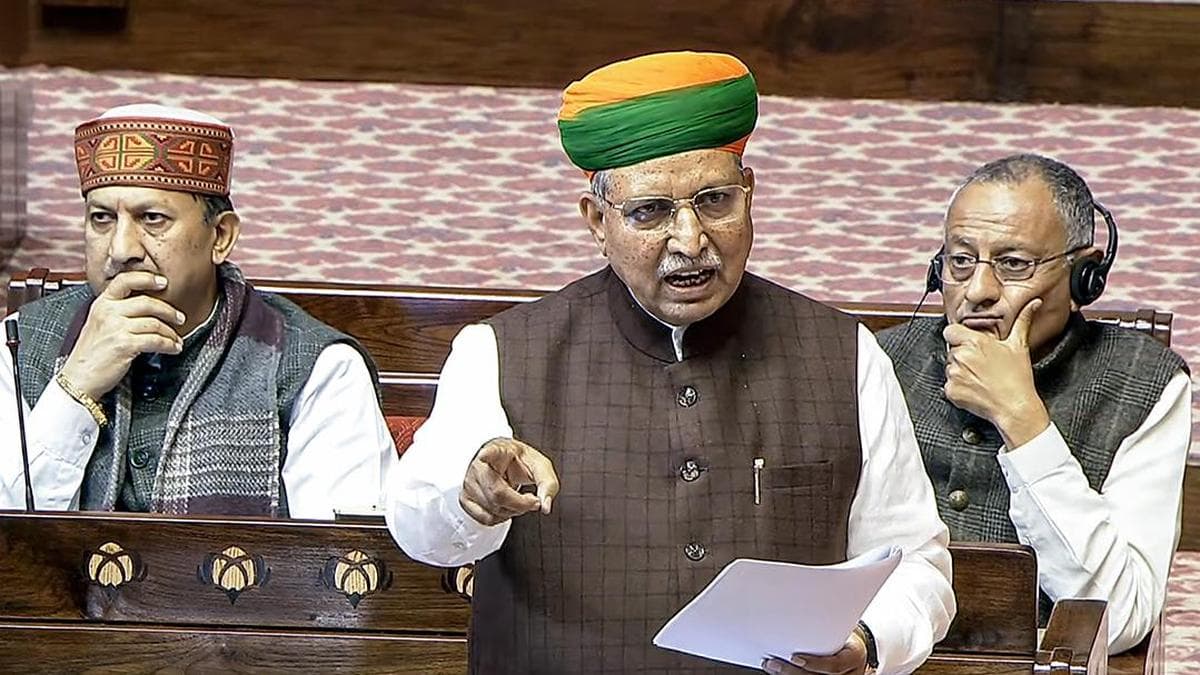
Law Minister Meghwal evades affidavit verification query, citing "sub judice" status.
Summary
Union Law Minister Arjun Ram Meghwal evaded a question from Congress president and Rajya Sabha MP Mallikarjun Kharge regarding the verification of candidates' affidavits during polls. The Minister cited the matter as "sub judice," meaning it is currently under judicial consideration. This highlights the constitutional principle limiting parliamentary discussion on ongoing legal cases and is relevant for understanding parliamentary procedures and legal terminology for competitive exams.
Key Points
- 1Union Law Minister Arjun Ram Meghwal responded to a parliamentary question.
- 2The question was posed by Congress president and Rajya Sabha MP Mallikarjun Kharge.
- 3The query concerned the verification process of candidates' affidavits during elections.
- 4Minister Meghwal cited the legal principle of "sub judice" for not responding.
- 5The "sub judice" principle restricts discussion on matters currently under judicial consideration in Parliament.
In-Depth Analysis
The recent instance where Union Law Minister Arjun Ram Meghwal declined to answer a parliamentary question on the verification of candidates' affidavits, citing the matter as 'sub judice,' offers a crucial insight into the intricate workings of India's democratic institutions. This seemingly simple parliamentary exchange encapsulates significant principles of governance, separation of powers, and electoral integrity, making it highly relevant for competitive exam aspirants.
**Background Context: The Purity of Elections and Candidate Affidavits**
At the heart of any robust democracy lies the sanctity of its electoral process. In India, the Election Commission of India (ECI), a constitutional body established under Article 324, is tasked with the superintendence, direction, and control of elections to Parliament, state legislatures, and the offices of President and Vice-President. A pivotal step towards ensuring transparency and informed voting was the Supreme Court's landmark judgment in the 2002 case of *Union of India v. Association for Democratic Reforms (ADR)*. This ruling mandated that all candidates contesting elections must file an affidavit disclosing their criminal antecedents, assets and liabilities, and educational qualifications. This disclosure is vital as it empowers voters to make informed choices and holds candidates accountable. However, the efficacy of this system hinges on the veracity of these affidavits, and concerns about false declarations have consistently plagued the electoral landscape.
**What Happened: A Parliamentary Evasion and a Constitutional Principle**
The incident involved Congress president and Rajya Sabha MP Mallikarjun Kharge posing a direct question to Union Law Minister Arjun Ram Meghwal concerning the verification process of these crucial candidate affidavits during elections. The Minister, rather than providing a direct answer, invoked the legal principle of 'sub judice.' 'Sub judice' is a Latin term meaning 'under judicial consideration' or 'before the court.' In parliamentary practice, this principle dictates that matters actively being heard or decided by a court of law should not be discussed in Parliament to avoid prejudicing the judicial proceedings or undermining the independence of the judiciary. This rule is enshrined in the Rules of Procedure and Conduct of Business in both Lok Sabha and Rajya Sabha, preventing parliamentary debate from becoming a parallel trial or influencing judicial outcomes.
**Key Stakeholders Involved: A Web of Institutions**
Several key players are central to this issue. Firstly, the **Union Law Minister (Executive)** represents the government and its stance, demonstrating the executive's adherence to parliamentary rules and respect for the judiciary. Secondly, **Mallikarjun Kharge (Legislature/Opposition)**, as an MP and leader of the opposition, exemplifies the legislature's role in seeking accountability from the executive and raising issues of public importance. Thirdly, **Parliament (Legislature)** itself, as the primary forum for debate and law-making, operates under specific procedural rules like the 'sub judice' principle to maintain order and respect for other branches of government. Fourthly, the **Election Commission of India (Constitutional Body)** is the ultimate authority responsible for ensuring the accuracy and verification of these affidavits, though its powers in this regard have been subject to judicial interpretation. Finally, the **Supreme Court/Judiciary** is the institution before which the matter is 'sub judice,' highlighting its crucial role in electoral reforms and upholding the rule of law. The **Voters/Public** are the ultimate beneficiaries or victims of the transparency and fairness of the electoral process.
**Significance for India: Upholding Democratic Values**
This incident is significant for several reasons. It underscores the delicate balance of **separation of powers** between the legislature, executive, and judiciary, a cornerstone of India's constitutional framework. The 'sub judice' rule is vital for protecting judicial independence and ensuring that parliamentary debates do not interfere with the administration of justice. Furthermore, it highlights the ongoing national concern regarding **electoral integrity** and the need for robust mechanisms to verify candidate information. The issue of false affidavits directly impacts **transparency in governance** and the quality of democratic representation. While the rule prevents immediate parliamentary discussion, it doesn't diminish the public's right to know or the need for a resolution through the judicial process.
**Historical Context and Constitutional Provisions**
The journey towards greater transparency in elections has been largely driven by judicial pronouncements. The Supreme Court's directives in the *ADR case (2002)* and subsequent judgments, like *PUCL v. Union of India (2003)*, have significantly expanded the scope of information candidates must disclose. These judgments are often seen as instances of **judicial activism**, filling legislative gaps to strengthen democracy. The **Representation of the People Act, 1951 (RPA)**, specifically Sections 33A and 33B, was amended following these judgments to incorporate the affidavit requirement, though the extent of ECI's power to verify these affidavits remains a point of contention and judicial scrutiny. The 'sub judice' rule itself is a convention rooted in parliamentary tradition and codified in the **Rules of Procedure and Conduct of Business** of both Houses of Parliament, ensuring that discussions do not prejudice ongoing legal proceedings.
**Future Implications: Towards Greater Accountability?**
The ongoing legal consideration of affidavit verification could lead to significant future implications. A potential Supreme Court ruling could further clarify or strengthen the ECI's powers to verify affidavits or even mandate specific mechanisms for verification, potentially leading to amendments in the RPA, 1951. This would enhance **electoral accountability** and potentially reduce the entry of candidates with questionable backgrounds. However, it also raises questions about the scope of judicial intervention in legislative and executive domains. The incident also serves as a reminder for Parliament to consider legislative measures that proactively address such transparency issues, rather than solely relying on judicial directives. Ultimately, the outcome will shape the future landscape of electoral transparency and the balance of power among India's democratic institutions.
Exam Tips
This topic falls under 'Indian Polity and Governance' for UPSC Civil Services (GS-II), SSC CGL/CHSL (General Awareness), and State PSCs. Focus on the roles and responsibilities of constitutional bodies like the ECI.
Study related topics such as the 'Representation of the People Act, 1951' (RPA), parliamentary procedures (Question Hour, 'sub judice' rule), landmark Supreme Court judgments on electoral reforms (e.g., ADR cases), and the concept of separation of powers.
Common question patterns include direct questions on the meaning and application of 'sub judice,' the powers of the ECI regarding candidate affidavits, the evolution of electoral reforms through judicial intervention, and the constitutional articles related to elections (e.g., Article 324).
Related Topics to Study
Full Article
Union Law Minister Arjun Ram Meghwal was responding to a question by Congress president and Rajya Sabha MP Mallikarjun Kharge