



Relevant for Exams
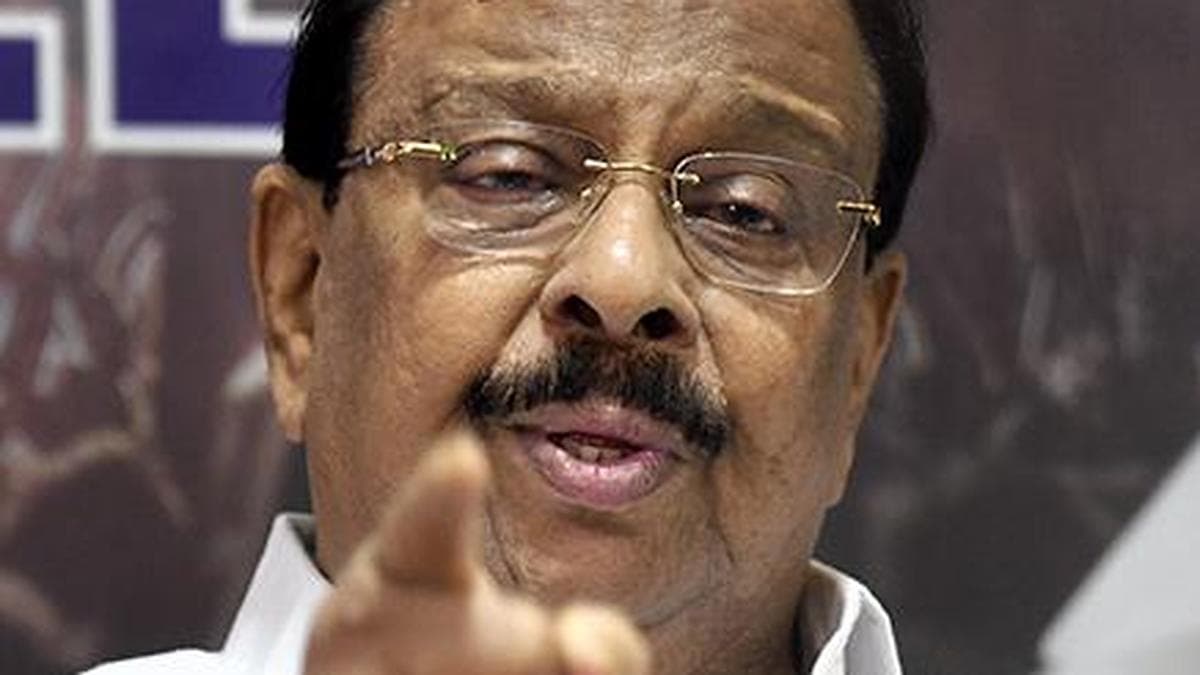
Former KPCC President K. Sudhakaran alleges Kerala CM Pinarayi Vijayan 'rattled' after local body election results.
Summary
Former KPCC president K. Sudhakaran alleged that Kerala CM Pinarayi Vijayan is 'rattled' by the fear of losing power. This statement follows the results of the Kerala local body elections, which Sudhakaran claimed 'shattered the Left's dream of a third Pinarayi government'. This news highlights internal state-level political dynamics and election outcomes, primarily relevant for state-specific competitive exams.
Key Points
- 1K. Sudhakaran, former President of the Kerala Pradesh Congress Committee (KPCC), made the allegations.
- 2The allegations were directed against Kerala Chief Minister Pinarayi Vijayan.
- 3The context for these political statements was the results of the recent Kerala local body elections.
- 4Sudhakaran claimed the election outcomes 'shattered the Left's dream of a third Pinarayi government'.
- 5The news reflects the ongoing political rivalry between the Congress and the Left Democratic Front (LDF) in Kerala.
In-Depth Analysis
Kerala's political landscape is famously dynamic, characterized by a unique phenomenon where power traditionally alternates between two major fronts: the Left Democratic Front (LDF), led by the Communist Party of India (Marxist) [CPI(M)], and the United Democratic Front (UDF), spearheaded by the Indian National Congress. This cyclical pattern was significantly broken in the 2021 Assembly elections when the LDF, under Chief Minister Pinarayi Vijayan, secured a historic second consecutive term, a feat unprecedented in nearly five decades. This victory was widely seen as a testament to the LDF government's handling of crises like the Nipah outbreak, floods, and the initial phase of the COVID-19 pandemic, alongside its welfare initiatives.
The recent statement by K. Sudhakaran, former President of the Kerala Pradesh Congress Committee (KPCC), alleging that CM Pinarayi Vijayan is "rattled" by the fear of losing power, comes in the wake of results from the Kerala local body elections. While the specific outcomes of these elections are not detailed in the given snippet, Sudhakaran's claim that they have "shattered the Left's dream of a third Pinarayi government" indicates a perceived setback for the ruling LDF. Local body elections in India, encompassing Panchayats and Municipalities, are often viewed as a crucial barometer of public sentiment, offering insights into the political mood ahead of state assembly or parliamentary elections.
Key stakeholders in this political drama include K. Sudhakaran, representing the primary opposition force, the UDF, whose statements aim to galvanize his party cadre and project an image of a weakening government. Chief Minister Pinarayi Vijayan, leading the CPI(M) and the LDF government, is the target of these allegations. His political stature and the LDF's recent electoral successes make any perceived vulnerability a significant talking point. The Kerala electorate, through their votes in these local elections, are the ultimate stakeholders, their choices reflecting shifting allegiances or endorsements of governance. The LDF and UDF, as the two dominant political coalitions, are constantly vying for control, making every election a high-stakes affair.
This development holds significant implications for India's federal structure and democratic health, particularly for Kerala. Local self-governance, enshrined in the Indian Constitution through the 73rd and 74th Amendment Acts of 1992, is the bedrock of grassroots democracy. These amendments introduced Part IX (Panchayats) and Part IXA (Municipalities) to the Constitution, mandating the establishment of Panchayati Raj Institutions (PRIs) and urban local bodies across states. Articles like 243G and 243W define the powers, authority, and responsibilities of these local bodies, empowering them to formulate and implement schemes for economic development and social justice. The State Election Commissions (under Articles 243K and 243ZA) oversee these elections, ensuring fairness and transparency.
For Kerala, known for its high human development indices and strong welfare orientation, the outcomes of local elections can influence state-level policy decisions, resource allocation, and the overall political narrative. A perceived erosion of support for the ruling LDF could prompt a re-evaluation of their strategies and policies, while bolstering the UDF's confidence. Historically, Kerala's unique political culture, characterized by high political awareness and active participation, means that local issues often resonate deeply, impacting state and even national politics.
Looking ahead, the implications are multi-faceted. If Sudhakaran's assessment holds true, the local body results could signify a potential shift in voter sentiment, posing challenges for the LDF's ambitions for continued dominance and possibly impacting the upcoming Lok Sabha elections in 2024. For the Congress and the UDF, any gains in local bodies would be a much-needed morale booster and a platform to rebuild their base for the 2026 Assembly elections. This political maneuvering highlights the constant struggle for power and the critical role of local governance in India's vibrant democracy. It underscores how even localized election results can send ripples through the broader political landscape, influencing state-level governance, electoral strategies, and the overall balance of power between competing fronts.
From a constitutional perspective, the functioning and electoral health of local bodies directly reflect the success of decentralization envisioned by the 73rd and 74th Amendments. Any political party's performance in these elections can be a report card on their commitment to empowering local institutions and delivering services at the grassroots level, which is a key aspect of good governance in India.
Exam Tips
This topic falls under 'Indian Polity' and 'Current Affairs' sections of the UPSC Civil Services Exam (Prelims and Mains GS-II) and State PSC exams. Focus on the constitutional provisions related to Local Self-Governance (73rd and 74th Amendments).
Study the structure, powers, and functions of Panchayati Raj Institutions and Urban Local Bodies. Understand the role of the State Election Commission (Article 243K, 243ZA) and State Finance Commission (Article 243I, 243Y).
Analyze the political dynamics of states, especially the alternating power phenomenon in Kerala. Questions often involve comparing state political models or the impact of regional parties on national politics. Be prepared for questions on the significance of local elections as political barometers.
Understand the historical context of local self-governance in India, from ancient times through the British era (e.g., Lord Ripon's Resolution of 1882) to post-independence reforms.
Practice questions that test your understanding of federalism and decentralization. Common question patterns include direct questions on constitutional articles, analytical questions on the challenges and successes of local self-governance, or scenario-based questions related to state-level political developments.
Related Topics to Study
Full Article
Former KPCC president says results of Kerala local body elections have ‘shattered the Left’s dream of a third Pinarayi government’