



Relevant for Exams
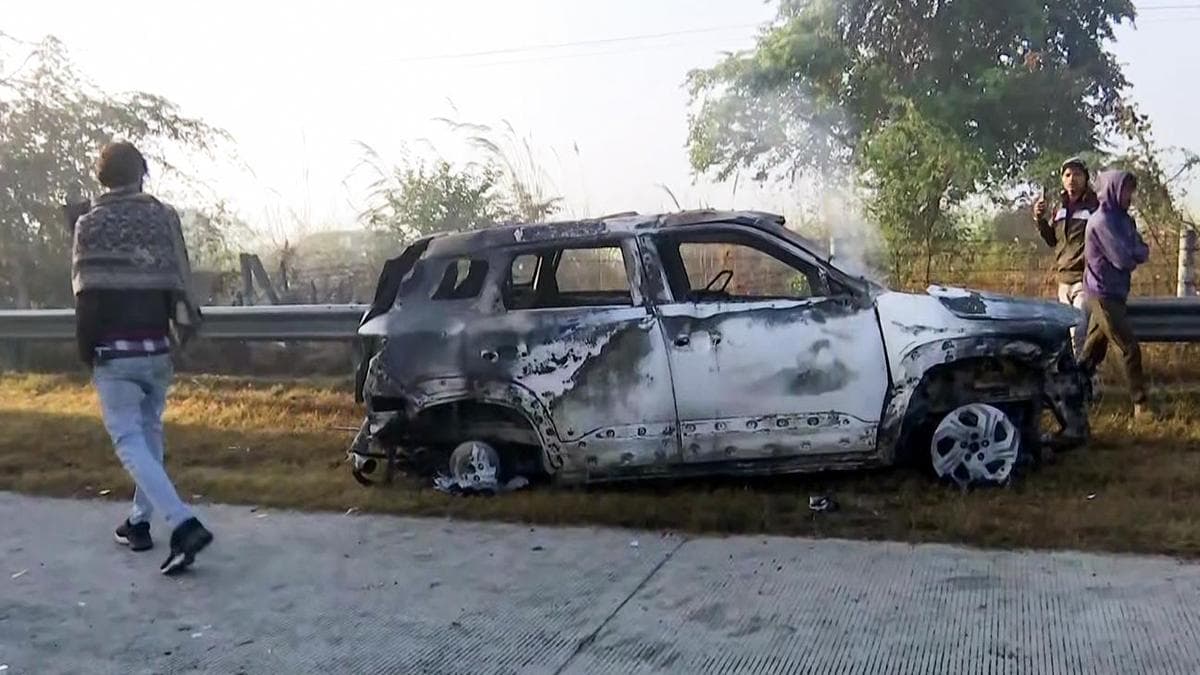
Yamuna Expressway pile-up near Mathura on Dec 16 claims 19 lives in multi-vehicle collision.
Summary
A tragic multi-vehicle pile-up occurred on December 16 on the Yamuna Expressway near Mathura, involving eight buses and two smaller vehicles, leading to 19 fatalities and a massive fire. This incident, while a regional news event, highlights critical issues of road safety and emergency response in India, which are important broader topics for competitive exam discussions on infrastructure, public safety, and disaster management. Specific details are relevant for general awareness sections.
Key Points
- 1The accident occurred on the Yamuna Expressway near Mathura.
- 2The pile-up took place on December 16.
- 3Eight buses and two smaller vehicles were involved in the collision.
- 4The incident triggered a massive fire.
- 5The death toll from the accident rose to 19.
In-Depth Analysis
The tragic multi-vehicle pile-up on the Yamuna Expressway near Mathura on December 16, involving eight buses and two smaller vehicles and resulting in 19 fatalities, serves as a grim reminder of India's persistent road safety challenges. While a localized event, it encapsulates broader systemic issues related to infrastructure, enforcement, emergency response, and public awareness that are critical for India's development trajectory.
**Background Context: India's Expanding Road Network and Safety Paradox**
India boasts one of the largest road networks in the world, critical for its economic growth and connectivity. The Yamuna Expressway, a 165 km six-lane access-controlled expressway connecting Greater Noida with Agra, is a prime example of modern infrastructure aimed at reducing travel time and boosting regional development. Inaugurated in 2012, it was built under a Public-Private Partnership (PPP) model by Jaypee Infratech. While such expressways offer speed and efficiency, they also present unique safety challenges, including high-speed collisions, driver fatigue, and sometimes inadequate safety features or enforcement. India consistently ranks among the top countries globally in terms of road accident fatalities, recording over 1.5 lakh deaths annually, costing the economy an estimated 3-5% of its GDP.
**The Incident and its Immediate Aftermath**
The December 16 accident was a catastrophic chain reaction, reportedly triggered by poor visibility (possibly fog) combined with high speeds and insufficient braking distances. The involvement of multiple heavy vehicles and the subsequent massive fire exacerbated the tragedy, making rescue operations challenging and contributing to the high death toll. Such incidents highlight not just the immediate causes but also underlying vulnerabilities in vehicle fitness, driver training, and emergency preparedness.
**Key Stakeholders and Their Responsibilities**
Several entities bear responsibility for road safety on expressways like the Yamuna Expressway. The **Uttar Pradesh Government** (through its Transport Department and Police) is responsible for law enforcement, traffic management, and providing emergency services (ambulances, fire tenders). The **Yamuna Expressway Industrial Development Authority (YEIDA)** acts as the regulatory body, overseeing the operations and safety standards of the expressway. The **concessionaire (Jaypee Infratech)** is contractually obligated to maintain the expressway, implement safety measures, manage traffic, and ensure quick emergency response. The **Ministry of Road Transport and Highways (MoRTH)** at the central level formulates national road safety policies and sets standards. Crucially, **drivers and passengers** are also stakeholders, with a responsibility to adhere to traffic rules, maintain vehicle fitness, and exercise caution.
**Significance for India: A National Crisis with Far-Reaching Impacts**
Road accidents are not merely isolated incidents but a national crisis with profound economic, social, and public health implications. Economically, they lead to loss of productive workforce, damage to property, and strain on healthcare systems. Socially, they cause immense grief, trauma, and often push families into poverty, especially when the deceased is a primary earner. For India, a young and developing nation, this loss of human capital is particularly devastating. The incident also brings into focus the challenges in disaster management and emergency response, questioning the preparedness and coordination among various agencies.
**Historical Context and Policy Evolution**
India's struggle with road safety has a long history. Early legislation like the **Motor Vehicles Act, 1988**, proved insufficient to curb the rising accident rates. Recognizing the escalating crisis, the government introduced the **National Road Safety Policy in 2010**, focusing on the '4 Es': Engineering (of roads and vehicles), Education, Enforcement, and Emergency Care. A significant step was the **Motor Vehicles (Amendment) Act, 2019**, which introduced stricter penalties for traffic violations, provisions for electronic monitoring, a national road safety board, and protection for Good Samaritans. Despite these efforts, implementation gaps and behavioral issues persist.
**Constitutional and Legal Framework**
While there isn't one specific constitutional article directly addressing road safety, several provisions are relevant. **Directive Principles of State Policy (DPSP)**, particularly **Article 47**, which mandates the State to raise the level of nutrition and the standard of living and to improve public health, implicitly covers public safety measures like road safety. The **Seventh Schedule** of the Constitution places 'Roads' under the State List (List II, Entry 13) and 'National Highways' under the Union List (List I, Entry 23), indicating shared responsibilities. 'Motor Vehicles' falls under the Concurrent List (List III, Entry 35), allowing both central and state governments to legislate. This necessitates strong coordination. Furthermore, **Article 51A (Fundamental Duties)**, particularly the duty to strive towards excellence and protect public property, can be linked to responsible civic behavior on roads.
**Future Implications and Way Forward**
The Mathura pile-up underscores the urgent need for a multi-pronged approach. This includes: (1) **Enhanced Enforcement**: Stricter monitoring of speed limits, drunken driving, and fatigue, especially on expressways. (2) **Technological Adoption**: Implementation of Intelligent Transport Systems (ITS), advanced warning systems for fog/hazards, and AI-based surveillance. (3) **Improved Infrastructure Design**: Safer road engineering, better signage, rumble strips, and adequate rest areas. (4) **Public Awareness and Education**: Continuous campaigns to instill a culture of road safety. (5) **Strengthened Emergency Response**: Faster ambulance services, well-equipped trauma centers along expressways, and better coordination among police, fire, and medical teams. Accountability of private concessionaires for safety standards must also be rigorously enforced to prevent such tragedies in the future and ensure India's economic progress is not undermined by preventable human loss.
Exam Tips
This topic falls under GS Paper II (Governance, Social Justice, Public Policy) and GS Paper III (Disaster Management, Infrastructure, Internal Security) for UPSC. For SSC/State PSCs, it's relevant for General Awareness and Current Affairs.
Study related topics like the Motor Vehicles (Amendment) Act, 2019, National Road Safety Policy, 2010, Disaster Management Act, 2005, and the role of Public-Private Partnerships (PPPs) in infrastructure development. Understand the '4 Es' of road safety.
Common question patterns include: analytical questions on the causes of road accidents in India and proposed solutions; factual questions on specific acts, policies, or committees related to road safety; and essay-type questions on the socio-economic impact of road accidents and the way forward for India.
Related Topics to Study
Full Article
The accident occurred on December 16 when eight buses and two smaller vehicles collided on the expressway, triggering a massive fire