

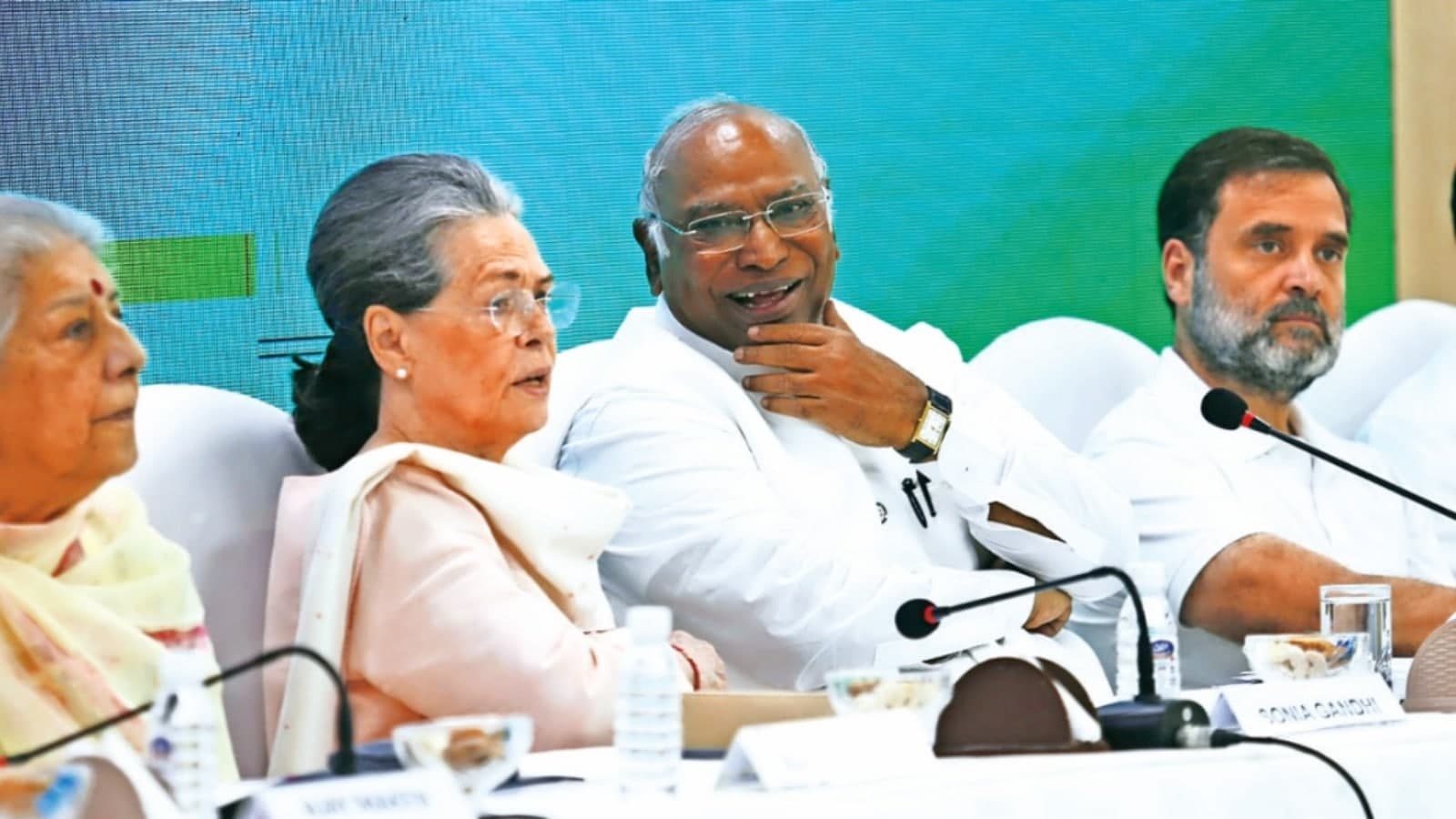


Content unavailable for CWC meet on Dec 27 for nationwide stir against Bill.
Summary
The article's content is unavailable, preventing a detailed summary of the CWC meeting on December 27 regarding a nationwide stir against an unspecified Bill. Without specific information on the nature of the Bill, the CWC's exact plans, or the political context, its significance for competitive exams cannot be assessed or summarized accurately.
Key Points
- 1No content available for extraction of specific facts regarding the CWC meeting.
- 2No specific dates, names, or details about the 'Bill' or 'nationwide stir' could be identified.
- 3Information on the CWC's agenda, decisions, or the target of the stir is missing.
- 4The article lacks factual basis to identify constitutional/legal provisions or specific numbers.
- 5Without content, no exam-relevant MCQs can be formulated from this article.
In-Depth Analysis
The provided article, referencing a Congress Working Committee (CWC) meeting on December 27 to plan a nationwide stir against an unspecified Bill, lacks specific content. Therefore, this analysis will proceed by examining the broader implications and context surrounding such an event within India's democratic framework, rather than detailing a specific Bill or protest.
**Background Context: The Role of Opposition and Legislative Process**
In a vibrant democracy like India, the opposition plays a crucial role in holding the government accountable and representing alternative viewpoints. When the government introduces a Bill, it goes through a rigorous legislative process involving introduction, debate, committee scrutiny, and voting in both Houses of Parliament (Lok Sabha and Rajya Sabha). However, if an opposition party, particularly a major one like the Indian National Congress, perceives a Bill as detrimental to public interest, unconstitutional, or against the spirit of federalism, it often resorts to various forms of protest. Historically, nationwide stirs have been powerful tools to mobilize public opinion and pressure the government. Examples range from the anti-Emergency movement in the 1970s to more recent protests against the Citizenship Amendment Act (CAA) in 2019-2020 or the Farm Laws in 2020-2021.
**What Generally Happens in Such Scenarios**
The CWC, as the highest decision-making body of the Indian National Congress, meeting to 'chalk out a nationwide stir' signifies a serious escalation of opposition to a particular legislative proposal. Such a meeting would involve extensive deliberation on the Bill's provisions, its potential impact, and the strategy for public mobilization. A 'nationwide stir' typically encompasses a range of activities, including public rallies, demonstrations, dharnas, press conferences, social media campaigns, and possibly calls for bandhs (strikes) or chakka jams (road blockades). The objective is to create widespread awareness, garner public support, and compel the government to reconsider or withdraw the contentious Bill.
**Key Stakeholders Involved**
1. **The Congress Working Committee (CWC):** As the primary initiator, their strategy and unity are paramount. Their ability to articulate the reasons for the protest and mobilize party cadres across states is crucial.
2. **The Government (Executive and Legislature):** The ruling dispensation, responsible for drafting and passing the Bill. Their response could range from engaging in dialogue, offering amendments, or standing firm on the Bill's provisions.
3. **Citizens/Public:** The ultimate beneficiaries or sufferers of any legislation. Their participation and support determine the success and impact of a nationwide stir.
4. **Other Opposition Parties:** Often, major protests against Bills see convergence of various opposition parties, forming a united front to amplify their voice.
5. **Media:** Plays a critical role in disseminating information, shaping public discourse, and bringing the protest to national attention.
6. **Law Enforcement Agencies:** Responsible for maintaining law and order during protests, ensuring peaceful demonstrations while preventing violence or damage to public property.
**Significance for India**
Such events are vital for the health of Indian democracy. They underscore the importance of dissent and the right to protest as fundamental tenets. Politically, they test the government's resolve and the opposition's strength and unity. Socially, they can bring various sections of society together or create divisions, depending on the nature of the Bill. Economically, prolonged nationwide stirs can lead to disruptions in trade, transport, and daily life, impacting local economies. Moreover, the outcome of such a stir can have significant implications for future policy-making, potentially influencing electoral outcomes and the political landscape.
**Constitutional Provisions and Legal Framework**
Several constitutional articles underpin the right to protest and the legislative process:
* **Article 19(1)(a):** Guarantees the right to freedom of speech and expression.
* **Article 19(1)(b):** Guarantees the right to assemble peacefully and without arms.
* These rights, however, are not absolute and are subject to reasonable restrictions under Article 19(2) and 19(3) in the interest of public order, sovereignty and integrity of India, etc.
* **Article 21:** Guarantees the right to life and personal liberty, which the Supreme Court has interpreted to include various aspects necessary for a dignified life, implicitly supporting the right to protest non-violently.
* **Articles 107-111:** Outline the ordinary legislative procedure for passing Bills in Parliament.
* **Articles 245-246 & Seventh Schedule:** Define the distribution of legislative powers between the Union and States, which becomes particularly relevant if a Bill is perceived to infringe upon state autonomy or federal principles.
* **Prevention of Damage to Public Property Act, 1984:** This Act is often invoked during protests where public property is damaged, highlighting the legal boundaries within which demonstrations must operate.
**Future Implications**
The success or failure of a nationwide stir against a Bill can have several ripple effects. If the protest gains significant traction, the government might be compelled to reconsider the Bill, introduce amendments, or even withdraw it. This would empower the opposition and demonstrate the strength of public opinion. Conversely, if the stir fizzles out, it could weaken the opposition's credibility and embolden the government. Such events also set precedents for future legislative challenges and public movements, shaping the dynamics between the ruling party, opposition, and civil society. Ultimately, they contribute to the ongoing evolution of India's democratic practices and the balance of power within its political system.
Exam Tips
This topic falls under 'Indian Polity and Governance' (UPSC Mains GS-II, State PSCs, SSC CGL). Focus on the roles of political parties, the legislative process, and fundamental rights.
Study related topics like the functions of the CWC, the procedure for passing ordinary bills and constitutional amendment bills, and the concept of federalism in India. Understand the difference between a political party's internal decision-making body and its legislative role.
Common question patterns include: 'Discuss the role of opposition in a democracy with special reference to recent legislative challenges.' 'Analyze the constitutional provisions related to the right to protest in India.' 'Examine the impact of nationwide stirs on policy-making and governance.' Be prepared to write analytical answers, not just factual recall.