

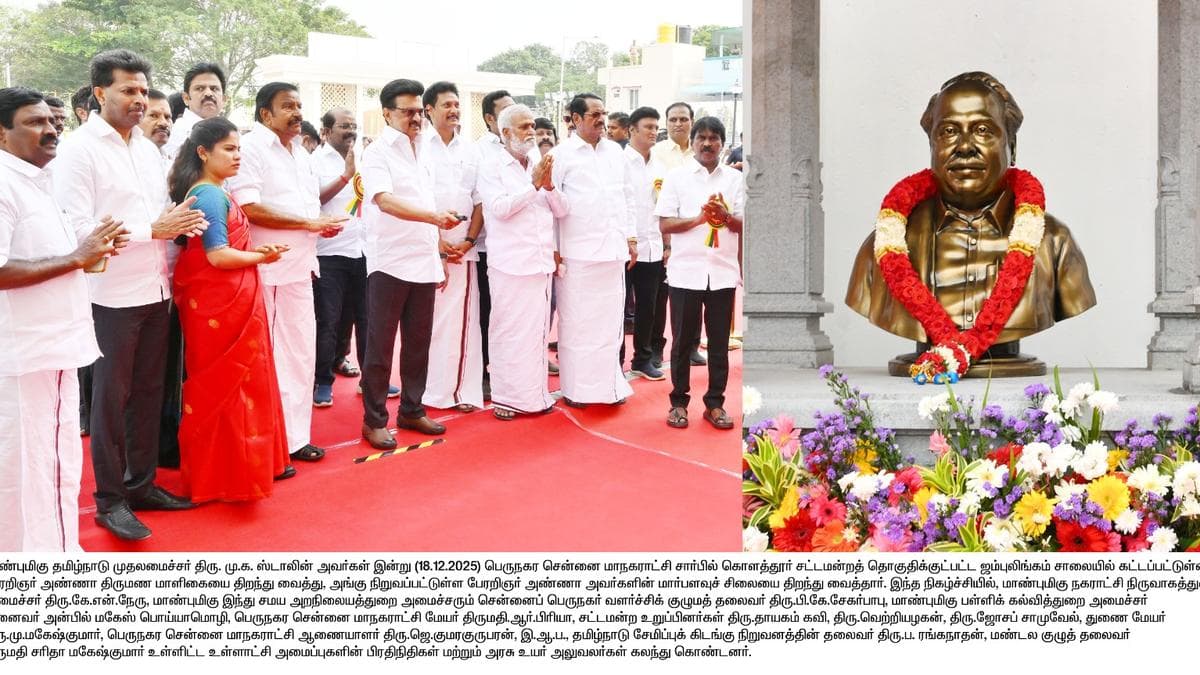


CM Stalin's Kolathur project inauguration: No content available for analysis.
Summary
The article lacks content, preventing a detailed summary of CM Stalin's new project inaugurations in Kolathur. Without specific project details, it's impossible to assess their impact, significance, or exam relevance for competitive exam preparation.
Key Points
- 1Article content regarding CM Stalin's new project inaugurations in Kolathur is unavailable.
- 2Specific details such as project names, costs, beneficiaries, or dates cannot be extracted.
- 3For competitive exams, precise facts about government projects are crucial for General Awareness sections.
- 4Without content, the policy implications or developmental significance of these projects cannot be analyzed.
- 5Such regional news, if detailed, would primarily be relevant for State Public Service Commission exams.
In-Depth Analysis
While the specific details of CM Stalin's new project inaugurations in Kolathur are unavailable, this event provides an excellent opportunity to understand the broader context of state government initiatives, their significance in India's federal structure, and their relevance for competitive exams. Such inaugurations are not mere ceremonial events; they represent the culmination of policy planning, resource allocation, and implementation by state administrations, directly impacting the lives of citizens.
**Background Context and What Happened (General Perspective):**
In India's federal system, state governments play a crucial role in socio-economic development. Chief Ministers, as the elected heads of state governments, frequently inaugurate various projects spanning infrastructure, public welfare, education, health, and urban development. These projects are typically initiated after extensive planning, budget allocation through the state assembly, and execution by various government departments. The 'inauguration' signifies the project's completion and its opening for public use, often aligning with the government's electoral promises and developmental agenda. For instance, a CM might inaugurate a new flyover, a water treatment plant, a school building, a primary healthcare center, or a housing scheme. While the specific Kolathur projects are unknown, they would undoubtedly fall into one of these categories, reflecting the state government's commitment to local development and public service delivery.
**Key Stakeholders Involved:**
Several key stakeholders are involved in such initiatives. The primary stakeholder is the **State Government**, led by the **Chief Minister** (e.g., M.K. Stalin in Tamil Nadu), which conceives, funds, and oversees these projects. The **Bureaucracy and Administrative Machinery** (e.g., various state departments like Public Works, Urban Development, Health, Education) are responsible for the detailed planning, tendering, execution, and quality control of the projects. **Local Self-Governments** (Panchayats or Municipalities, like the one governing Kolathur) often play a crucial role in identifying local needs, facilitating land acquisition, and sometimes even co-implementing projects. The ultimate **Beneficiaries** are the citizens residing in the project area, who directly benefit from improved infrastructure or services. Finally, **Contractors and Private Sector Entities** are often involved in the actual construction and maintenance of these projects, operating under government contracts.
**Significance for India:**
Such state-level project inaugurations hold immense significance for India. Firstly, they are a testament to **India's federal structure**, where states have significant autonomy and responsibility in areas vital for public welfare, as enshrined in the Seventh Schedule of the Constitution (State List, e.g., Public Health and Sanitation, Local Government, Roads, Water Supply, Industries). Secondly, these projects are critical for **inclusive growth and regional development**, aiming to bridge infrastructure gaps and improve living standards, especially in underserved areas. They contribute to **economic activity** by creating employment opportunities (both direct and indirect), stimulating local businesses, and improving connectivity and productivity. Politically, inaugurations allow governments to showcase their performance, fulfill electoral mandates, and strengthen their public image, reinforcing **democratic accountability**. From a governance perspective, they highlight the government's capacity to plan, fund, and execute large-scale initiatives, which is crucial for maintaining public trust.
**Historical Context and Constitutional Provisions:**
Post-independence, India adopted a planned development approach, with both central and state governments undertaking large-scale projects. The **First Five-Year Plan (1951-56)** and subsequent plans emphasized state-led development in sectors like irrigation, power, education, and health. The **73rd and 74th Constitutional Amendment Acts of 1992** further decentralized power by constitutionally recognizing Panchayati Raj Institutions and Urban Local Bodies, empowering them to plan and implement schemes for economic development and social justice (as per **Articles 243G and 243W**). The **Directive Principles of State Policy (DPSP)**, particularly **Articles 38, 39, and 47**, guide state governments to promote the welfare of the people, ensure a just social order, and raise the level of nutrition, standard of living, and public health. State budgets, framed annually, are the financial blueprints that allocate funds for these projects, often supplemented by central grants as part of fiscal federalism.
**Future Implications:**
The continued focus on state-led development projects has several future implications. It underscores the importance of **fiscal federalism** and efficient resource allocation to ensure states have adequate funds for their developmental goals. The success of these projects is vital for achieving India's broader development targets, including the Sustainable Development Goals (SDGs). Future trends might see a greater emphasis on **smart infrastructure, green initiatives, and technology integration** in project planning and execution. Moreover, the performance of state governments in delivering projects effectively and transparently will continue to be a significant factor in electoral outcomes and public perception, driving demand for greater accountability and public participation in governance. The balance between central guidance (e.g., NITI Aayog's role) and state autonomy in project selection and implementation will remain a key aspect of India's developmental trajectory.
Exam Tips
This topic falls under 'Indian Polity & Governance', 'Social Justice', 'Economy' (especially State Finances & Developmental Schemes) and 'Current Events of State Importance' in competitive exam syllabi. Focus on the structural aspects of governance.
Study related topics such as Federalism (Centre-State relations, Seventh Schedule), Local Self-Government (Panchayati Raj & Urban Local Bodies – 73rd & 74th Amendments), Directive Principles of State Policy (DPSP), and State Budgeting/Fiscal Federalism alongside this. Understand how these concepts enable or constrain state actions.
Common question patterns include: 'Which Constitutional Amendment Act empowered ULBs with specific functions?', 'Which list of the Seventh Schedule contains subjects like Public Health and Sanitation?', 'What is the primary objective of DPSP?', or 'Analyze the role of state governments in India's developmental trajectory.' For state-specific exams, factual questions about specific projects or schemes might be asked if details are available.