



Relevant for Exams
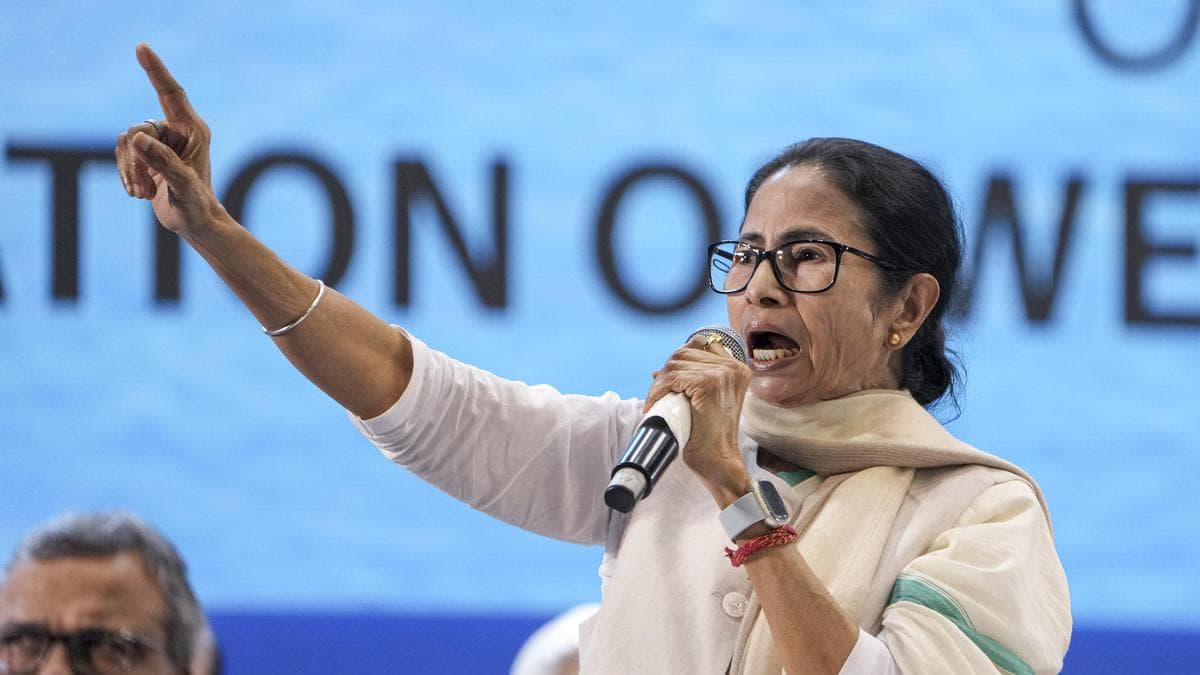
West Bengal CM Mamata Banerjee to rename state job scheme after Gandhi, slams Centre over 'G RAM G bill'.
Summary
West Bengal Chief Minister Mamata Banerjee announced plans to rename a state job scheme after Mahatma Gandhi, criticizing the Centre over the 'G RAM G bill'. This move highlights a political dispute between the state and central governments regarding national icons and the implementation of welfare schemes. For competitive exams, it signifies the ongoing political dynamics between states and the Centre, particularly concerning centrally sponsored schemes and their branding.
Key Points
- 1West Bengal Chief Minister Mamata Banerjee announced the renaming of a state job scheme.
- 2The state job scheme is proposed to be renamed after Mahatma Gandhi.
- 3The decision came amidst CM Banerjee's criticism of the Centre over the 'G RAM G bill'.
- 4CM Banerjee stated the action was to show respect to national icons, without directly naming BJP.
- 5This move signifies a political contention between the West Bengal government and the Central government.
In-Depth Analysis
The announcement by West Bengal Chief Minister Mamata Banerjee to rename a state job scheme after Mahatma Gandhi, amidst criticism of the Centre over the 'G RAM G bill', is a significant development that encapsulates several crucial aspects of Indian federalism, welfare policy, and political symbolism. This move, while seemingly local, has profound implications for Centre-State relations and the implementation of social security programs across the nation.
**Background Context: The Genesis of MGNREGA and Centre-State Dynamics**
At the heart of this political contention lies the Mahatma Gandhi National Rural Employment Guarantee Act (MGNREGA), 2005. This landmark legislation, initially known as NREGA, was enacted to provide a legal guarantee of 100 days of wage employment in a financial year to adult members of any rural household willing to do unskilled manual work. It aims to enhance livelihood security in rural areas, reduce distress migration, and create durable assets. MGNREGA is a centrally sponsored scheme, meaning the central government provides a significant portion of the funding (e.g., 100% of the wage cost for unskilled labour and 75% of the material cost) while states are responsible for implementation, administrative costs, and their share of material costs. This funding structure inherently creates a dependency and, at times, friction between the Centre and states over resource allocation, timely release of funds, and compliance with guidelines.
Over the past few years, there have been recurring disputes regarding MGNREGA, particularly concerning the release of funds by the Centre to states, especially those governed by opposition parties. West Bengal, in particular, has seen significant delays in the release of MGNREGA funds, with the Centre citing alleged irregularities in the implementation and auditing of the scheme. This has led to a standoff, impacting the livelihoods of millions of rural workers in the state. The 'G RAM G bill' mentioned by CM Banerjee likely refers to the central government's efforts to reform or modify aspects of MGNREGA, or perhaps even a branding initiative related to the scheme, which the state perceives as an encroachment or an attempt to dilute the scheme's original spirit or its state-level identity.
**What Happened: A Political Counter-Move**
In response to the perceived central neglect and alleged attempts to undermine MGNREGA, CM Mamata Banerjee announced that a state-specific job scheme would be renamed after Mahatma Gandhi. This is a direct political counter-move. By associating a state scheme with Mahatma Gandhi, Banerjee aims to reclaim the moral high ground and assert the state's commitment to welfare and national ideals, implicitly criticizing the Centre's actions. The statement, "if some political parties failed to show respect to our national icons, we will do it," without directly naming the BJP, clearly signals a broader political narrative where the Trinamool Congress (TMC) government positions itself as the true custodian of national values, contrasting with the central government's approach.
**Key Stakeholders Involved:**
1. **West Bengal Government (Trinamool Congress)**: Led by CM Mamata Banerjee, they are asserting state autonomy, criticizing central policies, and using political symbolism to rally support and highlight perceived injustices in funding and policy implementation.
2. **Central Government (BJP-led)**: They are the primary funder and policy-maker for MGNREGA. Their perspective often involves ensuring accountability, preventing corruption, and promoting national branding for centrally sponsored schemes. The alleged delays in fund release are part of this dynamic.
3. **Rural Labourers/Beneficiaries in West Bengal**: These are the ultimate recipients of the job scheme. Delays in fund release or political disputes directly impact their access to guaranteed employment and wages, leading to economic hardship.
4. **Mahatma Gandhi's Legacy**: As a national icon, his name is often invoked in political discourse to lend legitimacy and moral authority to various initiatives. The renaming is a strategic use of his legacy.
**Why This Matters for India: Federalism, Welfare, and Political Symbolism**
This incident is a prime example of the complexities of **Indian federalism**. The friction over centrally sponsored schemes, funding, and branding reflects the ongoing tension between cooperative and competitive federalism. States often feel that central schemes, while beneficial, come with restrictive guidelines and inadequate funding, infringing upon their autonomy in areas like rural development, which falls under the State List (Entry 9, Public order; Entry 20, Economic and Social Planning in Concurrent List also relevant). Article 282 of the Constitution allows the Union or a State to make grants for any public purpose, which is often the basis for centrally sponsored schemes, but it doesn't resolve the political disputes over their implementation.
Furthermore, it highlights the politicization of **welfare schemes**. MGNREGA is a critical safety net, particularly for vulnerable populations. Any disruption or political tussle over its implementation can have severe socio-economic consequences, potentially undermining its effectiveness in poverty alleviation and rural development. The use of national icons for political branding also raises questions about the sanctity of such figures and their deployment in partisan battles.
**Future Implications:**
This move could set a precedent for other states to rename or launch their own versions of centrally sponsored schemes, leading to further fragmentation in welfare delivery and increased federal friction. It signals a hardening of positions between the West Bengal government and the Centre, potentially impacting other areas of cooperation. For beneficiaries, it creates uncertainty and could lead to a dual system of job guarantees if the state's scheme functions in parallel to a potentially revived MGNREGA. The broader debate on the branding and implementation of centrally sponsored schemes will likely intensify, forcing a re-evaluation of the current financial and administrative architecture of such programs.
This incident underscores the need for greater clarity, transparency, and a spirit of genuine cooperative federalism in the design and execution of welfare policies to ensure that the ultimate beneficiaries are not caught in political crossfire. The constitutional framework, particularly the division of powers under the Seventh Schedule, provides the structure, but political will and mutual respect are essential for its smooth functioning.
Exam Tips
This topic falls under GS Paper II (Polity & Governance: Indian Constitution—Federalism, Centre-State Relations; Social Justice—Government Schemes and their performance).
Study the Mahatma Gandhi National Rural Employment Guarantee Act (MGNREGA), 2005, in detail: its objectives, features, funding pattern, implementation challenges, and impact. Also, understand the difference between Centrally Sponsored Schemes and Central Sector Schemes.
Prepare for analytical questions on Centre-State financial relations, the concept of cooperative vs. competitive federalism, and the challenges in implementing welfare schemes across different states. Questions might also involve the role of national icons in political discourse.
Be aware of relevant constitutional articles, such as Article 246 (Seventh Schedule - distribution of legislative powers), Article 282 (grants for public purposes), and Directive Principles of State Policy (DPSP) like Article 41 (Right to work).
Practice essay questions on the effectiveness of MGNREGA, challenges to federalism in India, or the politicization of welfare programs.
Related Topics to Study
Full Article
West Bengal CM said if some political parties “failed to show respect to our national icons, we will do it”, without directly naming the BJP