



Relevant for Exams
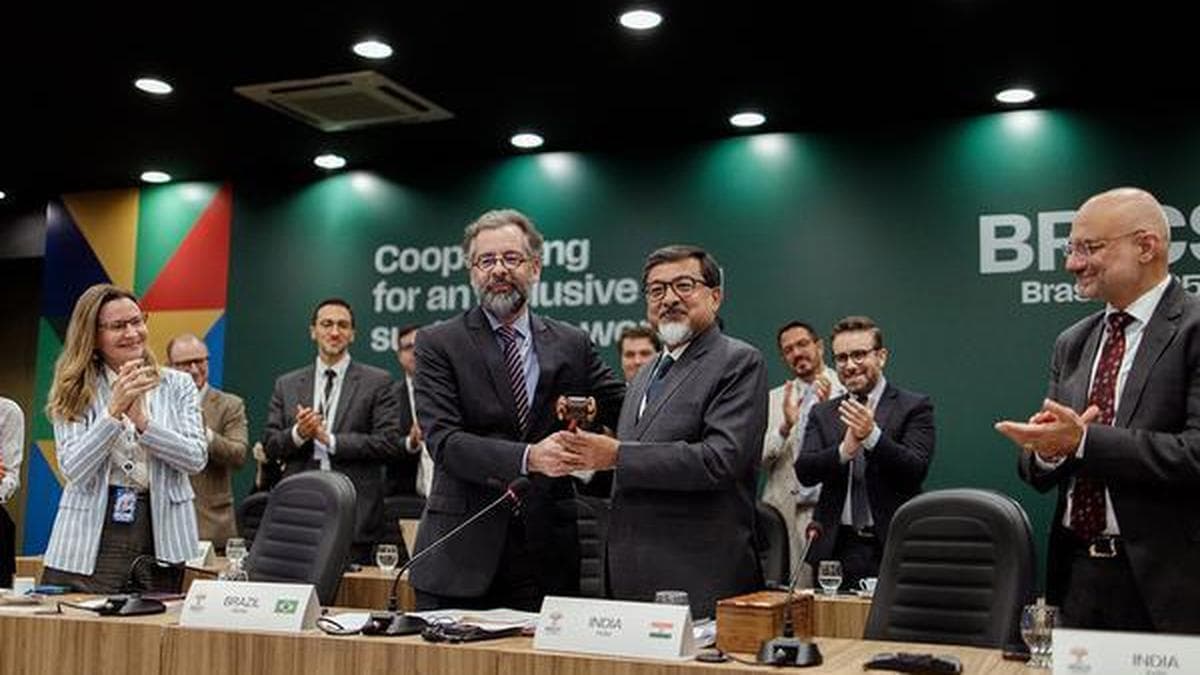
Brazil hands BRICS presidency to India, continuing focus on sustainability and inclusive development.
Summary
Brazil has concluded its BRICS presidency, marked by efforts towards sustainability and inclusive development amidst global challenges like wars and tariffs. India has now assumed the presidency, signaling a continuation of these ambitious goals for the influential economic bloc. This transition is crucial for understanding current international relations and economic cooperation for competitive exams.
Key Points
- 1Brazil concluded its presidency of the BRICS group.
- 2India has assumed the presidency of the BRICS group.
- 3Brazil's BRICS presidency focused on themes of sustainability and inclusive development.
- 4Brazil's term was impacted by global challenges, including 'multiple wars' and 'Trump’s slew of tariffs'.
- 5India's presidency is set to continue the path of sustainability and inclusive development.
In-Depth Analysis
The transition of the BRICS presidency from Brazil to India marks a significant moment for this influential economic and political grouping, especially amidst a complex global landscape. BRICS, an acronym for Brazil, Russia, India, China, and South Africa, was initially coined by Goldman Sachs economist Jim O'Neill in 2001 to describe the four emerging economies (BRIC) that were expected to dominate global growth. South Africa joined in 2010, expanding it to BRICS. The bloc formally began with the first BRIC summit in Yekaterinburg, Russia, in 2009. Its primary objective has been to promote peace, security, development, and cooperation, contributing significantly to the development of humanity and establishing a more equitable and fair world.
Brazil's presidency, which concluded recently, was indeed challenging. It navigated a period marked by significant global headwinds, including the economic repercussions of 'multiple wars' (such as the Russia-Ukraine conflict and others impacting global supply chains and energy markets) and the 'slew of tariffs' initiated by the Trump administration, which triggered global trade tensions. Despite these obstacles, Brazil commendably focused its agenda on critical themes like 'sustainability and inclusive development'. This emphasis underscored the bloc's commitment to addressing pressing global issues beyond mere economic growth, promoting environmental stewardship, and ensuring that development benefits all segments of society, not just a select few. Brazil's stewardship helped maintain the bloc's momentum and relevance during a turbulent phase in international relations.
Now, India has assumed the presidency, signaling a continuity in these ambitious goals. India's approach is expected to build upon Brazil's foundational work, further cementing the bloc's role in advocating for the Global South. The key stakeholders involved are, of course, the five member nations: Brazil, Russia, India, China, and South Africa. Each nation brings its unique economic strengths, geopolitical interests, and regional influence to the table. Russia, a major energy producer; China, the world's second-largest economy; India, a rapidly growing market and democratic voice; Brazil, a South American powerhouse; and South Africa, representing the African continent. The collective strength of these nations offers an alternative voice to traditional Western-dominated global institutions, promoting a multi-polar world order. The New Development Bank (NDB), established by BRICS in 2014, headquartered in Shanghai, is another crucial stakeholder, providing financial support for infrastructure and sustainable development projects in member and other developing countries.
This transition holds immense significance for India. Economically, BRICS provides a platform for India to enhance trade, investment, and economic cooperation with other major emerging economies, diversifying its economic partnerships and reducing reliance on traditional markets. Politically, India's leadership role within BRICS elevates its stature on the international stage, reinforcing its position as a responsible global actor and a voice for developing nations. It aligns with India's broader foreign policy objectives of promoting South-South cooperation and reforming global governance structures. India's emphasis on inclusive development and sustainability within BRICS resonates with its domestic policy initiatives like the 'Sustainable Development Goals' (SDGs) and its commitment to climate action, as outlined in its Nationally Determined Contributions (NDCs) under the Paris Agreement.
Historically, BRICS has evolved from an investment concept to a formal intergovernmental organization, showcasing the growing influence of emerging economies. Its establishment of the Contingent Reserve Arrangement (CRA) in 2014, designed to provide protection against global liquidity pressures, further highlights its ambition to create alternative financial architecture. India's foreign policy is guided by Article 51 of the Constitution, a Directive Principle of State Policy, which mandates the State to 'endeavour to promote international peace and security; maintain just and honourable relations between nations; foster respect for international law and treaty obligations... and encourage settlement of international disputes by arbitration.' India's active participation and leadership in BRICS directly align with these constitutional imperatives, promoting cooperation and multilateralism.
Looking ahead, India's presidency will likely focus on strengthening intra-BRICS cooperation, potentially exploring avenues for local currency trade to de-dollarize global transactions, and expanding the 'BRICS+' outreach to include more developing countries. Challenges remain, including internal differences among members on certain geopolitical issues, and external pressures from established powers. However, the bloc's continued focus on sustainability, digital transformation, and inclusive growth positions it as a vital platform for addressing global challenges and advocating for the interests of the Global South. India's leadership will be crucial in steering BRICS towards greater cohesion and effectiveness, contributing to a more balanced and equitable global order. The outcomes of India's presidency will have far-reaching implications for global economic governance, climate action, and the future of multilateralism.
Exam Tips
This topic falls under the 'International Relations' and 'Indian Economy' sections of the UPSC Civil Services Exam syllabus (GS Paper II and III). For SSC, Banking, and State PSCs, it's relevant for General Awareness/Current Affairs.
Study related topics such as the New Development Bank (NDB), South-South Cooperation, India's foreign policy objectives (e.g., Act East Policy, Neighbourhood First Policy), and the concept of Multilateralism and Global Governance. Understand the differences and similarities between BRICS, G7, G20, and SCO.
Common question patterns include: MCQs on the founding year of BRICS, its members, location of NDB headquarters, or key initiatives. Descriptive questions might ask about the significance of BRICS for India, its challenges and opportunities, or its role in promoting a multi-polar world order.
Related Topics to Study
Full Article
Brazil’s presidency of BRICS was punctuated by the aftereffects of multiple wars and Trump’s slew of tariffs, among other challenges; yet, it worked towards sustainability and inclusive development, effectively steering the group through the calamity; India’s chapter is set to continue on this path