

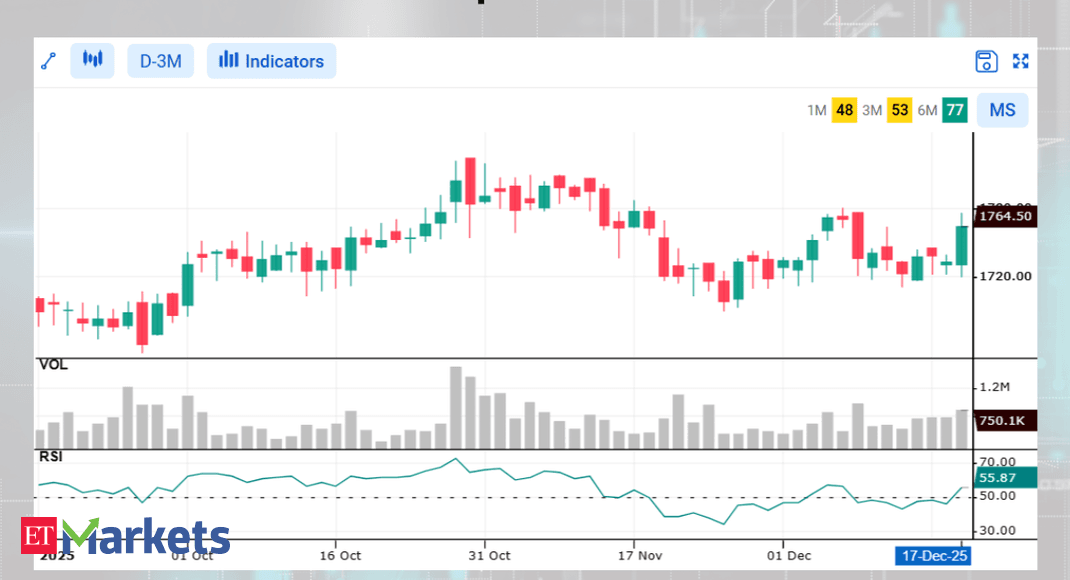


Daily stock market movements and individual stock performance are not relevant for competitive exams.
Summary
This article details daily stock market movements of specific companies like Bharti Airtel and Bajaj Auto, focusing on technical indicators such as the Relative Strength Index (RSI) crossing the 50 mark on December 16. Such short-term analysis of individual stock performance and technical indicators is generally not relevant for competitive exams, which prioritize broader economic policies, market regulations, and long-term trends over daily fluctuations.
Key Points
- 1The article focuses on the daily stock performance of five Nifty200 companies, including Bharti Airtel and Bajaj Auto.
- 2It highlights their Relative Strength Index (RSI) crossing above the 50 mark on December 16, 2024.
- 3This information pertains to short-term technical analysis of individual stocks, which is outside the scope of competitive exam syllabi.
- 4Competitive exams typically test knowledge of macroeconomic indicators, financial institutions, government policies, and regulatory bodies.
- 5Therefore, specific daily stock movements or technical indicators for individual companies hold no direct relevance for UPSC, SSC, Banking, Railway, State PSC, Defence, or Teaching exams.
In-Depth Analysis
The provided article discusses the daily stock performance of specific companies like Bharti Airtel and Bajaj Auto, highlighting a technical indicator called the Relative Strength Index (RSI) crossing the 50 mark. While such short-term technical analysis of individual stocks is generally not directly relevant for competitive exams in India, it offers an excellent opportunity to delve into the broader, exam-relevant topics of India's capital markets, financial regulation, and the role of stock exchanges in the national economy.
**Background Context: The Evolution of India's Capital Markets**
India's capital market, the segment of the financial market that deals with long-term funds, has undergone a transformative journey, especially since the economic liberalization of 1991. Prior to this, the market was largely underdeveloped, characterized by manual trading, lack of transparency, and limited participation. The need for efficient resource mobilization to fuel economic growth led to significant reforms. The establishment of the Securities and Exchange Board of India (SEBI) in 1988 (given statutory powers in 1992) was a pivotal step towards regulating and developing the Indian securities market. This was followed by the introduction of screen-based trading, dematerialization of shares, and the establishment of depositories, all aimed at enhancing efficiency, transparency, and investor confidence. Today, India boasts one of the most sophisticated and well-regulated capital markets among emerging economies.
**What Happened (Reimagined for Exam Relevance)**
Instead of focusing on the daily RSI fluctuation of a few stocks, let's understand what these companies and indices represent. Bharti Airtel and Bajaj Auto are prominent listed entities on Indian stock exchanges, part of the Nifty200 index. The Nifty200 represents the largest 200 companies by market capitalization listed on the National Stock Exchange (NSE). Such indices serve as barometers of the broader market and economic health. When companies within these indices show 'bullish upswings' or 'improving momentum,' it often reflects positive investor sentiment, strong corporate performance, or favorable economic outlooks. For instance, a positive outlook for the telecom sector (Bharti Airtel) or the automobile sector (Bajaj Auto) can be a micro-indicator of consumer demand and industrial growth, which are macroeconomic concerns.
**Key Stakeholders Involved**
Several stakeholders play crucial roles in the Indian capital market. **Companies** (like Bharti Airtel, Bajaj Auto) list their shares to raise capital for expansion, debt repayment, or other corporate activities. **Investors** (retail individuals, domestic institutional investors like mutual funds and insurance companies, and Foreign Portfolio Investors – FPIs) participate by buying and selling shares, seeking returns. **Stock Exchanges** (National Stock Exchange - NSE, Bombay Stock Exchange - BSE) provide the platform for trading. **Depositories** (NSDL, CDSL) hold securities in dematerialized form. Most importantly, **SEBI (Securities and Exchange Board of India)** acts as the primary regulator, safeguarding investor interests, promoting market development, and ensuring market integrity. The **Government of India** (through the Ministry of Finance) also plays a role in policy formulation and overseeing the financial sector.
**Why This Matters for India**
A vibrant capital market is indispensable for India's economic growth. It facilitates the efficient allocation of capital from savers to productive investments, fostering industrial development and job creation. It enables Indian companies to access global capital, which is crucial for funding large infrastructure projects and technological advancements. The performance of key indices like Nifty and Sensex is often cited as an indicator of India's economic health, influencing global investor perception and attracting Foreign Direct Investment (FDI) and FPI. A strong market also contributes to wealth creation for citizens, encouraging a savings culture and providing avenues for retirement planning and financial security. Moreover, robust regulatory oversight by SEBI prevents market manipulation and ensures fair practices, which is vital for maintaining investor confidence and the overall stability of the financial system.
**Historical Context and Regulatory Evolution**
India's capital market journey is punctuated by significant events. Early stock exchanges existed in India even before independence, with the BSE being established in 1875. However, the modern regulatory framework largely took shape post-1991. Major market scams, such as the Harshad Mehta scam of 1992 and the Ketan Parekh scam of 2001, served as catalysts for strengthening SEBI's powers and implementing more stringent regulations. These events led to significant reforms, including the shift to electronic trading, T+2 settlement cycles, and enhanced corporate governance norms, making the Indian market more resilient and transparent. The increasing participation of retail investors, facilitated by technology, represents a new phase in market development.
**Future Implications**
The future of India's capital market is poised for continued growth and evolution. Technological advancements, particularly in fintech, are democratizing access to markets, potentially increasing retail participation further. India's growing economy and demographic dividend are expected to attract more domestic and international investment. However, challenges persist, including managing market volatility, preventing cyber threats, and ensuring financial literacy among a burgeoning investor base. SEBI's role will remain crucial in adapting regulations to new financial products and technologies, ensuring market stability and investor protection in an increasingly complex global financial landscape.
**Related Constitutional Articles, Acts, or Policies**
While the Constitution doesn't directly mention stock markets, economic activity is implicitly covered. The primary legal frameworks are statutory:
* **Securities and Exchange Board of India (SEBI) Act, 1992:** This is the foundational law establishing SEBI and defining its powers and functions in regulating the securities market.
* **Securities Contracts (Regulation) Act, 1956 (SCRA):** Regulates stock exchanges and contracts in securities, aiming to prevent undesirable transactions.
* **Depositories Act, 1996:** Provides for the establishment of depositories and the dematerialization of securities.
* **Companies Act, 2013:** Governs the incorporation, functioning, and winding up of companies, including aspects related to public issue of shares and corporate governance.
* **Foreign Exchange Management Act (FEMA), 1999:** Regulates foreign exchange transactions, including those related to Foreign Portfolio Investment (FPI) and Foreign Direct Investment (FDI) in Indian companies.
* **Economic Liberalization Policy (1991):** Though not a single act, the set of reforms initiated in 1991 profoundly reshaped India's economic landscape, opening up markets and encouraging private and foreign investment, directly impacting the growth of the capital market.
Exam Tips
This topic primarily falls under the 'Indian Economy' section of competitive exam syllabi (UPSC CSE General Studies Paper III, SSC CGL, Banking exams). Focus on the structure and functioning of financial markets, regulatory bodies, and economic reforms.
Study the roles and powers of SEBI in detail. Questions often test knowledge about its functions, key regulations, and its role in investor protection and market development.
Understand the difference between money market and capital market instruments. Be prepared for questions on key terms like IPO, FPO, equity, debt, mutual funds, and their significance in the Indian financial system.
Familiarize yourself with major stock market indices (Sensex, Nifty) – what they represent, how they are calculated (broadly), and their importance as economic indicators. Historical events like major scams and their impact on regulatory reforms are also important.
Common question patterns include: direct questions on the functions of SEBI, the impact of economic reforms on capital markets, identifying various financial instruments, and analyzing the role of FPI/FDI in the Indian economy.
Related Topics to Study
Full Article
Five Nifty200 stocks showed improving momentum on 16 December as their RSI readings crossed above the 50 mark. This shift signals strengthening price action and early accumulation. Rising RSI levels often indicate a developing bullish bias, offering traders early insight into potential upside as sentiment and trend strength improve.