



Relevant for Exams
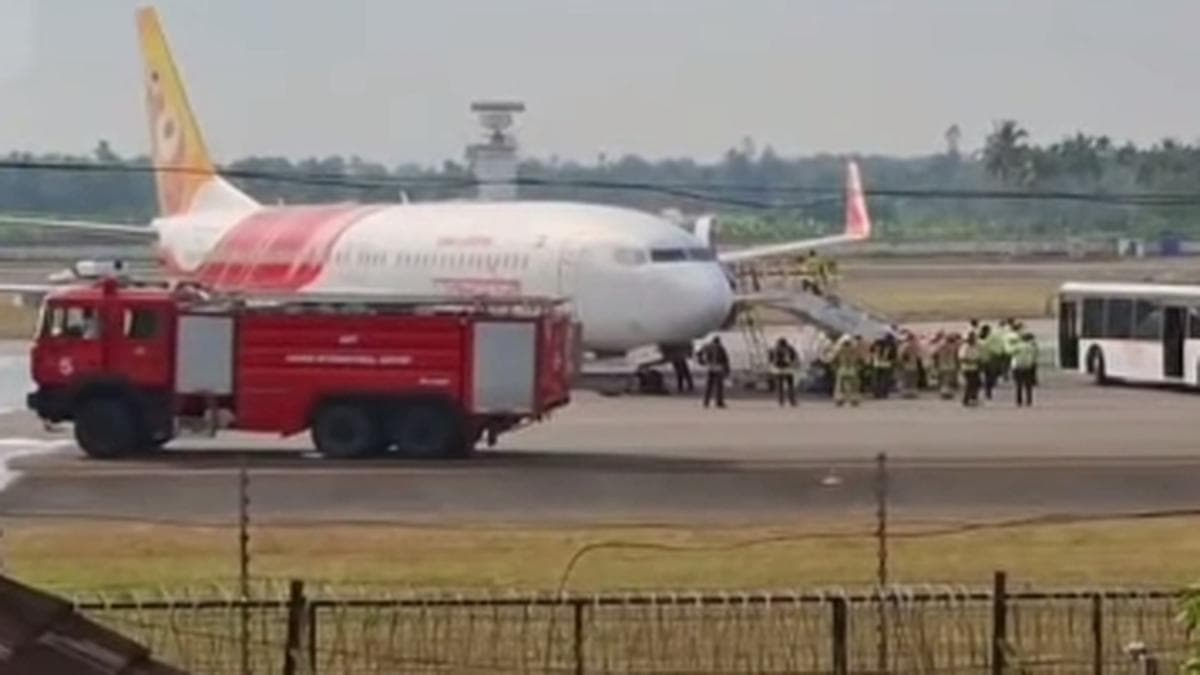
Air India Express flight from Jeddah makes precautionary landing in Kochi after tyre burst.
Summary
An Air India Express flight from Jeddah, bound for Kozhikode and carrying 160 passengers, made a precautionary landing at Kochi airport due to a tyre burst. Post-landing inspection confirmed both right-side tyres had burst. This incident highlights aviation safety protocols and the importance of emergency preparedness for competitive exams, particularly concerning airline operations and airport management.
Key Points
- 1The incident involved an Air India Express flight.
- 2The flight originated from Jeddah.
- 3The original destination of the flight was Kozhikode.
- 4The flight made a precautionary landing at Kochi airport.
- 5The cause of the precautionary landing was the bursting of both right-side tyres.
In-Depth Analysis
The recent incident involving an Air India Express flight from Jeddah, bound for Kozhikode, making a precautionary landing at Kochi airport due to a tyre burst, serves as a critical case study in aviation safety and emergency preparedness. This event, while safely managed, underscores the rigorous protocols and the robust regulatory framework that govern India's rapidly expanding aviation sector. Understanding such incidents is crucial for competitive exam aspirants, as it touches upon governance, infrastructure, economy, and public safety.
**Background Context and What Happened:**
India's aviation industry has witnessed significant growth over the past two decades, becoming the third-largest domestic aviation market globally. This expansion necessitates a strong emphasis on safety and regulatory oversight. Airlines like Air India Express, a subsidiary of Air India, operate extensive domestic and international routes, connecting India to various global destinations, including those in the Middle East which are vital for trade, tourism, and diaspora. The incident involved an Air India Express flight carrying 160 passengers and crew. The flight originated from Jeddah, Saudi Arabia, and was en route to Kozhikode (Calicut) International Airport in Kerala. During the flight, a critical technical snag occurred: a tyre burst on the aircraft. Following established emergency procedures, the pilots made the professional decision to divert the flight to Kochi's Cochin International Airport (CIAL), which is equipped with advanced facilities for handling such emergencies. The landing was executed safely, and a post-landing inspection confirmed that both right-side tyres of the aircraft had burst. The successful precautionary landing is a testament to the crew's training and the airport's emergency response capabilities.
**Key Stakeholders Involved:**
Several key players are central to such aviation incidents and their resolution. **Air India Express** is the primary stakeholder as the airline operating the flight. Its responsibility encompasses aircraft maintenance, crew training, adherence to safety protocols, and passenger welfare. The **Directorate General of Civil Aviation (DGCA)** is India's main regulatory body for civil aviation. It is responsible for safety oversight, investigation of incidents, licensing, and setting operational standards. The DGCA's role is paramount in ensuring compliance with national and international aviation safety norms. The **Airports Authority of India (AAI)**, or in the case of Kochi, Cochin International Airport Ltd (CIAL), which is a public-private partnership, manages the airport infrastructure, air traffic control (ATC), runway maintenance, and emergency services. Their readiness is critical for safe diversions and landings. The **Aircraft Accident Investigation Bureau (AAIB)**, an independent body, is responsible for investigating serious incidents and accidents to determine causes and recommend preventative measures. Finally, the **passengers and crew** are direct stakeholders, whose safety and well-being are the ultimate priority, and whose experiences often shape public perception and regulatory responses.
**Significance for India:**
This incident, though safely resolved, carries significant implications for India. Firstly, it highlights the **critical importance of aviation safety** in maintaining public trust and sustaining the growth of the sector. Any perceived lapse in safety can have far-reaching consequences on passenger confidence and international reputation. Secondly, routes to the Middle East, like Jeddah, are crucial for India's economy, facilitating trade, tourism, and the movement of a large Indian diaspora, including Hajj and Umrah pilgrims. Ensuring the safety of these routes is vital for maintaining these economic and cultural links. Thirdly, it tests and demonstrates the **effectiveness of India's emergency response systems** at airports and within airlines. The successful diversion and landing at Kochi underscore the preparedness of CIAL and the professionalism of the Air India Express crew. This incident also reinforces the need for continuous investment in advanced aircraft maintenance technologies and ongoing training for aviation personnel, aligning with India's broader vision of becoming a global aviation hub.
**Historical Context and Constitutional/Policy Framework:**
India's aviation safety framework has evolved significantly over the decades, often in response to past incidents and international best practices. The foundational legal instrument is the **Aircraft Act, 1934**, which provides the legislative basis for regulating the manufacture, possession, use, operation, sale, import, and export of aircraft. This is supplemented by the **Aircraft Rules, 1937**, which lay down detailed provisions for aircraft registration, licensing, airworthiness, and safety procedures. The DGCA operates under these legislative frameworks. Furthermore, the **Airports Authority of India Act, 1994**, established the AAI to manage and operate civil airports. Constitutionally, aviation falls under the Union List (Entry 29 of the Seventh Schedule of Article 246), granting the central government exclusive power to legislate on "Airways; air traffic and aerodromes; provision for aeronautical education and training and regulation of air traffic for safety at aerodromes and elsewhere; regulation of meteorological services to air navigation." This centralized control ensures uniform standards and coordinated responses across the nation. India is also a signatory to the Chicago Convention (1944), adhering to standards set by the **International Civil Aviation Organization (ICAO)**, which mandates robust safety management systems.
**Future Implications:**
Such incidents invariably lead to enhanced scrutiny and potential policy reviews. The DGCA and AAIB will conduct a thorough investigation to determine the root cause of the tyre burst, which could lead to revised maintenance protocols, operational guidelines, or even design checks for specific aircraft types. Airlines might face increased audits, and there could be a renewed emphasis on pilot training for emergency procedures. For passengers, the incident reinforces the importance of airline safety records when making travel choices. For the broader Indian aviation sector, it means continued vigilance, investment in modern infrastructure, and adherence to global safety benchmarks to sustain its growth trajectory and maintain international credibility. The incident, while concerning, ultimately serves as a valuable learning experience to further fortify India's aviation safety ecosystem.
Exam Tips
This topic falls under General Studies Paper II (Governance, Polity, and International Relations) and General Studies Paper III (Economy, Infrastructure, and Disaster Management). Focus on the roles of regulatory bodies like DGCA, AAI, and AAIB.
Study related topics such as the structure and functions of civil aviation authorities, major aviation policies (e.g., UDAN scheme), and international aviation organizations (ICAO). Understand the legal framework, including the Aircraft Act, 1934, and relevant constitutional provisions.
Common question patterns include factual questions on the headquarters/functions of DGCA/AAI, analytical questions on challenges facing the Indian aviation sector (safety, infrastructure, competition), and current affairs questions linking incidents to policy responses or regulatory changes.
Related Topics to Study
Full Article
Kozhikode-bound flight carrying 160 passengers was diverted to Kochi airport. Post-landing inspection confirmed that both right-side tyres had burst