



Relevant for Exams
PM Modi in Oman: India takes swift decisions, delivers results; highlights strong India-Oman ties.
Summary
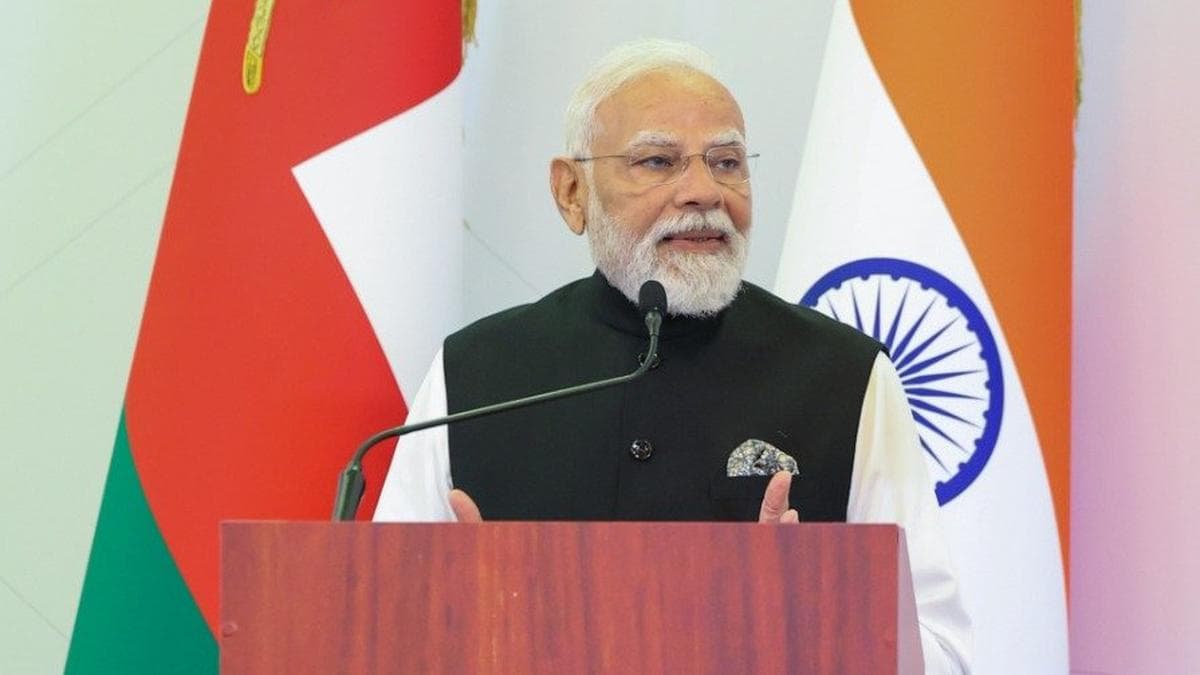
Prime Minister Narendra Modi, while addressing the Indian community at the 'Maitiri Parv' event in Oman, stated that 21st-century India makes swift decisions and delivers results promptly. He emphasized the deep, generational ties between India and Oman, extending beyond mere geography. This highlights India's perceived efficient governance and strong bilateral relations, which are general themes relevant for understanding India's foreign policy and internal narrative for competitive exams.
Key Points
- 1Prime Minister Narendra Modi addressed the Indian community and students in Oman.
- 2The event where PM Modi spoke was named 'Maitiri Parv'.
- 3PM Modi stated that '21st century India takes big, swift decisions' and delivers results in a time-bound manner.
- 4He emphasized that India and Oman are connected by 'geography' and 'generations'.
- 5The address was part of PM Modi's engagement with the Indian diaspora during his visit to Oman.
In-Depth Analysis
Prime Minister Narendra Modi's address at the 'Maitiri Parv' event in Oman, where he asserted that '21st century India takes big, swift decisions' and delivers results in a time-bound manner, carries significant implications for understanding India's evolving foreign policy, governance narrative, and diaspora engagement. This statement, delivered to the Indian community, is more than just a diplomatic pleasantry; it articulates a core message about India's domestic capabilities and its approach to international relations.
**Background Context and What Happened:**
India has a long-standing historical, cultural, and economic relationship with the Gulf region, including Oman. This relationship has intensified in recent decades due to energy security needs, trade, and the presence of a large Indian diaspora. PM Modi's visit to Oman, part of a broader tour of West Asian nations, underscored India's 'Look West' policy, which aims to strengthen strategic, economic, and cultural ties with countries in the region. The 'Maitiri Parv' event, meaning 'Festival of Friendship', served as a platform for the Prime Minister to engage directly with the Indian diaspora, a crucial component of India's soft power and economic strength. In his address, he not only praised the efficiency of modern India's decision-making but also highlighted the deep, multi-generational bonds between India and Oman, moving beyond mere geographical proximity.
**Key Stakeholders Involved:**
1. **Government of India (GoI):** Led by the Prime Minister and the Ministry of External Affairs, the GoI is the primary architect of India's foreign policy and the propagator of its governance narrative. The statement aims to project an image of a strong, decisive, and efficient nation on the global stage.
2. **Government of Oman:** As the host nation, Oman is a key strategic partner for India in the Gulf. Its stability and location at the mouth of the Strait of Hormuz are vital for India's energy security and maritime trade routes. The bilateral relationship encompasses defense cooperation, trade, and cultural exchanges.
3. **Indian Diaspora in Oman:** Comprising a significant portion of Oman's expatriate population, the Indian diaspora acts as a vital bridge between the two nations. Their economic contributions (remittances) and cultural influence are substantial. Engaging with the diaspora is a cornerstone of India's contemporary foreign policy.
4. **Indian Citizens (Domestic Audience):** The narrative of 'swift decisions' and 'time-bound results' is also aimed at a domestic audience, reinforcing the government's commitment to good governance, economic development, and efficiency.
**Why This Matters for India:**
This statement is significant on multiple fronts. Firstly, from a **foreign policy** perspective, it reinforces India's commitment to strengthening ties with West Asian nations, crucial for energy security (India imports a large percentage of its oil and gas from this region) and trade. Oman, in particular, offers strategic access to the Indian Ocean and plays a role in maritime security. The emphasis on 'generational ties' acknowledges the historical depth of this relationship, building trust and continuity. Secondly, the narrative of 'swift decisions' is a powerful **governance** message. It attempts to counter the historical perception of bureaucratic delays and project India as a nimble, effective nation capable of rapid policy implementation. This aligns with broader initiatives like 'Ease of Doing Business' and 'Minimum Government, Maximum Governance'. Thirdly, **diaspora engagement** is a cornerstone of India's foreign policy. The Indian diaspora is a valuable asset, contributing through remittances (among the highest globally), investments, and cultural diplomacy. Events like 'Maitiri Parv' are crucial for maintaining these ties and leveraging the diaspora's potential.
**Historical Context and Future Implications:**
The relationship between India and Oman dates back millennia, with ancient maritime trade routes connecting the two regions. Indians have been settling in Oman for centuries, contributing to its economy and culture. This long history forms the 'generational' ties mentioned by PM Modi. In modern times, diplomatic relations were established in 1955, and the relationship has evolved into a strategic partnership. Oman is a key pillar of India's maritime security strategy in the Indian Ocean Region, evident through joint naval exercises and port visits.
Looking ahead, this statement implies a continued focus on proactive and outcome-oriented governance within India, aiming to further boost economic growth and attract foreign investment. Externally, it signals India's intent to be a reliable and decisive partner on the global stage, particularly in its extended neighborhood. We can expect sustained efforts to deepen bilateral ties with Oman, especially in defence, energy, and technology sectors, and continued robust engagement with the Indian diaspora worldwide. The emphasis on 'swift decisions' will likely be a recurring theme in India's diplomacy, aiming to project an image of a dynamic and capable nation.
**Related Constitutional Articles, Acts, or Policies:**
While no single constitutional article directly dictates such a statement, it broadly aligns with the **Directive Principles of State Policy (DPSP)**, specifically **Article 51**, which mandates the state to 'endeavour to promote international peace and security, maintain just and honourable relations between nations, foster respect for international law and treaty obligations... and encourage settlement of international disputes by arbitration.' This article provides the overarching framework for India's foreign policy. The government's emphasis on 'swift decisions' and 'time-bound results' resonates with the principles of good governance and administrative efficiency, which are implicit in the functioning of a democratic republic. Policies like the 'Look West' policy and the various initiatives under the Ministry of External Affairs for diaspora engagement (e.g., Pravasi Bharatiya Divas, OCI scheme) are direct manifestations of these broader objectives. Furthermore, economic policies such as 'Make in India' and efforts to improve India's ranking in the 'Ease of Doing Business' index are concrete steps that underpin the claim of efficient governance and decision-making.
Exam Tips
This topic falls under **General Studies Paper 2 (International Relations & Governance)** for UPSC, and general awareness sections for SSC, Banking, Railway, and State PSC exams. Focus on India's foreign policy towards West Asia/Gulf region, the role of the Indian diaspora, and key governance initiatives.
Study related topics such as India-GCC relations, India's energy security strategy, maritime security in the Indian Ocean Region, 'Look West' and 'Act East' policies, and the concept of 'soft power' in international relations. Understanding the historical context of India's ties with the Gulf is also crucial.
Common question patterns include direct questions on India's bilateral relations with Oman or other Gulf countries, analytical questions on the significance of the Indian diaspora, or questions linking governance reforms with India's global image. Be prepared to discuss the economic and strategic importance of the region for India.
Related Topics to Study
Full Article
Addressing the gathering of Indian students and the community at the ‘Maitiri Parv’ event, Narendra Modi said that India and Oman are tied not just by geography, but also by generations