

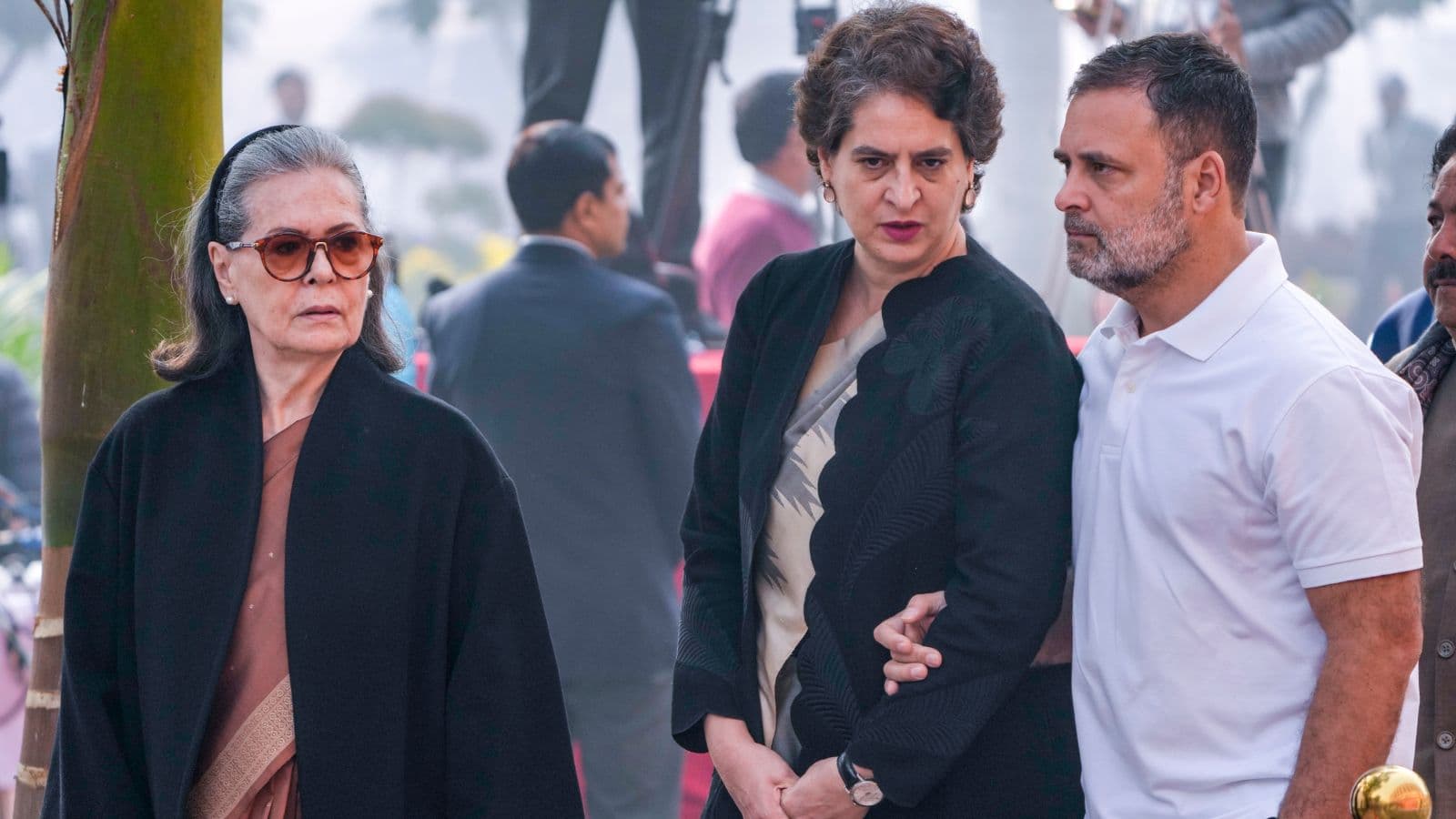


Congress vows continued fight against govt, citing legal victory; specific context currently unavailable.
Summary
The Congress party has declared its intent to continue opposing the government, asserting that legal principles have prevailed over political rhetoric. This statement, while highlighting an ongoing political and potentially legal confrontation, lacks specific details regarding the particular issues, court rulings, or government policies involved. Consequently, without further context, its direct relevance for competitive exam preparation remains limited.
Key Points
- 1The article's title indicates a political statement made by the Congress party.
- 2The phrase 'Will keep fighting govt' reflects the Congress party's adversarial stance.
- 3The statement 'law has spoken louder than noise' suggests a legal or judicial dimension to the Congress's position.
- 4No specific details regarding the particular government policy, legal case, or individuals involved are provided in the content.
- 5Due to the absence of content, no specific dates, names, numbers, or constitutional provisions relevant for MCQs can be extracted.
In-Depth Analysis
The statement by the Congress party, declaring its intent to "keep fighting govt" and asserting that "law has spoken louder than noise," encapsulates a fundamental aspect of India's democratic framework: the crucial role of the opposition and the supremacy of the rule of law. While the original article lacks specific details about the particular issue at hand, this declaration provides a valuable opportunity to delve into the dynamics of Indian politics, the system of checks and balances, and the significance of a robust judiciary.
**Background Context and What Happened (Interpretive Analysis):**
In any parliamentary democracy, the opposition plays a vital role in ensuring accountability and transparency. The Congress, being a major opposition party in India, frequently expresses its dissent against the policies and actions of the incumbent government, currently led by the Bharatiya Janata Party (BJP). This statement likely emerged from a context where the Congress believes a particular government action, policy, or legislative move has violated established legal norms or constitutional principles. The phrase "law has spoken louder than noise" strongly suggests that the party is referring to a judicial pronouncement or a legal interpretation that has gone against the government's stance, or at least validated the opposition's concerns. It could relate to a Supreme Court or High Court ruling on a contentious law, an executive order, or even an investigation.
Historically, Indian politics has seen numerous instances where opposition parties have challenged government decisions, both politically through parliamentary debates and protests, and legally through petitions in courts. This statement reflects a continuation of that tradition, emphasizing the legal route as a powerful mechanism for redressal when political avenues seem insufficient or when constitutional principles are perceived to be at stake.
**Key Stakeholders Involved:**
1. **Congress Party:** As the primary opposition, their role is to scrutinize government functioning, highlight perceived failures, articulate alternative policies, and mobilize public opinion. Their statement reinforces their commitment to this role, particularly through legal challenges.
2. **Ruling Government (BJP-led NDA):** The executive is responsible for governance, policy formulation, and implementation. When challenged by the opposition, especially on legal grounds, the government must defend its actions and policies, often citing constitutional validity and public interest.
3. **Judiciary (Supreme Court/High Courts):** Implicitly, the judiciary is a central stakeholder. The phrase "law has spoken" directly points to the courts as the ultimate arbiters of legal and constitutional disputes. The Indian judiciary, through its power of judicial review, acts as a guardian of the Constitution and protector of fundamental rights.
4. **Citizens/Electorate:** Ultimately, the political and legal battles fought between the government and opposition impact the citizens. Their rights, welfare, and trust in democratic institutions are at stake. Citizens are also the final arbiters through electoral processes.
**Significance for India:**
This dynamic is crucial for the health of India's democracy. A vigilant opposition ensures that the government remains accountable, preventing potential overreach or arbitrary decision-making. When the opposition resorts to legal challenges, it underscores the importance of the **Rule of Law** and the principle that no entity, including the government, is above the law. This reinforces public faith in institutions and the constitutional framework. It also highlights the robust system of **checks and balances** envisioned by the Constitution, where the judiciary serves as a crucial check on the executive and legislature. Such confrontations, while sometimes appearing divisive, are essential for fostering a vibrant public discourse and ensuring that diverse perspectives are considered in governance.
**Historical Context and Broader Themes:**
India has a rich history of judicial activism and judicial review. Landmark cases like *Kesavananda Bharati v. State of Kerala* (1973) established the 'Basic Structure Doctrine,' affirming the judiciary's power to strike down constitutional amendments that violate fundamental principles. Throughout history, various governments have faced legal challenges from opposition parties and civil society on issues ranging from land acquisition to environmental regulations, and from electoral reforms to fundamental rights. This ongoing struggle between political will and legal scrutiny is a hallmark of India's constitutional democracy. It connects to broader themes of good governance, constitutionalism, human rights, and the balance of power among the three pillars of the state.
**Future Implications:**
Such statements signal continued political confrontation, potentially leading to more legal battles. This could result in significant judicial pronouncements that shape future policy and legislative actions. The judiciary's role will remain paramount in interpreting laws and upholding constitutional values, potentially leading to further debates on judicial overreach versus judicial activism. For the Congress, this stance aims to position itself as a defender of constitutional principles and a credible alternative, potentially influencing future electoral outcomes. For the government, it means facing increased scrutiny and having to robustly defend its actions in both the political and legal arenas. It also highlights the need for governments to ensure their policies are legally sound and constitutionally compliant to avoid judicial interventions.
**Related Constitutional Articles, Acts, or Policies:**
* **Article 13:** Declares that all laws inconsistent with or in derogation of Fundamental Rights shall be void. This is the basis for judicial review.
* **Article 32 & Article 226:** Grant the Supreme Court and High Courts, respectively, the power to issue writs for the enforcement of Fundamental Rights, making them accessible avenues for legal challenge.
* **Articles 124-147 (Union Judiciary) & Articles 214-237 (High Courts):** Outline the structure, powers, and functions of the Indian judiciary.
* **Separation of Powers:** While not explicitly mentioned in a single article, the Constitution implicitly establishes a separation of powers between the Legislature (Parliament), Executive (Government), and Judiciary.
* **Fundamental Rights (Part III, Articles 12-35):** Often the basis for challenging government actions, especially Article 14 (Equality before law), Article 19 (Freedoms of speech, assembly, etc.), and Article 21 (Protection of life and personal liberty).
* **Parliamentary Procedures:** Rules governing debates, question hour, and no-confidence motions, which are avenues for opposition to challenge the government politically.
In essence, the Congress's statement, though broad, reflects the enduring strength of India's constitutional democracy where political battles are often fought through legal channels, reinforcing the principle that the 'law speaks louder than noise' and ensuring accountability in governance.
Exam Tips
This topic primarily falls under **General Studies Paper II (Polity & Governance)**. Focus on the role of the opposition, the judiciary's powers (judicial review, activism), and the concept of separation of powers.
When studying, link this to **Fundamental Rights (Articles 13, 19, 21, 32, 226)** and their enforcement. Understand the checks and balances mechanism between the Executive, Legislature, and Judiciary. Also, study the role of political parties in a democracy.
Common question patterns include analytical questions on the importance of a strong opposition, the judiciary's role in upholding the Constitution, the principle of judicial review, and the challenges to democratic institutions in India. Be prepared to discuss the balance between executive action and judicial oversight with examples.