



Relevant for Exams
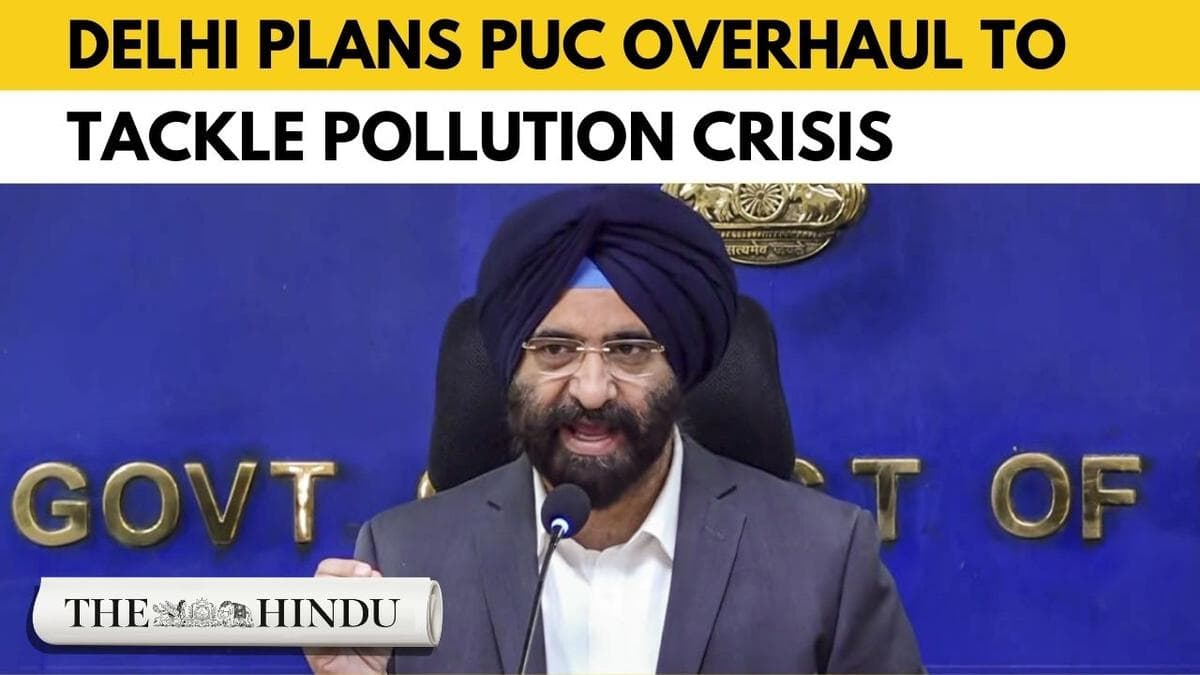
Delhi govt plans overhaul of PUC certificate system amid pollution crisis, says Environment Minister.
Summary
The Delhi government is planning a significant overhaul of its Pollution Under Control (PUC) certificate issuing system. Announced by Environment Minister Manjinder Singh Sirsa on December 17, this initiative aims to address the shortcomings of existing, outdated centers. The move is crucial for tackling the ongoing severe pollution crisis in the national capital, making it a relevant topic for competitive exams focusing on environmental governance and state-level policy interventions.
Key Points
- 1The Delhi government is planning an overhaul of the Pollution Under Control (PUC) certificate issuing system.
- 2The announcement was made by Delhi Environment Minister Manjinder Singh Sirsa.
- 3The decision was communicated on December 17.
- 4The overhaul addresses shortcomings in the existing 'old' PUC centres.
- 5The move is prompted by the ongoing pollution crisis in the national capital, Delhi.
In-Depth Analysis
Delhi's perpetual struggle with debilitating air pollution has long been a national concern, pushing various governmental bodies to implement a range of mitigation strategies. The recent announcement by Delhi Environment Minister Manjinder Singh Sirsa on December 17, regarding a planned overhaul of the Pollution Under Control (PUC) certificate issuing system, signifies another crucial step in this ongoing battle. This move is a direct response to the acknowledged shortcomings of existing, often outdated, PUC centers, which have proven inadequate in effectively curbing vehicular emissions – a significant contributor to the capital's noxious air.
**Background Context and What Happened:** Delhi consistently ranks among the most polluted cities globally, with its air quality often plummeting to 'severe' or 'hazardous' levels, particularly during the winter months. This crisis is a complex interplay of factors including vehicular emissions, industrial pollution, construction dust, biomass burning, and stubble burning from neighboring states. Vehicular pollution alone contributes substantially, making effective monitoring and control imperative. The Pollution Under Control (PUC) certificate system, mandated by the Motor Vehicles Act, 1988, is designed to ensure that vehicles on the road comply with prescribed emission standards. However, the existing system has been plagued by issues such as manual intervention, lack of transparency, outdated equipment, and alleged malpractices, leading to a diminished impact on actual emission control. The Delhi government's decision to overhaul this system acknowledges these failures and seeks to introduce a more robust, technologically advanced, and tamper-proof mechanism.
**Key Stakeholders Involved:** Several entities are directly impacted and involved in this initiative. The **Delhi Government**, specifically its Environment and Transport Departments, is the primary driver, responsible for policy formulation, implementation, and oversight. **Vehicle Owners** are crucial stakeholders, as they are the ones who must comply with the new system, potentially facing updated procedures, costs, and penalties. The **existing PUC Centers and their operators** will be significantly affected; their business models, infrastructure, and operational procedures will need to adapt to the new framework. The **Central Government**, through the Ministry of Road Transport and Highways (MoRTH) and the Ministry of Environment, Forest and Climate Change (MoEFCC), plays a vital role in setting national emission standards (like Bharat Stage norms) and providing overarching guidelines. Furthermore, **environmental advocacy groups, public health organizations, and citizens** are indirect but powerful stakeholders, whose health and well-being are directly tied to the success of such initiatives, and who often exert pressure for stricter environmental regulations. Finally, judicial bodies like the **Supreme Court and the National Green Tribunal (NGT)** frequently intervene in pollution matters, issuing directives and holding governments accountable, thus acting as crucial oversight mechanisms.
**Why this Matters for India and Historical Context:** This overhaul holds immense significance for India, extending beyond Delhi's borders. Firstly, it addresses a critical **public health crisis**. Air pollution leads to millions of premature deaths and a host of respiratory and cardiovascular diseases, imposing a massive burden on the healthcare system and reducing national productivity. By tackling vehicular emissions more effectively, Delhi can set a precedent for other Indian cities grappling with similar challenges. Economically, cleaner air can reduce healthcare expenditures and improve worker productivity. Politically, it demonstrates a commitment to environmental governance and can garner public trust. Historically, the PUC system in India dates back to the Motor Vehicles Act, 1988, which made it mandatory. Over the years, despite various amendments and the introduction of stricter emission norms (like Bharat Stage norms, culminating in BS-VI from April 1, 2020), the implementation of PUC has remained a weak link. This overhaul is an attempt to strengthen this critical enforcement mechanism.
**Future Implications and Related Constitutional Provisions:** The successful overhaul of the PUC system promises several positive implications. It could lead to a more transparent, efficient, and reliable emission testing regime, significantly reducing vehicular pollution. This might involve integrating advanced technologies like real-time data transmission, AI-based analysis, and tamper-proof mechanisms, potentially linking PUC data directly to vehicle registration and insurance renewals. If successful, it could serve as a model for other states and Union Territories to adopt similar modernizations, fostering a nationwide improvement in vehicular emission control. However, challenges like ensuring widespread adoption of new technologies, preventing new forms of malpractice, and managing the transition for existing centers will need careful handling.
From a constitutional perspective, the state's efforts align with fundamental principles. **Article 21 of the Indian Constitution**, which guarantees the 'Right to Life and Personal Liberty', has been expansively interpreted by the Supreme Court to include the 'Right to a Clean and Healthy Environment'. Furthermore, **Article 48A (Directive Principles of State Policy)** mandates that 'the State shall endeavour to protect and improve the environment and to safeguard the forests and wildlife of the country'. The overhaul is also underpinned by legislative frameworks like the **Motor Vehicles Act, 1988**, which provides the legal basis for PUC certificates, and the **Environment (Protection) Act, 1986**, which empowers the central government to take measures for protecting and improving environmental quality. The **National Green Tribunal Act, 2010**, further provides a specialized judicial body to address environmental disputes, often pushing for stricter enforcement of pollution norms. This initiative, therefore, is not merely an administrative change but a constitutional imperative, reflecting India's commitment to environmental protection and public health.
Exam Tips
This topic falls under General Studies Paper III (Environment & Ecology, Science & Technology) for UPSC and State PSC exams, and General Awareness/Current Affairs for SSC, Railway, and Defence exams. Focus on policy initiatives related to pollution control and environmental governance.
Study related topics such as the National Clean Air Programme (NCAP), Bharat Stage (BS) Emission Norms, Graded Response Action Plan (GRAP), and the role of the National Green Tribunal (NGT). Understand the causes and effects of air pollution in India.
Common question patterns include: 'Discuss the challenges in controlling vehicular pollution in urban areas and suggest measures,' 'Analyze the role of state governments in environmental protection, referencing recent initiatives,' or 'Explain the constitutional provisions related to environmental protection in India.' Be prepared to write about policy effectiveness and implementation challenges.
Memorize key constitutional articles like 21 and 48A, and important acts like the Motor Vehicles Act, 1988, and the Environment (Protection) Act, 1986, as they are frequently asked in objective and subjective questions.
Understand the technological aspects (e.g., real-time monitoring, AI integration) that can improve the PUC system, as questions on technology's role in governance are increasingly common.
Related Topics to Study
Full Article
Delhi government is considering an overhaul of the Pollution Under Control (PUC) certificate issuing system as the existing centres are old with many shortcomings Environment Minister Manjinder Singh Sirsa said on December 17, amid the ongoing pollution crisis in the national capital.