



Relevant for Exams
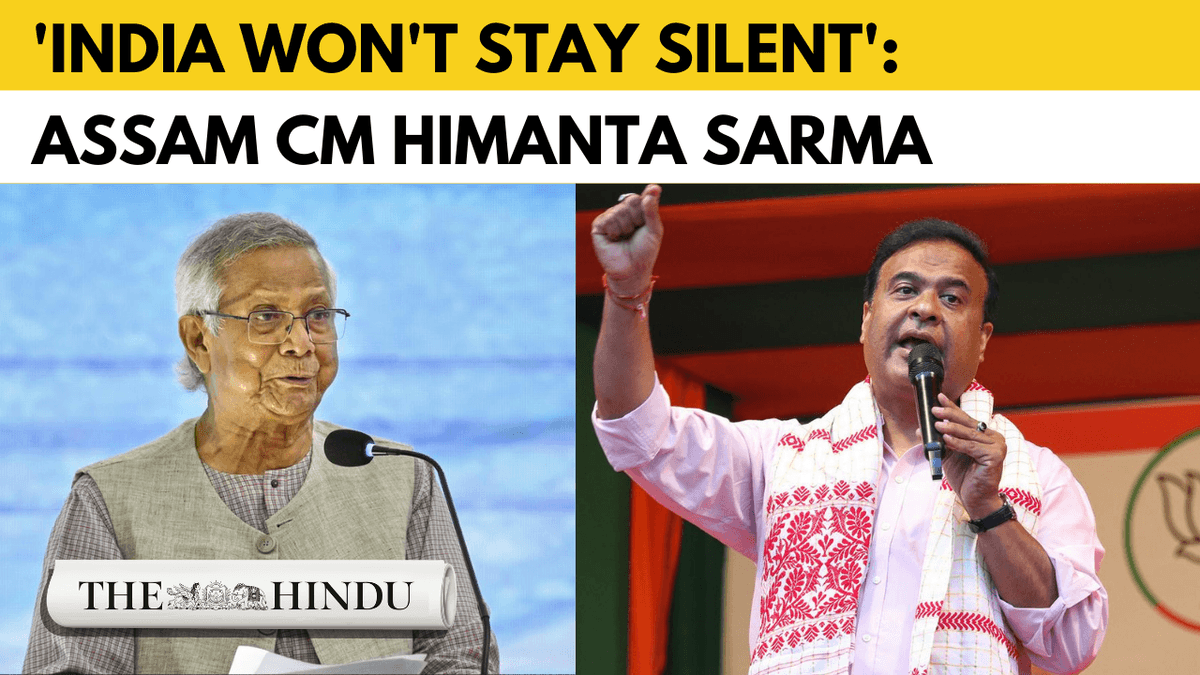
Assam CM condemns Bangladeshi leader's call to shelter separatists and sever India's North-East.
Summary
Assam Chief Minister Himanta Biswa Sarma strongly condemned a Bangladeshi youth leader's call to shelter Indian separatists and sever India's North-Eastern region from the mainland. This incident highlights persistent cross-border security concerns and diplomatic sensitivities between India and Bangladesh regarding secessionist movements. It is significant for understanding India's internal security challenges and regional geopolitical dynamics, particularly concerning its sensitive North-Eastern states.
Key Points
- 1Assam Chief Minister Himanta Biswa Sarma reacted to the controversial statement.
- 2The statement was made by an unnamed Bangladeshi youth leader.
- 3The Bangladeshi leader called for providing shelter to Indian separatists.
- 4The statement also advocated for severing India's North-Eastern region from its mainland.
- 5The incident underscores India's security concerns regarding cross-border support for secessionist elements in the North-East.
In-Depth Analysis
The statement by an unnamed Bangladeshi youth leader, calling for sheltering Indian separatists and severing India's North-Eastern region from the mainland, is a grave concern that underscores the persistent security challenges and diplomatic sensitivities between India and Bangladesh. Assam Chief Minister Himanta Biswa Sarma's strong condemnation highlights India's zero-tolerance stance towards any threat to its territorial integrity and sovereignty.
**Background Context and Historical Roots:**
India's North-Eastern region, often referred to as the 'Seven Sisters' plus Sikkim, is strategically vital but geographically isolated, connected to the rest of India by a narrow strip of land known as the 'Chicken's Neck' or Siliguri Corridor. This region has a complex history marked by ethnic diversity, socio-economic disparities, and a long-standing struggle with various insurgent groups since India's independence in 1947. The Partition of India in 1947 and the subsequent creation of East Pakistan (now Bangladesh) further complicated the region's geopolitics, severing traditional trade routes and cultural ties and creating porous borders that became havens for insurgents. Groups like the United Liberation Front of Asom (ULFA), National Socialist Council of Nagaland (NSCN) factions, and others have historically sought refuge and logistical support in neighbouring countries, including Bangladesh, Myanmar, and Bhutan. For decades, Bangladesh, particularly under previous regimes, was perceived as a sanctuary for many of these Indian insurgent groups, allowing them to operate training camps and launch attacks into India.
**What Happened:**
The recent incident involved an unnamed Bangladeshi youth leader making a public call to shelter Indian separatists and advocating for the secession of India's North-Eastern region. While the exact context or official affiliation of the youth leader is not detailed, the statement itself is highly provocative. Assam Chief Minister Himanta Biswa Sarma promptly and strongly reacted, declaring that such threats to cut off the North-East from India cannot be tolerated. This swift response from a key political figure in a border state underscores the seriousness with which India views such pronouncements, regardless of their source.
**Key Stakeholders Involved:**
1. **Indian Government:** Primarily the Ministry of Home Affairs and the Ministry of External Affairs, responsible for internal security, border management, and diplomatic relations. Their primary concern is maintaining India's territorial integrity and preventing cross-border support for separatist movements.
2. **Assam State Government:** Led by CM Himanta Biswa Sarma, it is a direct stakeholder as Assam is a frontline state in the North-East, heavily impacted by insurgency and cross-border issues. The state government plays a crucial role in maintaining law and order and collaborating with central agencies.
3. **Bangladesh Government:** While the statement came from a 'youth leader,' the official stance of the Bangladesh government, particularly under Prime Minister Sheikh Hasina, has been one of strong cooperation with India on security matters. Bangladesh has, in recent years, cracked down significantly on Indian insurgent groups operating from its soil, a policy shift that has greatly improved bilateral relations and security in the North-East.
4. **Indian Separatist Groups:** Though unnamed, these are the beneficiaries and instigators of such calls. Their aim is to destabilize the region and achieve their secessionist objectives.
5. **People of the North-East:** Their peace, security, and economic development are directly threatened by such statements and the potential for renewed instability.
**Why This Matters for India:**
This incident is significant for India on multiple fronts. Firstly, it directly challenges India's **internal security** and **territorial integrity**. Any call for secession, especially with external backing, strikes at the very foundation of the Indian Union. Secondly, it affects India's ongoing efforts to foster **national integration** in the North-East through infrastructure development (e.g., connectivity projects under the Bharatmala Pariyojana), economic growth, and cultural exchange. Thirdly, it tests the robust **diplomatic relationship** between India and Bangladesh. Under PM Sheikh Hasina, India-Bangladesh ties have reached unprecedented levels, marked by extensive cooperation on security, trade, and connectivity. A statement like this, if not swiftly disavowed by Bangladesh, could strain these crucial ties. Lastly, instability in the North-East hampers the success of India's **Act East Policy**, which aims to connect India's North-East with Southeast Asia, leveraging the region's strategic location for economic prosperity.
**Constitutional Provisions and Policies:**
India's Constitution strongly upholds the **Union of States**, as enshrined in **Article 1**. Any act or statement advocating secession is a direct challenge to this fundamental principle. The **Unlawful Activities (Prevention) Act, 1967 (UAPA)**, is a key legislative tool used by the Indian government to deal with unlawful associations and activities, including those that advocate or facilitate secession. The central government's powers related to defence and external affairs fall under the **Union List** (Seventh Schedule), granting it primary responsibility for national security and foreign policy. Policies like the **Armed Forces (Special Powers) Act, 1958 (AFSPA)**, though controversial, have been historically applied in parts of the North-East to aid counter-insurgency operations. India also has robust **border management policies** involving the Border Security Force (BSF) and other agencies to prevent infiltration and cross-border illegal activities. The **Act East Policy** is a strategic foreign policy initiative that relies heavily on stability in the North-East and strong ties with immediate neighbours like Bangladesh.
**Future Implications:**
This incident serves as a reminder that despite significant improvements in regional security, vigilance remains paramount. India will likely continue to engage diplomatically with Bangladesh to ensure such statements do not reflect official policy and to reinforce the existing security cooperation. Strengthening border infrastructure, intelligence sharing, and concerted efforts to address the root causes of insurgency – such as socio-economic disparities and lack of opportunities – will be crucial. The long-term stability of the North-East is integral to India's national security, economic growth, and its regional strategic ambitions. Any external attempt to destabilize the region must be met with a firm and coordinated response, blending diplomatic pressure, robust security measures, and sustained development initiatives.
Exam Tips
This topic falls under GS Paper II (Polity & Governance, International Relations) and GS Paper III (Internal Security) for UPSC. For State PSCs, SSC, and Railway exams, it's relevant for General Awareness, Current Affairs, and Indian Polity sections.
When studying this, focus on understanding the historical context of North-East insurgencies, India-Bangladesh bilateral relations (especially security cooperation post-1971 and under Sheikh Hasina's government), and India's Act East Policy. Relate internal security challenges to foreign policy and economic development.
Common question patterns include analytical questions on challenges to India's internal security from external actors, the role of federalism in managing border states, the significance of India's relations with its neighbours for national security, and the impact of cross-border issues on regional development. Be prepared to discuss constitutional provisions related to sovereignty and national integrity.
Related Topics to Study
Full Article
Himanta Biswa Sarma reacted to a Bangladeshi youth leader’s call to shelter Indian separatists and sever the region from India’s mainland