



Relevant for Exams
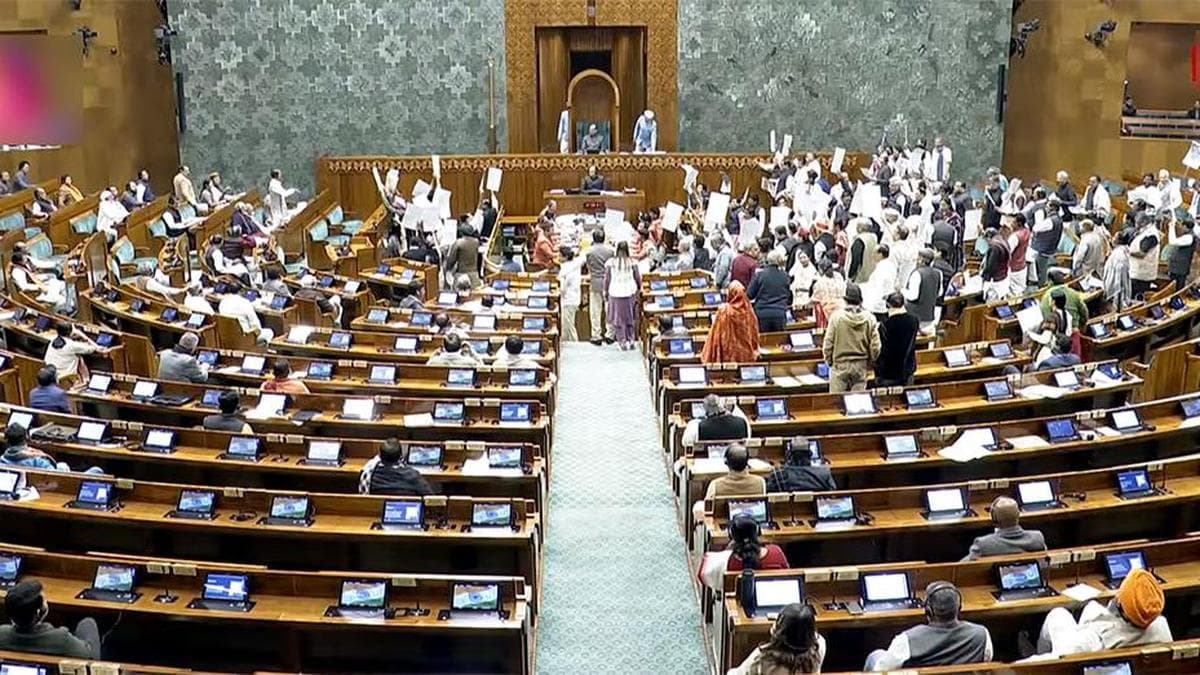
Lok Sabha debates new Bill to replace MGNREGA, facing opposition amid concerns over state funding.
Summary
Lok Sabha has commenced discussions on a new Bill aimed at replacing the Mahatma Gandhi National Rural Employment Guarantee Act (MGNREGA). This legislative move is facing strong opposition from various activist groups and opposition parties, highlighting significant policy debate. The Bill's potential impact on rural employment and state finances, particularly for fund-starved regions like Andhra Pradesh, makes it a crucial topic for competitive exams focusing on social schemes, polity, and economy.
Key Points
- 1Lok Sabha has initiated discussions on a new Bill in the Parliament.
- 2The proposed Bill is designed to replace the existing Mahatma Gandhi National Rural Employment Guarantee Act (MGNREGA).
- 3The new Bill is being opposed by various activists and opposition political parties.
- 4NDA allies have expressed support for the new Bill during the parliamentary discussion.
- 5Telugu Desam Party (TDP) specifically highlighted that fund-starved states like Andhra Pradesh would require additional support under the new Bill.
In-Depth Analysis
The discussion in Lok Sabha about a new Bill to replace the Mahatma Gandhi National Rural Employment Guarantee Act (MGNREGA) marks a significant moment in India's social welfare policy landscape. This move has ignited a robust debate among political parties, civil society organizations, and various stakeholders, highlighting the complexities of balancing social security with fiscal prudence and administrative efficiency.
**Background Context: The Genesis and Evolution of MGNREGA**
MGNREGA, originally enacted as the National Rural Employment Guarantee Act (NREGA) in 2005, is a flagship social welfare program that guarantees 100 days of wage employment in a financial year to any rural household whose adult members volunteer to do unskilled manual work. Born out of extensive advocacy by civil society groups, particularly the 'Right to Food Campaign', it was legislated with the primary objectives of enhancing livelihood security in rural areas, creating durable assets, and reducing rural-urban migration. The Act was a groundbreaking piece of legislation, linking employment to a legal right, an embodiment of the spirit of Article 41 of the Indian Constitution, which mandates the state to make effective provision for securing the right to work, within the limits of its economic capacity. Over the years, MGNREGA has been lauded for its role in poverty alleviation, women empowerment, and providing a crucial safety net, especially during times of distress like droughts or the COVID-19 pandemic. However, it has also faced criticisms regarding issues like delayed wage payments, corruption, poor quality of assets created, and administrative inefficiencies.
**What's Happening: The New Bill and Its Implications**
The current development involves the Lok Sabha initiating discussions on a Bill intended to replace the existing MGNREGA. While the specific provisions of this new Bill are not fully detailed in the provided context, the fact that it aims to 'replace' rather than merely 'amend' MGNREGA suggests a potentially significant overhaul of the scheme. The opposition from activists and opposition parties typically stems from concerns about a possible dilution of the legal guarantee of employment, reduced scope of work, decreased funding allocations, or changes in the wage payment mechanism that could negatively impact rural workers. The government's rationale for such a replacement could be to address the persistent criticisms, improve efficiency, enhance asset creation quality, or align the scheme with broader economic development goals. The support from NDA allies, while acknowledging the need for additional support for fund-starved states like Andhra Pradesh (as pointed out by TDP), indicates a desire to reform the existing framework.
**Key Stakeholders and Their Stances**
Several critical stakeholders are involved in this legislative process:
1. **The Central Government/Ruling Alliance (NDA):** As the proposer of the Bill, they aim to reform or replace MGNREGA, potentially citing reasons of better implementation, asset quality, or fiscal sustainability. Their support for the Bill indicates a strategic policy shift.
2. **Opposition Parties:** They are typically vocal against any move that they perceive as weakening social safety nets. Their opposition often centers on protecting the rights of rural workers and ensuring continued government commitment to welfare schemes.
3. **Activists and Civil Society Organizations:** These groups have historically been the architects and vigilant guardians of MGNREGA. Their strong opposition signals deep concerns about the potential erosion of workers' rights, transparency mechanisms, and the overall spirit of the original Act.
4. **State Governments:** States are crucial implementing agencies for MGNREGA. Their concerns, exemplified by the Telugu Desam Party's (TDP) demand for additional support for states like Andhra Pradesh, underscore the challenges of fiscal federalism. States often bear a significant portion of the administrative and material costs, and any changes in central funding patterns directly impact their fiscal health and capacity to implement the scheme effectively.
5. **Rural Workers/Beneficiaries:** The ultimate stakeholders, their livelihoods and access to guaranteed employment are directly at stake. Their voices, often channeled through advocacy groups, are critical in this debate.
**Significance for India and Future Implications**
The move to replace MGNREGA carries profound significance for India. Socially, it impacts the fundamental safety net for millions of rural poor, influencing poverty levels, distress migration, and gender equality in the workforce. Economically, changes to MGNREGA will affect rural wage rates, local demand, and the creation of community assets. Politically, it represents a major policy decision that will be debated vigorously, potentially shaping electoral outcomes and Centre-State relations. The TDP's concern highlights the ongoing challenges of fiscal federalism in India, where states rely heavily on central grants for implementing social sector schemes. Any new Bill must consider the diverse economic realities of various states and ensure equitable support, consistent with principles enshrined in the Constitution regarding the distribution of powers and finances.
Historically, MGNREGA has been viewed as a progressive step towards realizing Directive Principles of State Policy (DPSP) like Article 41 (Right to Work) and Article 43 (Living wage, etc., for workers). Any replacement Bill will be scrutinized against these constitutional ideals. Future implications could include a revamped rural employment scheme that is either more efficient and targeted, or one that faces widespread criticism for diluting workers' rights. The outcome will depend on the specifics of the new Bill, the nature of parliamentary debate, and the government's willingness to incorporate feedback from diverse stakeholders. It could set a new precedent for social welfare legislation in India, impacting the design and implementation of future schemes aimed at poverty alleviation and rural development.
Exam Tips
This topic falls under GS Paper II (Polity & Governance, Social Justice) and GS Paper III (Indian Economy, Rural Development) for UPSC. For SSC/State PSCs, it's crucial for General Awareness and Current Affairs. Focus on the constitutional backing (DPSP), the Act's provisions, its impact, and criticisms.
Study MGNREGA's key features (100 days guarantee, demand-driven, wage payment structure, social audit) and compare them with potential changes in the new Bill. Understand the concept of 'Right to Work' in the Indian context and its connection to DPSP.
Common question patterns include: Direct questions on MGNREGA's objectives and achievements; analysis of its impact on rural poverty/women empowerment; criticisms and suggested reforms; questions on fiscal federalism in the context of centrally sponsored schemes; and current affairs questions on the new Bill's implications.
Related Topics to Study
Full Article
Lok Sabha begins discussion on the Bill; NDA allies support the Bill, though TDP pointed out that a fund-starved State like Andhra Pradesh will need additional support