


Relevant for Exams
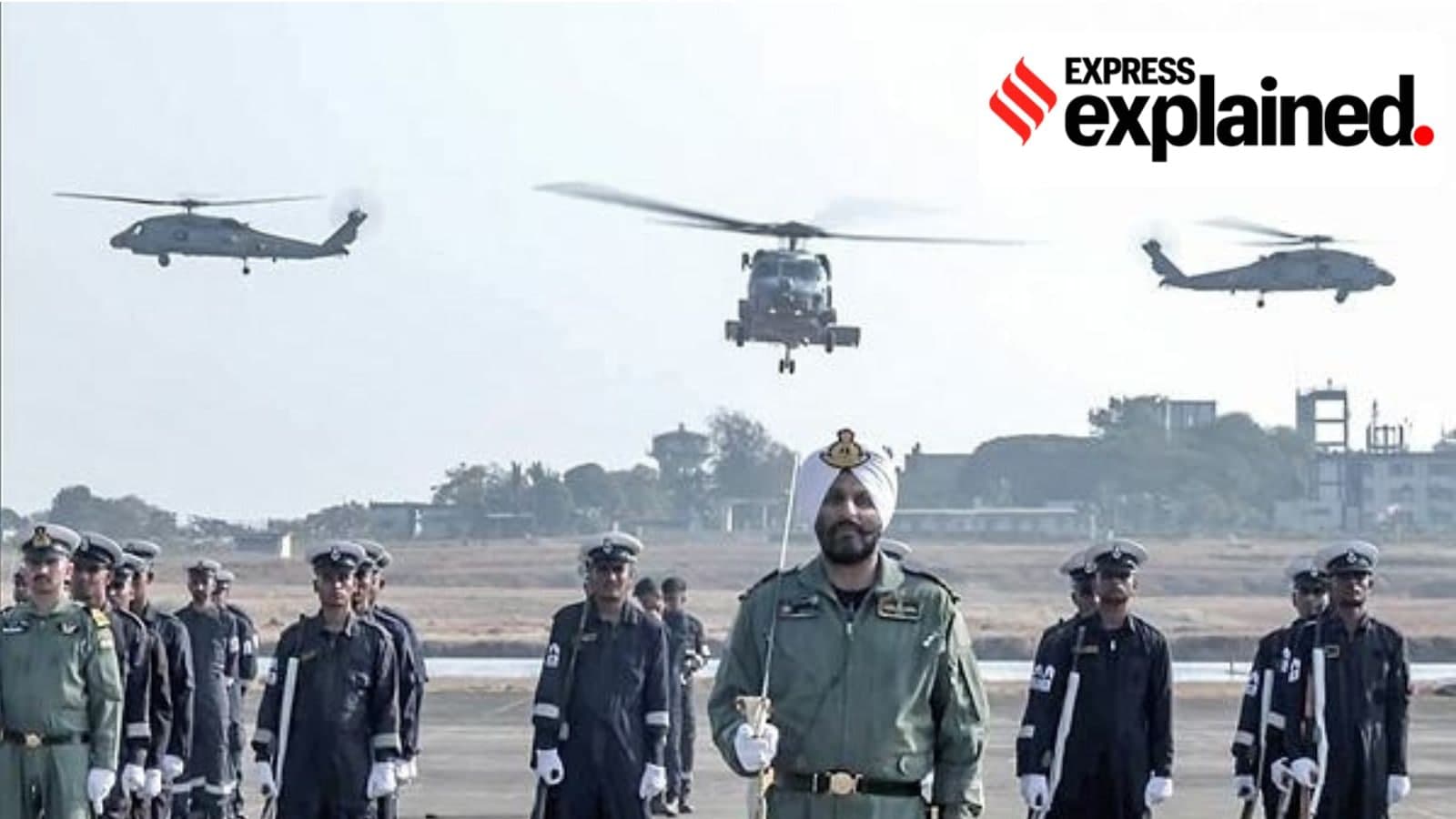
Content unavailable for Navy's second Seahawks squadron induction details.
Summary
The provided article content is unavailable, making it impossible to generate a detailed summary about the Indian Navy's induction of its second Seahawks squadron. Critical details such as the specific induction date, number of helicopters, their technical specifications, or strategic implications for India's defence capabilities cannot be extracted. Therefore, a comprehensive analysis for competitive exam preparation is not feasible.
Key Points
- 1Specific details regarding the Indian Navy's second Seahawks squadron induction are unavailable due to missing article content.
- 2The type of aircraft, Seahawks, is mentioned in the title, but no further specifics can be extracted.
- 3The article's purpose was to explain their capabilities and boost to India's defence, but information is missing.
- 4Key facts like induction date, squadron name, or number of helicopters are not provided in the absence of content.
- 5Without content, the strategic significance for competitive exams cannot be elaborated with specific data points.
In-Depth Analysis
While the specific content of the article regarding the Indian Navy's induction of its second Seahawks squadron is unavailable, the topic itself is of immense strategic importance for India's defence capabilities and deserves a thorough analysis based on general knowledge and publicly available information. The induction of the MH-60R Seahawk multi-role helicopters represents a significant leap in the Indian Navy's operational readiness and maritime security posture.
**Background Context and What Happened:**
India has long sought to modernize its naval helicopter fleet, a critical component for its blue-water ambitions and maritime security needs in the vast Indian Ocean Region (IOR). The existing fleet, primarily comprising aging Sea King helicopters, was nearing obsolescence, creating a significant capability gap, particularly in anti-submarine warfare (ASW) and anti-surface warfare (ASuW). This gap was keenly felt given the increasing submarine activity in the IOR and the evolving geopolitical landscape. After a prolonged procurement process, India signed a deal with the United States in February 2020 for 24 MH-60R Seahawk helicopters under a Foreign Military Sales (FMS) agreement, valued at approximately $2.6 billion. The MH-60R, manufactured by Lockheed Martin, is considered the world's most advanced maritime helicopter, capable of a wide range of missions including ASW, ASuW, naval gunfire support, search and rescue (SAR), and special operations support. The induction of a 'second squadron' signifies the ongoing, phased delivery and operationalization of these critical assets. The first squadron, INAS 334 'Seahawks', was commissioned at INS Garuda, Kochi, in March 2024, marking the formal integration of these advanced platforms into the Navy's arsenal.
**Key Stakeholders Involved:**
Several key players are central to this development. The **Indian Navy** is the primary end-user, integrating these helicopters onto its frontline warships, including destroyers, frigates, and potentially aircraft carriers. The **Ministry of Defence (MoD)** and the **Government of India** are the policy-makers and decision-makers, overseeing the procurement process, strategic planning, and allocation of resources. The **United States Government**, through its FMS program, acts as the seller, facilitating the transfer of technology and equipment. **Lockheed Martin**, the manufacturer, is responsible for the production, delivery, and initial support for these helicopters. Furthermore, Indian defence Public Sector Undertakings (PSUs) and private sector entities may eventually become stakeholders in maintenance, repair, and overhaul (MRO) activities, aligning with the 'Make in India' initiative.
**Why This Matters for India:**
This induction is crucial for India on multiple fronts. From a **defence capabilities** perspective, the MH-60R significantly bolsters the Navy's ASW capabilities, a vital deterrent against potential adversaries. Its advanced sensors, sonars, and torpedoes provide an unparalleled advantage in detecting and neutralizing submarines. Similarly, its ASuW capabilities, with missiles like Hellfire, enhance the Navy's ability to engage surface threats. This enhances India's maritime domain awareness and power projection in the IOR, securing crucial sea lanes of communication (SLOCs) and protecting its vast coastline and island territories. Strategically, it strengthens the **India-US defence partnership**, fostering greater interoperability and mutual trust. It also sends a strong signal regarding India's commitment to modernizing its armed forces and its role as a net security provider in the Indo-Pacific. Beyond combat roles, the Seahawks will significantly improve the Navy's **Humanitarian Assistance and Disaster Relief (HADR)** capabilities, given their robust SAR and utility functions.
**Historical Context and Future Implications:**
The journey to acquire modern multi-role helicopters has been long and arduous for India. The Sea King helicopters, which served the Navy for decades, were acquired from the UK in the 1970s and 80s. Their eventual phasing out underscored the urgent need for replacements. The MH-60R deal marks a new chapter, symbolizing India's pivot towards advanced Western military technology and strategic partnerships. Looking ahead, the full operationalization of all 24 MH-60R helicopters will see them integrated across various naval platforms, enhancing the combat punch of India's surface fleet. This will further solidify India's position as a formidable maritime power in the IOR. Future implications also include potential for greater indigenous content in MRO and even manufacturing, as India pushes for self-reliance under the 'Aatmanirbhar Bharat' initiative in defence. This acquisition also fits into India's broader Indo-Pacific strategy, where naval power plays a pivotal role in maintaining regional stability and a rules-based international order.
**Related Constitutional Articles, Acts, or Policies:**
While no specific constitutional article dictates military procurement, the **Seventh Schedule of the Indian Constitution, Union List (List I), Entry 2**, grants the Union Parliament exclusive power over "Naval, military and air forces; any other armed forces of the Union." This forms the constitutional basis for the Union government's authority to manage and equip the armed forces. **Article 53** states that the President shall be the Supreme Commander of the Defence Forces of the Union. From a policy perspective, the procurement falls under the **Defence Acquisition Procedure (DAP) 2020**, which governs all defence capital acquisitions, emphasizing transparency, indigenization, and efficiency. The 'Make in India' in defence policy, part of the broader 'Aatmanirbhar Bharat' vision, also influences the long-term support and potential future upgrades for these platforms within India.
Exam Tips
This topic falls under UPSC GS Paper III (Internal Security & Defence Technology) and GS Paper II (International Relations - India-US Defence Ties). For SSC/State PSC exams, it's relevant for Current Affairs and General Awareness (Defence News).
Study the technical specifications and multi-role capabilities of the MH-60R Seahawk (ASW, ASuW, SAR, utility). Understand the significance of 'multi-role' for naval operations. Also, link this to India's broader naval modernization efforts and specific projects.
Common question patterns include factual questions (e.g., origin country, number of helicopters, primary role), analytical questions (e.g., strategic impact on India's maritime security, role in Indo-Pacific, strengthening India-US ties), and policy-based questions (e.g., relevance of DAP 2020 or 'Make in India' in such acquisitions).