



Relevant for Exams
Kavach ATP system installed on 2,000 km of rail network, informs Minister Vaishnaw.
Summary
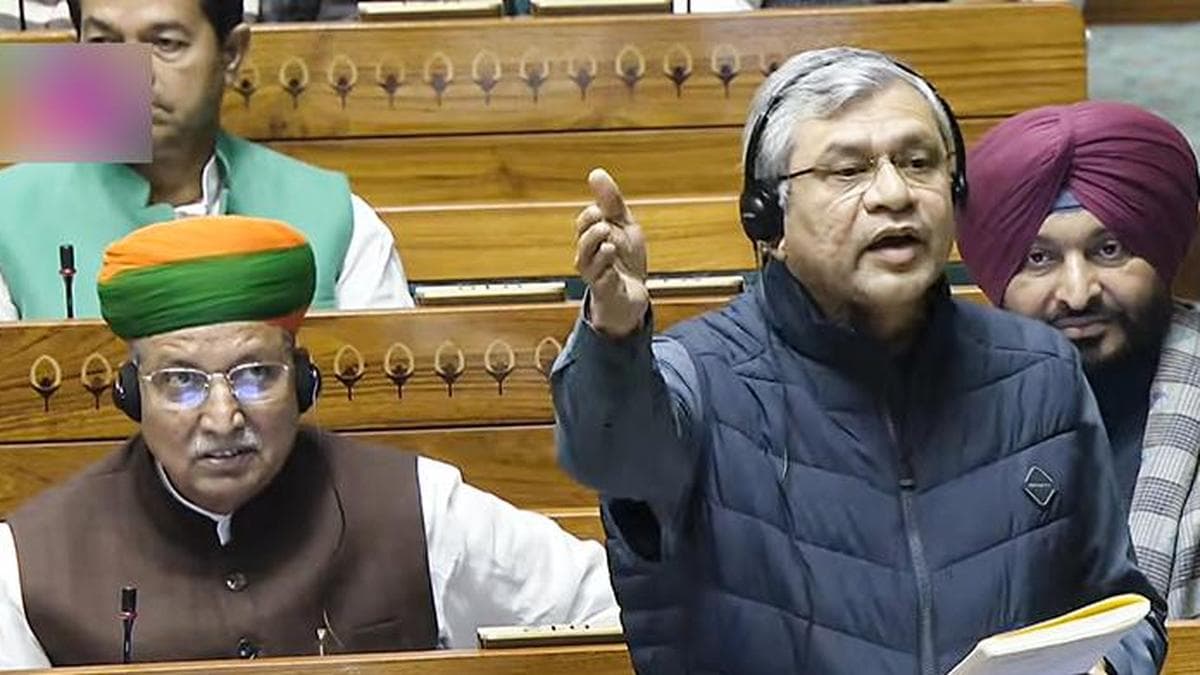
Railway Minister Ashwini Vaishnaw informed the Lok Sabha about the rapid progress of Kavach, India's indigenous Automatic Train Protection (ATP) system. It has been installed on 2,000 km of rail network, significantly enhancing railway safety. This initiative is crucial for competitive exams as it highlights government efforts in infrastructure modernization and technological adoption for public safety.
Key Points
- 1Kavach, India's indigenous Automatic Train Protection (ATP) system, has been installed on 2,000 km of the rail network.
- 2The information was provided by Railway Minister Ashwini Vaishnaw in the Lok Sabha.
- 3The Railways has laid 7,129 km of Optical Fibre Cable (OFC) as part of the system's infrastructure.
- 4A total of 4,154 locomotives have been equipped with the Kavach system.
- 5The initiative includes connecting 767 stations to data centres and deploying trackside equipment along 3,413 km.
In-Depth Analysis
The recent announcement by Railway Minister Ashwini Vaishnaw in the Lok Sabha regarding the rapid progress of 'Kavach' – India's indigenous Automatic Train Protection (ATP) system – marks a significant stride in enhancing railway safety and modernizing the nation's vast rail network. With Kavach installed on 2,000 km of the rail network and substantial infrastructure development, this initiative is a testament to India's commitment to technological self-reliance and public safety.
**The Genesis of Kavach: A Quest for Safety**
The Indian Railways, one of the world's largest rail networks, has historically grappled with the challenge of railway accidents, particularly those caused by human error like signal passing at danger (SPAD) and head-on collisions. Recognizing the urgent need for a robust safety mechanism, the Research Designs & Standards Organisation (RDSO), the research arm of Indian Railways, embarked on developing an indigenous ATP system. This initiative was part of a broader vision to enhance safety, efficiency, and reliability, aligning perfectly with the 'Make in India' and 'Atmanirbhar Bharat' policies. Earlier attempts at ATP systems often involved costly imports or partial solutions, highlighting the necessity for a cost-effective, scalable, and domestically developed alternative. Kavach, initially known as Train Collision Avoidance System (TCAS), was conceptualized to fulfill this critical requirement.
**How Kavach Works and Its Current Progress**
Kavach operates on the principle of preventing collisions by automatically applying brakes if a driver fails to control the train according to speed restrictions or if another train is detected on the same track. It uses a combination of global positioning system (GPS), radio communication, and trackside equipment to continuously monitor train movements and signals. The system provides an alert to the loco pilot, takes control of the train if necessary, and ensures adherence to speed limits. The Minister's statement highlighted impressive progress: 2,000 km of network covered, 7,129 km of Optical Fibre Cable (OFC) laid for communication, 860 telecom towers installed, 767 stations connected to data centres, 3,413 km of trackside equipment deployed, and 4,154 locomotives equipped. These figures underscore the comprehensive infrastructure overhaul required for such a sophisticated system.
**Key Players in India's Railway Safety Revolution**
The primary stakeholders driving this initiative include the **Ministry of Railways** and the **Railway Board**, responsible for policy formulation, funding, and overall implementation. The **Research Designs & Standards Organisation (RDSO)** is the intellectual backbone, having developed and standardized the Kavach technology. Various **Public Sector Undertakings (PSUs)** under the Ministry of Railways, along with private sector partners, are involved in the manufacturing, supply, and installation of the equipment. The **Lok Sabha**, as the legislative body, plays a crucial role in parliamentary oversight, accountability, and approving budgetary allocations for such large-scale infrastructure projects. The Minister's address there demonstrates governmental transparency and commitment.
**Transformative Impact for India**
The widespread implementation of Kavach holds immense significance for India. Foremost is the enhanced **safety** for millions of passengers and railway personnel, drastically reducing the risk of collisions and derailments due to human error. This boosts public confidence in railway travel. Economically, a safer and more reliable rail network translates into fewer disruptions, faster movement of freight and passengers, and improved operational efficiency, which contributes to the nation's GDP. The indigenous nature of Kavach aligns with the 'Make in India' initiative, fostering domestic manufacturing, creating jobs, and reducing reliance on foreign technology, thereby saving foreign exchange. It positions India as a leader in developing advanced railway safety solutions, potentially opening avenues for export to other developing nations.
**Constitutional and Policy Framework**
The development and deployment of Kavach are deeply intertwined with India's constitutional and policy framework. Railways fall under **Entry 22 of the Union List (List I) in the Seventh Schedule** of the Indian Constitution, granting the Union Parliament exclusive power to legislate on railways. This central control facilitates nationwide implementation of uniform safety standards. The government's push for 'Make in India' and 'Atmanirbhar Bharat' is a key policy driver, promoting self-reliance in critical sectors. While no specific constitutional article directly mandates ATP systems, the broader Directive Principles of State Policy (DPSP), particularly **Article 38** (State to secure a social order for the promotion of welfare of the people) and **Article 47** (duty of the State to raise the level of nutrition and the standard of living and to improve public health), implicitly support government initiatives that enhance public safety and welfare, such as Kavach. The **Railway Act, 1989**, provides the legal framework for the operation and safety of railways in India.
**The Road Ahead: Future Implications**
The successful rollout of Kavach on 2,000 km is just the beginning. The Indian Railways has an ambitious target to cover 34,000 km of high-density routes with Kavach. This phased implementation will progressively make the entire network safer and more efficient. Future implications include the potential for Kavach to be integrated with other smart railway technologies like predictive maintenance, real-time tracking, and automated diagnostics, leading to a truly intelligent rail network. This indigenous success story could also pave the way for India to become a global supplier of advanced railway technology, bolstering its position in the international market. The continuous monitoring and upgradation of the system will be crucial to adapting to evolving technological landscapes and operational needs, ensuring that Indian Railways remains at the forefront of safety and innovation.
Exam Tips
This topic falls under 'General Science & Technology' (specifically, indigenous technology and infrastructure development), 'Indian Economy' (infrastructure, 'Make in India' policy), and 'Current Affairs' (national importance) sections of competitive exams like UPSC, SSC, Banking, and State PSCs.
Study related topics such as the National Rail Plan 2030, other railway modernization projects (e.g., Dedicated Freight Corridors, high-speed rail), government policies like 'Make in India' and 'Atmanirbhar Bharat', and the structure and functions of Indian Railways (including RDSO).
Common question patterns include factual questions (What is Kavach? What is its primary function? Who developed it? How many kilometers covered?), conceptual questions (Significance of Kavach for India's economy/safety, link to 'Make in India'), and policy-based questions (Government's vision for railway safety, constitutional provisions related to railways).
Related Topics to Study
Full Article
The Minister said the Railways has so far laid 7,129 km of OFC, installed 860 telecom towers, connected 767 stations to data centres, deployed trackside equipment along 3,413 km, and equipped 4,154 locomotives with the system