



Relevant for Exams
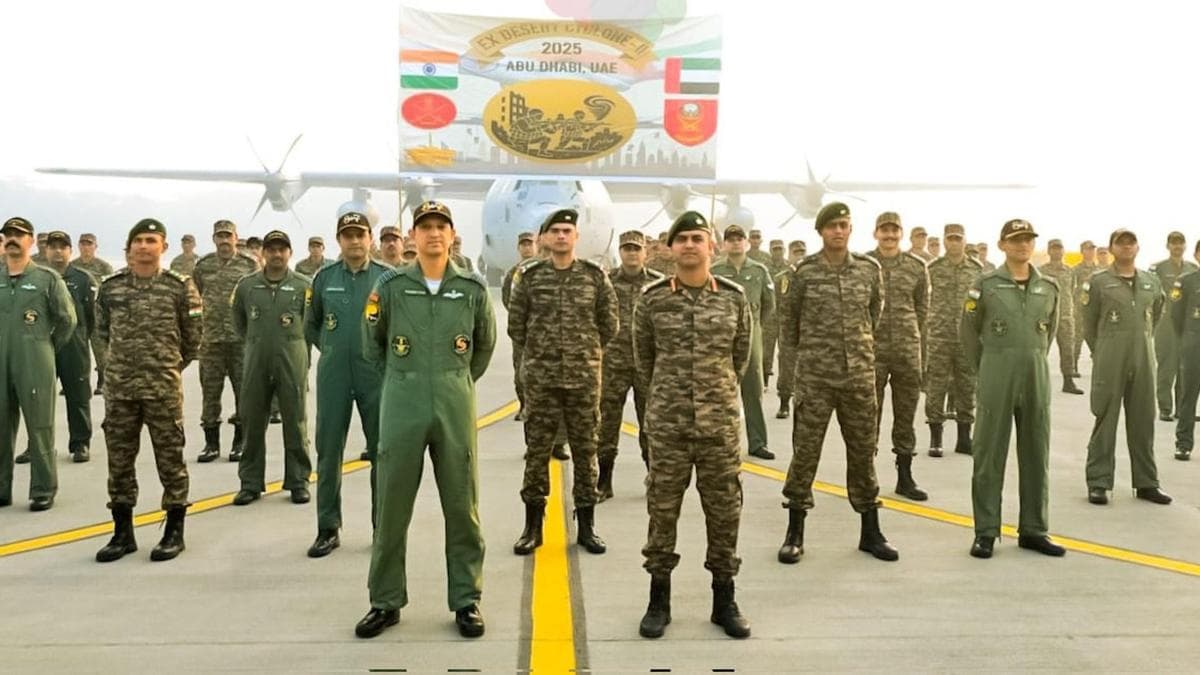
Indian Army contingent leaves for India-U.A.E. joint exercise 'Desert Cyclone II' in Abu Dhabi.
Summary
An Indian Army contingent has departed for Abu Dhabi, U.A.E., to participate in the second edition of the joint military exercise 'Desert Cyclone'. This exercise aims to bolster interoperability and defence cooperation between India and the U.A.E., specifically focusing on enhancing capabilities for urban operations. Such bilateral defence exercises are crucial for strengthening strategic ties and are a recurring topic in competitive exams under international relations and defence.
Key Points
- 1The joint military exercise is named 'Desert Cyclone II'.
- 2The exercise involves an Indian Army contingent and forces from the U.A.E.
- 3The location for 'Desert Cyclone II' is Abu Dhabi, U.A.E.
- 4The primary objective is to enhance interoperability and defence cooperation between India and U.A.E.
- 5The exercise specifically focuses on improving capabilities for urban operations.
In-Depth Analysis
The 'Desert Cyclone II' joint military exercise between India and the United Arab Emirates (U.A.E.) represents a significant stride in bolstering the strategic partnership between the two nations. An Indian Army contingent's departure for Abu Dhabi underscores the commitment to enhancing defence cooperation and interoperability, particularly in the challenging domain of urban operations. This exercise is not merely a routine military drill but a crucial component of India's broader foreign policy and strategic outreach.
**Deepening Bilateral Ties: A Historical Perspective**
India's relationship with the U.A.E. has historically been robust, rooted in centuries of trade and cultural exchange, significantly amplified by the presence of a large Indian diaspora. Initially driven by economic imperatives, especially energy security and trade, the relationship has evolved into a comprehensive strategic partnership. This elevation was formalized during Prime Minister Narendra Modi's visit to the U.A.E. in 2015, marking a shift from a purely economic partnership to one encompassing defence, security, and counter-terrorism cooperation. The U.A.E. is a vital partner for India, being its third-largest trading partner and a major source of crude oil. The strategic partnership was further solidified in 2017, leading to increased high-level exchanges and institutionalized dialogues across various sectors, including defence.
**The 'Desert Cyclone' Series and its Objectives**
'Desert Cyclone II' is the second iteration of this bilateral exercise, building upon the foundation laid by its predecessor. The primary objective is to enhance interoperability between the Indian and U.A.E. armies. Interoperability refers to the ability of different armed forces to operate effectively together, sharing common doctrines, procedures, and equipment where possible. This is crucial for joint operations, especially in complex environments. The specific focus on 'urban operations' reflects the contemporary challenges of modern warfare, where conflicts often occur in densely populated areas, requiring specialized tactics, training, and coordination. Such exercises also facilitate the exchange of best practices, tactical knowledge, and expertise in areas like counter-terrorism, special operations, and logistics.
**Key Stakeholders and Their Motivations**
The primary stakeholders are the Indian Army and the U.A.E. Armed Forces, guided by their respective Ministries of Defence and External Affairs. For India, engaging in such exercises is multi-faceted. It aligns with its 'Look West' policy, aiming to strengthen ties with countries in the Gulf region, which are critical for India's energy security and economic interests. It also serves India's broader defence diplomacy objectives, projecting its military capabilities and commitment to regional stability. From the U.A.E.'s perspective, collaboration with India, a rising global power with a significant military, offers opportunities to modernize its armed forces, enhance its operational capabilities, and address shared security concerns, particularly those related to regional instability and the threat of terrorism. Both nations also share concerns about maritime security in the Indian Ocean Region.
**Significance for India**
This exercise holds immense significance for India. Strategically, it diversifies India's defence partnerships beyond traditional allies, enhancing its strategic autonomy. It strengthens India's position as a net security provider in the Indian Ocean Region. Economically, closer defence ties often translate into broader economic cooperation, including potential defence exports from India and increased trade and investment. Politically, it deepens the comprehensive strategic partnership, fostering mutual trust and understanding. Furthermore, in the context of global counter-terrorism efforts, sharing intelligence and operational expertise gained through such exercises is invaluable for both nations in combating extremist threats.
**Constitutional and Policy Framework**
While no specific constitutional article directly mandates joint military exercises, they are an integral part of India's foreign policy and defence strategy, falling under the Executive's powers. The conduct of such exercises is consistent with the Directive Principles of State Policy, particularly **Article 51**, which enjoins the State to endeavor to promote international peace and security, maintain just and honorable relations between nations, and foster respect for international law. The Ministry of Defence, in coordination with the Ministry of External Affairs, is responsible for executing such initiatives, which are guided by India's broader national security policy and defence doctrines. These exercises are a practical manifestation of India's 'Act East' and 'Look West' policies, aiming to secure its interests across extended neighbourhood.
**Future Implications**
'Desert Cyclone II' is expected to further solidify the defence pillar of the India-U.A.E. strategic partnership. Future implications could include more frequent and complex joint exercises, potential for defence technology exchange, joint research and development, and even collaboration in defence production. This enhanced cooperation could also lead to greater coordination on regional security issues, counter-piracy operations, and humanitarian assistance and disaster relief (HADR) efforts. A stronger India-U.A.E. defence axis contributes to the stability of the Gulf region, which is crucial for global energy markets and trade routes, directly impacting India's economic well-being.
In conclusion, 'Desert Cyclone II' is a testament to the growing strategic convergence between India and the U.A.E., moving beyond traditional economic ties to a robust defence and security partnership. Such exercises are vital for addressing contemporary security challenges and reinforcing India's strategic footprint in a critical geopolitical region.
Exam Tips
This topic primarily falls under GS Paper 2 (International Relations) and GS Paper 3 (Internal Security & Defence) for UPSC Civil Services Exam. For SSC, Banking, Railway, and State PSC exams, it's relevant under General Awareness/Current Affairs.
When studying, focus on the name of the exercise ('Desert Cyclone'), participating countries (India, U.A.E.), location (Abu Dhabi), and the primary objective (interoperability, urban operations). Also, understand the broader context of India's relations with the U.A.E.
Common question patterns include direct questions like 'Which two countries participate in 'Desert Cyclone'?' or 'What is the primary focus of 'Desert Cyclone'?' You might also encounter analytical questions on India's strategic partnerships in the Middle East or the significance of defence diplomacy.
Relate this exercise to India's 'Look West' policy and its overall foreign policy objectives, especially concerning energy security and counter-terrorism. Understand how defence cooperation strengthens diplomatic and economic ties.
Pay attention to the type of forces involved (Army, Navy, Air Force) for different exercises, as this can be a distinguishing factor. For 'Desert Cyclone', it's the Army.
Related Topics to Study
Full Article
Exercise in Abu Dhabi aims to enhance interoperability and defence cooperation in urban operations