

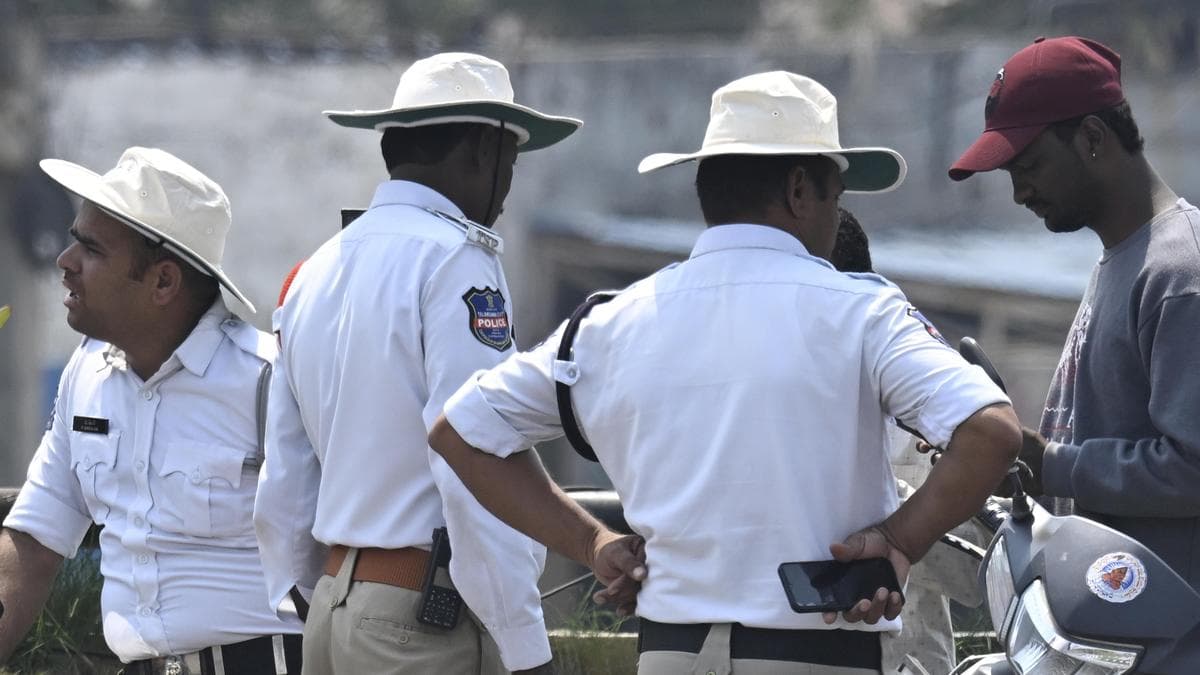


Relevant for Exams
Cyberabad Police issue ₹2.52 Cr challans for 51,389 violations via WhatsApp citizen complaints.
Summary
Cyberabad traffic police issued challans worth ₹2.52 crore for 51,389 violations across 45 categories between January and December 15, 2025, leveraging citizen-led enforcement via WhatsApp. This initiative highlights the increasing role of technology and public participation in traffic management, significantly tripling mobile phone driving cases since May. It's crucial for understanding e-governance and smart policing trends for competitive exams.
Key Points
- 1Cyberabad traffic police issued challans totaling ₹2.52 crore.
- 2A total of 51,389 traffic violations were booked.
- 3The violations were recorded across 45 different categories.
- 4The enforcement period was from January to December 15, 2025.
- 5Mobile phone driving cases specifically tripled since May, enforced through WhatsApp complaints.
In-Depth Analysis
The recent success of the Cyberabad traffic police in issuing challans worth ₹2.52 crore for over 51,000 violations via WhatsApp, leveraging citizen-led enforcement, represents a significant stride in India's journey towards smart policing and e-governance. This initiative, which saw a tripling of mobile phone driving cases booked since May, highlights the transformative potential of technology and public participation in addressing critical urban challenges.
**Background Context and the Need for Innovation:**
India's urban centers grapple with alarming rates of traffic violations, congestion, and road accidents. Traditional policing methods, often constrained by manpower shortages and limited surveillance infrastructure, have struggled to ensure widespread compliance with traffic laws. This often leads to a perception of impunity among violators, further exacerbating the problem. The sheer volume and complexity of traffic management in rapidly expanding cities like Hyderabad necessitated innovative solutions. The increasing penetration of smartphones and internet connectivity among citizens provided a fertile ground for exploring technology-driven, community-centric enforcement models.
**The Cyberabad Model: What Happened?**
Between January and December 15, 2025, the Cyberabad traffic police implemented a proactive system allowing citizens to report traffic violations through WhatsApp. Citizens could capture photographic or video evidence of violations across 45 categories – ranging from improper parking and signal jumping to, notably, driving while using a mobile phone – and submit them directly to the police. This citizen-generated evidence was then verified by the authorities, leading to the issuance of e-challans. The impressive figures of 51,389 violations booked and ₹2.52 crore collected in fines underscore the efficacy and scalability of this model. The dramatic increase in mobile phone driving cases booked specifically highlights the initiative's success in targeting specific dangerous behaviors.
**Key Stakeholders Involved:**
1. **Cyberabad Traffic Police:** As the implementing agency, they designed and managed the system, verified complaints, and issued challans. Their role is crucial in building trust and ensuring the integrity of the process.
2. **Citizens (Complainants):** The backbone of this initiative, citizens act as vigilant eyes, actively participating in law enforcement by reporting violations. Their engagement is driven by a desire for safer roads and a more disciplined civic environment.
3. **Vehicle Owners/Drivers (Violators):** These are the subjects of enforcement, whose behavior is intended to be modified by the threat of penalty and increased surveillance.
4. **Government (State and Central):** Provides the policy framework, legal backing, and technological infrastructure (e.g., Digital India initiatives) that enable such smart policing projects.
**Significance for India:**
This initiative holds profound significance for India across several dimensions. Firstly, it embodies the spirit of **e-governance and the Digital India program**, leveraging digital platforms to enhance public service delivery and citizen engagement. It promotes transparency and reduces human intervention, potentially mitigating issues like corruption. Secondly, it marks a shift towards **smart policing**, where technology, data analytics, and community participation are integrated to create a more efficient and responsive law enforcement system. Thirdly, by empowering citizens, it fosters a sense of **civic responsibility and collective ownership** in maintaining public order and safety. This collaborative approach can lead to a more disciplined traffic culture and, consequently, a reduction in road accidents, which remain a major public health concern in India. Economically, the collection of fines contributes to state revenue, which can be reinvested in infrastructure or public services. Socially, safer roads improve quality of life and reduce the burden on healthcare systems.
**Legal and Policy Framework:**
This initiative is firmly rooted in India's legal and policy landscape. The primary legal instrument is the **Motor Vehicles Act, 1988**, significantly bolstered by the **Motor Vehicles (Amendment) Act, 2019**. The 2019 amendment introduced stricter penalties for various traffic offenses and explicitly recognized electronic monitoring and enforcement, including through photographic and video evidence. This provides the statutory basis for issuing challans based on citizen-submitted digital proof. The **Information Technology Act, 2000**, provides the legal framework for the validity of electronic records and digital evidence. From a constitutional perspective, while not directly providing for traffic enforcement, the state's duty to ensure public safety aligns with the spirit of **Article 21 (Right to Life and Personal Liberty)**, which has been interpreted to include the right to a safe environment. However, such initiatives also raise concerns about **privacy**, a fundamental right affirmed by the Supreme Court in the Puttaswamy judgment (2017) under Article 21. Ensuring proper verification, data protection, and preventing misuse of citizen-submitted data is crucial.
**Future Implications:**
The success of Cyberabad's model paves the way for its replication in other Indian cities, potentially transforming traffic management nationwide. Future advancements could involve the integration of Artificial Intelligence (AI) and Machine Learning (ML) for automated detection and verification of violations, further reducing manual intervention. However, challenges remain, including ensuring data privacy, preventing frivolous or malicious complaints, and standardizing verification protocols. The long-term impact will depend on sustained public trust, robust technological infrastructure, and a clear legal framework that balances enforcement efficiency with individual rights. Ultimately, such initiatives contribute to building a more accountable, tech-savvy, and citizen-centric governance model in India.
Exam Tips
This topic falls under 'Governance', 'Internal Security', 'Science & Technology', and 'Current Affairs' sections of competitive exam syllabi. Focus on the convergence of technology and administration.
Study the Motor Vehicles (Amendment) Act, 2019, in detail, especially provisions related to electronic enforcement, penalties, and road safety authorities. Understand how it enables initiatives like this.
Be prepared for questions on e-governance initiatives, smart policing concepts, citizen participation in governance, and the ethical/legal implications (e.g., privacy concerns) of technology in law enforcement. Case studies related to successful digital initiatives are common.
Understand the broader context of Digital India program, Smart Cities Mission, and their objectives. This initiative is a practical example of these policies in action.
Practice analyzing the pros and cons of such initiatives, including efficiency, transparency, citizen empowerment, and potential challenges like data misuse or verification issues.
Related Topics to Study
Full Article
Between January and December 15, 2025, Cyberabad traffic police booked 51,389 violations across 45 categories through WhatsApp complaints, with mobile phone driving cases tripling since May