



Relevant for Exams
PM Modi in Jordan, Jaishankar in Israel: India reiterates West Asia peace stance.
Summary
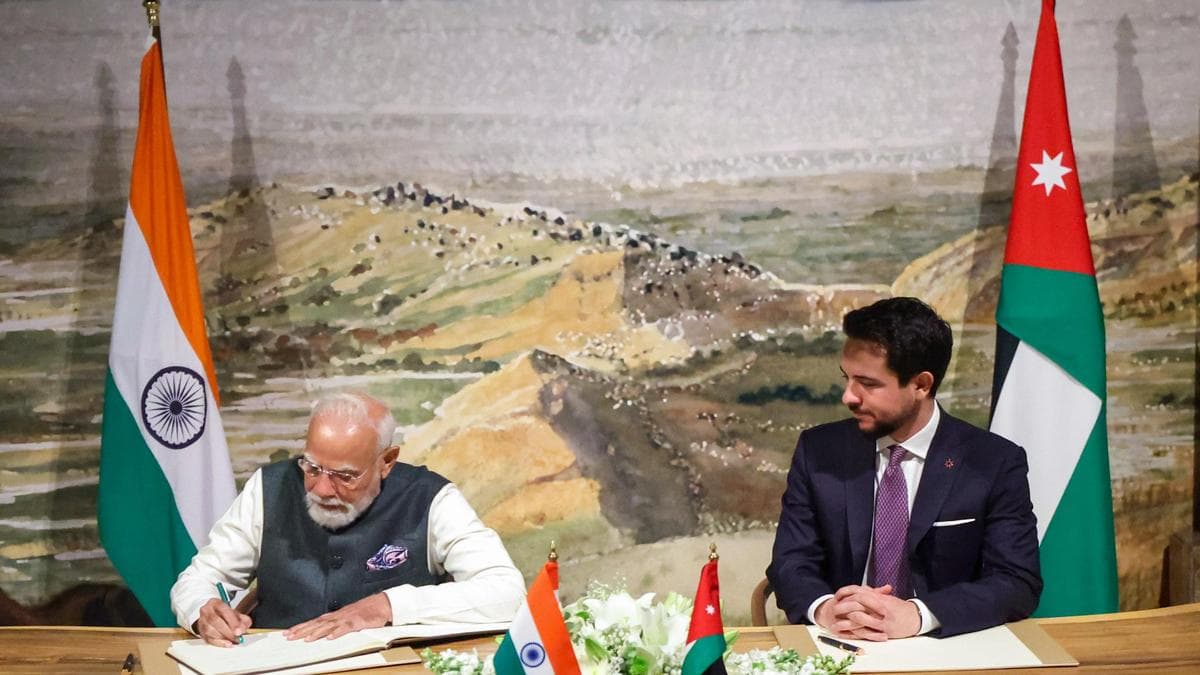
Prime Minister Narendra Modi visited Jordan, meeting King Abdullah II, where India reaffirmed its commitment to achieving durable peace in West Asia. This diplomatic engagement, alongside External Affairs Minister S. Jaishankar's concurrent visit to Israel, underscores India's active and balanced foreign policy approach in the complex West Asian region. This is significant for understanding India's stand on international relations for competitive exams.
Key Points
- 1Prime Minister Narendra Modi visited Jordan for diplomatic engagements.
- 2PM Modi held a meeting with Jordan’s King Abdullah II.
- 3India reaffirmed its support for achieving "durable peace" in the West Asian region.
- 4External Affairs Minister S. Jaishankar was concurrently visiting Israel.
- 5These visits highlight India's active and balanced foreign policy towards West Asian conflicts.
In-Depth Analysis
India's foreign policy in the complex and volatile West Asian region has historically been characterized by a delicate balancing act, driven by strategic, economic, and historical imperatives. The recent diplomatic engagements, with Prime Minister Narendra Modi visiting Jordan and External Affairs Minister S. Jaishankar concurrently in Israel, vividly underscore this nuanced approach. This dual visit, where India reaffirmed its commitment to "durable peace" in West Asia, is a testament to India's evolving and pragmatic foreign policy, moving beyond traditional alignments to foster comprehensive partnerships with all regional stakeholders.
The background to India's engagement in West Asia is multifaceted. Historically, India maintained strong ties with Arab nations and the Palestinian cause, rooted in its anti-colonial stance and the principles of the Non-Aligned Movement (NAM). Leaders like Jawaharlal Nehru were vocal proponents of Palestinian self-determination. However, since the establishment of full diplomatic relations with Israel in 1992, India's policy has gradually shifted towards 'de-hyphenation,' meaning its relationship with Israel is no longer viewed through the prism of its ties with Palestine or the wider Arab world. This allows India to pursue parallel and independent engagements, maximizing its strategic autonomy and national interests.
What precisely happened was a significant diplomatic maneuver. Prime Minister Modi's meeting with Jordan's King Abdullah II, a key Arab leader and custodian of Muslim holy sites in Jerusalem, provided a platform for India to reiterate its support for regional peace and stability. Jordan, sharing a long border with Israel and host to a large Palestinian refugee population, is a crucial voice in the Arab world regarding the Israeli-Palestinian conflict. Concurrently, External Affairs Minister Jaishankar's visit to Israel highlighted the deepening strategic partnership between India and Israel, encompassing defense, technology, agriculture, and water management. This simultaneous engagement effectively signaled India's ability to maintain excellent relations with both sides of the regional divide, emphasizing dialogue and cooperation over partisan alignment.
Key stakeholders involved include India, actively projecting its influence as a responsible global power; Jordan, a moderate Arab state critical for regional stability and a voice for the Palestinian cause; and Israel, a significant strategic partner for India in defense and technology. The Palestinian Authority, though not directly engaged in these specific visits, remains a central stakeholder whose aspirations for statehood India continues to support. Other regional players like Saudi Arabia, UAE, and Iran also indirectly influence the geopolitical dynamics, making India's balanced approach even more critical.
This matters immensely for India for several reasons. Firstly, **energy security** is paramount; West Asia remains India's primary source of crude oil and natural gas, making regional stability vital for India's economic growth. Secondly, the **Indian diaspora** in the Gulf region numbers over 8.5 million, contributing significantly through remittances and requiring robust consular support. Thirdly, **economic ties** with the entire region, encompassing trade, investment, and infrastructure projects, are substantial. Fourthly, India's **strategic autonomy** is reinforced by its capacity to engage all parties, allowing it to pursue its national interests without being constrained by historical baggage or external pressures. Lastly, cooperation on **counter-terrorism** and intelligence sharing with various regional actors is crucial for India's national security.
From a constitutional perspective, India's foreign policy is guided by **Article 51 of the Constitution**, which directs the State to "endeavour to (a) promote international peace and security; (b) maintain just and honourable relations between nations; (c) foster respect for international law and treaty obligations... and (d) encourage settlement of international disputes by arbitration." India's call for "durable peace" in West Asia directly aligns with this directive, emphasizing peaceful resolution and stable international relations. The 'Look West' policy, though not a specific constitutional article, is a strategic foreign policy initiative guiding India's comprehensive engagement with the extended West Asian region.
The future implications of this approach suggest India will continue to deepen its strategic partnerships across West Asia while consistently advocating for a two-state solution to the Israeli-Palestinian conflict. This balanced foreign policy positions India as a potential mediator or a bridge-builder, especially as new regional alignments emerge, such as those facilitated by the Abraham Accords. India's growing economic and strategic clout will likely lead to greater engagement, potentially involving more trilateral or multilateral initiatives focused on development, connectivity, and security, further solidifying its role as a significant player in global geopolitics.
Exam Tips
This topic falls primarily under GS Paper 2 (International Relations) of the UPSC Civil Services Exam. Focus on India's foreign policy principles, its relations with West Asian countries, and the geopolitical significance of the region.
Study related topics such as India-Israel relations, India-Palestine relations, India's 'Look West' policy, energy security challenges, and the historical evolution of the Israeli-Palestinian conflict. Understand the concept of 'de-hyphenation' in Indian foreign policy.
Common question patterns include analytical questions on India's strategic autonomy, essay questions on the challenges and opportunities for India in West Asia, and MCQs on specific diplomatic visits, agreements, or key regional organizations like the GCC. Be prepared to discuss the economic and security dimensions of India's engagement.
For SSC, Banking, Railway, and State PSC exams, focus on factual aspects: names of leaders, countries involved, key policy terms (e.g., durable peace, de-hyphenation), and the primary reasons for India's interest in the region (energy, diaspora, trade).
Related Topics to Study
Full Article
The government said that Prime Minister Narendra Modi, who met with Jordan’s King Abdullah II, “reaffirmed India’s support for efforts being made to achieve durable peace in the region”