



Relevant for Exams
Opposition protests new VB-G RAM G Bill aiming to replace MGNREGA; Congress plans nationwide agitation.
Summary
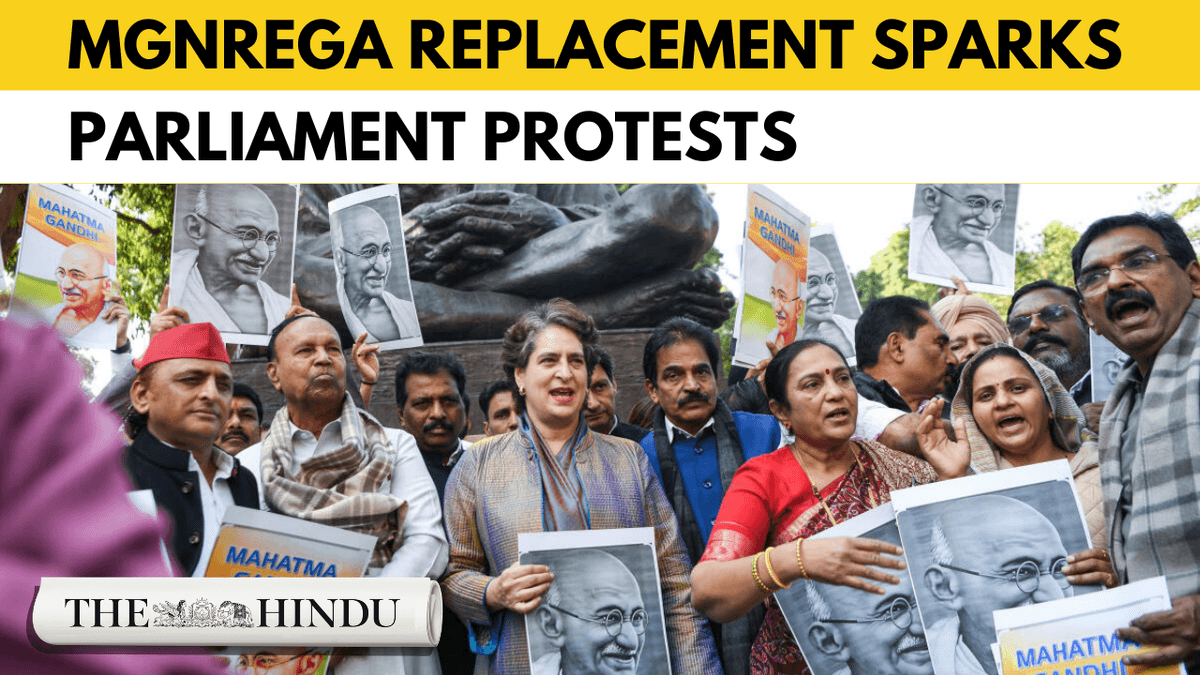
The VB-G RAM G Bill has been introduced in Parliament, aiming to replace the Mahatma Gandhi National Rural Employment Guarantee Act (MGNREGA). This move has triggered significant opposition protests within the Parliament complex, highlighting a major policy shift concerning rural employment. The Congress party has announced a nationwide agitation on Wednesday, underscoring the political and social importance of this legislative development for competitive exams.
Key Points
- 1The new legislative proposal is named the VB-G RAM G Bill.
- 2The primary objective of the VB-G RAM G Bill is to replace the existing MGNREGA.
- 3Opposition parties staged protests inside the Parliament complex following the bill's introduction.
- 4The Congress party announced a nationwide agitation to be held on Wednesday against the bill.
- 5MGNREGA (Mahatma Gandhi National Rural Employment Guarantee Act) is a significant social welfare scheme targeted for replacement.
In-Depth Analysis
The introduction of the VB-G RAM G Bill in Parliament, aimed at replacing the Mahatma Gandhi National Rural Employment Guarantee Act (MGNREGA), marks a pivotal moment in India's social welfare policy landscape. This legislative move has not only sparked intense opposition protests within the Parliament complex but also prompted the Congress party to announce a nationwide agitation, underscoring the deep political and social ramifications of such a change.
**Background Context: The Genesis and Impact of MGNREGA**
To truly understand the significance of this proposed change, one must first grasp the foundational role of MGNREGA. Enacted on August 25, 2005, as the National Rural Employment Guarantee Act (NREGA) and later renamed MGNREGA on October 2, 2009, it stands as one of the world's largest social welfare programs. Its core objective is to guarantee 100 days of wage employment in a financial year to every rural household whose adult members volunteer to do unskilled manual work. This rights-based approach, enshrined in law, aimed at poverty alleviation, rural development, and creating durable assets like roads, ponds, and irrigation canals. It has been lauded for providing a crucial safety net, especially during economic downturns, improving rural incomes, empowering women (as at least one-third of the beneficiaries must be women), and reducing distress migration. However, the scheme has also faced persistent criticisms, including issues related to delayed wage payments, allegations of corruption, creation of poor-quality assets, and administrative inefficiencies.
**What Happened: The Introduction and Immediate Fallout**
The government recently introduced the VB-G RAM G Bill in Parliament with the stated intention of replacing MGNREGA. While the specific details of the new bill are yet to be fully debated and disclosed, the very notion of replacing a well-established, rights-based welfare scheme like MGNREGA immediately drew sharp reactions. Opposition parties, particularly the Congress, viewing this as a potential dilution of social security measures for rural India, staged vehement protests inside the Parliament complex. This parliamentary uproar quickly escalated, with the Congress announcing a nationwide agitation to mobilize public opinion against the proposed legislation.
**Key Stakeholders Involved**
The stakeholders in this legislative battle are numerous and diverse. **The Central Government (ruling party)** is the primary proponent of the VB-G RAM G Bill, likely justifying it on grounds of enhancing efficiency, better asset creation, improved targeting of beneficiaries, or addressing the perceived shortcomings of MGNREGA. **Opposition parties**, led by the Congress, are staunchly opposing the move, fearing it could dismantle a vital social safety net, reduce employment guarantees, or weaken the rights-based framework. **Rural workers and their households**, who are the direct beneficiaries of MGNREGA, are arguably the most critical stakeholders, as their livelihoods and economic security will be directly impacted by any changes. **Civil Society Organizations (CSOs) and social activists** have historically played a crucial role in advocating for and monitoring MGNREGA, and they are expected to critically scrutinize the new bill. Finally, **State Governments** are also key stakeholders, as they are instrumental in the implementation of such large-scale welfare programs, and any policy shift from the Centre will necessitate significant administrative adjustments at the state level.
**Significance for India: Economic, Social, and Political Dimensions**
The replacement of MGNREGA carries immense significance for India. Economically, changes to the scheme could alter rural demand, consumption patterns, and poverty levels. A less robust employment guarantee could lead to increased rural distress, reverse gains in poverty reduction, and potentially fuel urban migration. Socially, MGNREGA has been a significant tool for empowering women and Scheduled Castes/Tribes, providing them with independent income. Any alteration could impact social equity and the economic independence of vulnerable groups. Politically, the issue is highly charged. MGNREGA has been a flagship program, and its proposed replacement is likely to become a major electoral issue, influencing public sentiment, especially in rural constituencies. It also highlights the ongoing debate about the nature and extent of state intervention in welfare provisioning.
**Constitutional and Policy Context**
MGNREGA draws its spirit from the **Directive Principles of State Policy (DPSP)** enshrined in Part IV of the Indian Constitution. Specifically, **Article 38** mandates the state to secure a social order for the promotion of welfare of the people, and **Article 39(a)** directs the state to secure that citizens, men and women equally, have the right to an adequate means of livelihood. Most importantly, **Article 41** directs the state, within the limits of its economic capacity and development, to make effective provision for securing the right to work, to education and to public assistance in cases of unemployment, old age, sickness and disablement. MGNREGA was a legislative embodiment of this 'right to work' in the rural context. The new VB-G RAM G Bill will be assessed against these constitutional ideals and the legal precedent set by a rights-based framework.
**Future Implications**
The passage of the VB-G RAM G Bill, if it occurs, will usher in a new era for rural employment policy. The key implications will depend on the specifics of the new legislation: whether it retains the legal guarantee of employment, its funding mechanism, eligibility criteria, wage rates, and the nature of assets to be created. It could potentially lead to a more targeted approach, greater technological integration, or perhaps a shift towards skill development. However, there are significant challenges: ensuring a smooth transition without disrupting livelihoods, maintaining the demand-driven nature of employment, and guaranteeing transparency and accountability. The political landscape will remain turbulent, with continued debates on social security, federalism in welfare delivery, and the government's approach to poverty alleviation. The success or failure of the new scheme will have profound implications for millions of rural Indians and for the future trajectory of India's inclusive growth agenda.
Exam Tips
This topic falls under the 'Indian Economy' (GS-III) and 'Social Justice' / 'Governance' (GS-II) sections of the UPSC Civil Services Syllabus. For SSC, Banking, and State PSC exams, it's relevant for General Awareness, Indian Polity, and Economy sections.
Study MGNREGA's key features, objectives, achievements, and criticisms in detail. Be prepared to compare and contrast it with the proposed VB-G RAM G Bill (once details are clearer), focusing on differences in scope, funding, and rights-based aspects.
Common question patterns include: 'Analyze the significance of MGNREGA in rural development and poverty alleviation.' 'Discuss the constitutional basis for social welfare schemes like MGNREGA.' 'Examine the potential implications of replacing MGNREGA with a new scheme.' 'Critically evaluate the arguments for and against the proposed changes to rural employment guarantee schemes.'
Pay attention to the constitutional articles related to Directive Principles of State Policy (DPSP), particularly Article 38, 39(a), and 41, as MGNREGA is a direct manifestation of these principles. Understand how a rights-based approach differs from a discretionary welfare scheme.
Keep track of the legislative process and any amendments or final details of the VB-G RAM G Bill as they emerge, as competitive exams often feature questions on current legislative developments and their impact.
Related Topics to Study
Full Article
Following protests inside the Parliament complex, the Congress announced a nationwide agitation on Wednesday