



Relevant for Exams
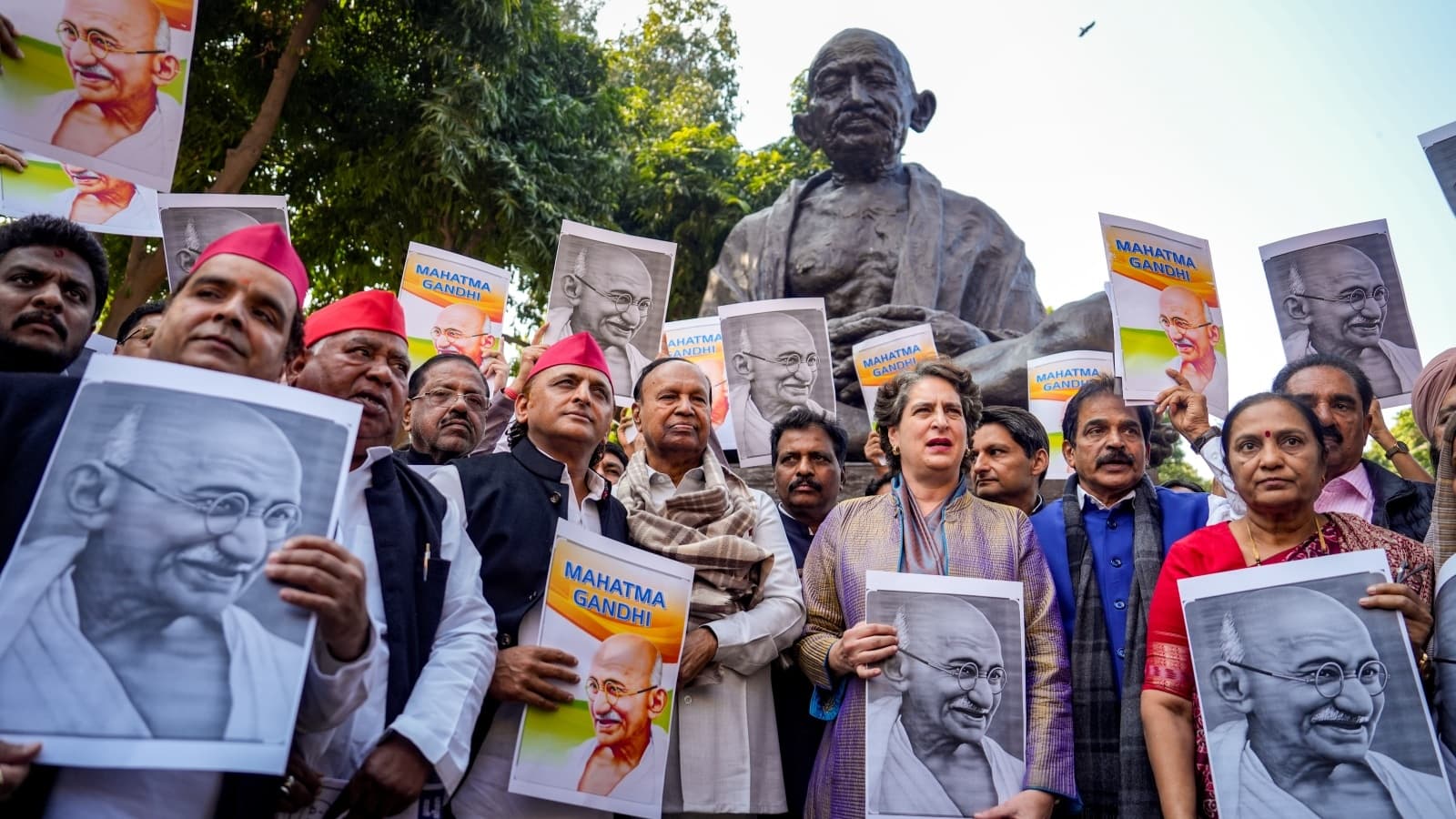
"VB-G RAM G BILL" introduced in Lok Sabha; Opposition protests Gandhi's name drop, Govt cites poor welfare.
Summary
A bill, identified as the "VB-G RAM G BILL," was introduced in the Lok Sabha, sparking protests from the Opposition over the alleged dropping of "Gandhi's name." The government defended the bill, asserting its priority is the welfare of the poor. This event highlights legislative processes and political debates over naming conventions, crucial for understanding parliamentary proceedings and government initiatives for competitive exams.
Key Points
- 1The "VB-G RAM G BILL" was formally introduced in the Lok Sabha.
- 2The Opposition registered protests specifically against the removal of "Gandhi's name" from the bill.
- 3The Government stated its primary justification for the bill as focusing on the "welfare of the poor."
- 4The bill's introduction occurred in the Lok Sabha, the lower house of the Indian Parliament.
- 5The incident reflects ongoing political debate regarding legislative naming and government policy priorities.
In-Depth Analysis
The introduction of the "VB-G RAM G BILL" in the Lok Sabha, accompanied by Opposition protests over the alleged removal of "Gandhi's name" and the government's defense citing "welfare of the poor," encapsulates a recurring theme in Indian politics: the interplay of symbolism, political legacy, and policy objectives. This incident, though specific, provides a rich lens through which to understand legislative processes, political discourse, and the administration of welfare programs in India.
**Background Context and What Happened:**
Historically, various welfare and developmental schemes in India have been named after prominent national leaders, particularly those from the Nehru-Gandhi family. This practice aimed to honor their contributions and associate the schemes with their vision for the nation. Examples include the Mahatma Gandhi National Rural Employment Guarantee Act (MGNREGA), Indira Awas Yojana (now Pradhan Mantri Awas Yojana - Gramin), and Rajiv Gandhi Grameen Vidyutikaran Yojana. The current government, since 2014, has often emphasized a shift towards renaming schemes to reflect either the current government's priorities (e.g., 'Pradhan Mantri' prefix) or to remove names associated with specific political dynasties, aligning with its broader ideological stance of promoting a 'new India' or a 'non-dynastic' approach. The "VB-G RAM G BILL" likely falls into this pattern, suggesting a legislative move to either rename an existing scheme that carried 'Gandhi' in its title or introduce a new scheme with similar objectives, but without the previously associated name. The government's justification of prioritizing the "welfare of the poor" underscores its claim that the essence of the program remains, irrespective of its nomenclature.
**Key Stakeholders Involved:**
1. **The Government (Ruling Party):** As the initiator of the bill, the government aims to implement its policy agenda, which often includes rebranding or restructuring existing welfare programs. Their stated priority is the "welfare of the poor," suggesting a focus on effective delivery and perhaps a desire to claim ownership of successful schemes.
2. **The Opposition Parties:** Their protest against the alleged removal of "Gandhi's name" is rooted in ideological differences, political legacy, and often a defense of the contributions of past leaders. For the Opposition, such renaming attempts are often perceived as an erasure of history or an attempt to undermine the legacy of certain national figures, particularly those belonging to their own political lineage.
3. **The Lok Sabha:** As the lower house of the Indian Parliament, the Lok Sabha is the primary forum where such bills are introduced, debated, and passed. It serves as a crucial arena for legislative action and political deliberation.
4. **Citizens/Beneficiaries:** Ultimately, the impact of such legislative changes, whether in name or substance, falls upon the intended beneficiaries of these welfare schemes. Their access to and the effectiveness of these programs are paramount.
**Significance for India and Historical Context:**
This event is significant for India as it highlights the ongoing political contestation over national narratives and policy direction. Renaming schemes is not merely a cosmetic change; it often reflects a broader ideological shift. For instance, the renaming of the 'Indira Awas Yojana' to 'Pradhan Mantri Awas Yojana - Gramin' under the current government symbolized a shift from a dynastic naming convention to one associated with the incumbent Prime Minister. Such debates are integral to a vibrant democracy, showcasing the divergent perspectives on how the nation's past should inform its present and future. Historically, political parties have used naming conventions to solidify their ideologies and legacies. This particular incident reinforces that trend, underscoring how even the names of welfare programs become battlegrounds for political symbolism.
**Related Constitutional Provisions, Acts, or Policies:**
While the specific bill's content is unknown, its introduction and the surrounding debate touch upon several constitutional aspects:
* **Parliamentary Procedure:** The introduction of a bill in the Lok Sabha is governed by Articles 107 to 111 of the Constitution, which outline the legislative process for ordinary bills. The debate and eventual passage (or rejection) of such a bill are fundamental to India's parliamentary democracy.
* **Directive Principles of State Policy (DPSP):** The government's stated aim of "welfare of the poor" directly aligns with the spirit of the DPSP, particularly Article 38, which mandates the State to secure a social order for the promotion of the welfare of the people, and Article 41, which directs the State to make effective provision for securing the right to work, to education and to public assistance in cases of unemployment, old age, sickness and disablement. Welfare schemes, regardless of their names, are mechanisms to achieve these constitutional objectives.
* **Existing Welfare Acts:** If the bill aims to modify or replace an existing scheme like MGNREGA (enacted in 2005), it would necessitate amendments to the original Act or the creation of a new Act with similar provisions.
**Future Implications:**
The incident foreshadows continued political debates over policy implementation and historical narratives. It suggests that the current government will likely continue its strategy of rebranding or launching new schemes under its own nomenclature, aiming to establish its distinct legacy. For the Opposition, it signals a continued effort to defend the contributions of past leaders and critique what they perceive as attempts to erase history. For the citizens, the focus will remain on the efficacy and reach of these welfare programs, irrespective of their names. The quality of debate and the ultimate impact on the beneficiaries will be key metrics for evaluating these legislative and political maneuvers.
This event is a microcosm of the larger political and ideological battles being waged in India, where policy, symbolism, and legacy are intricately intertwined.
Exam Tips
**General Studies Paper II (Polity & Governance):** Focus on parliamentary procedures (bill introduction, debate, passage - Articles 107-111), the role of the Lok Sabha, the functions of the government and opposition, and the concept of a welfare state (Directive Principles of State Policy like Articles 38, 39, 41). Understand the difference between ordinary bills and money bills.
**General Studies Paper III (Economy/Social Sector):** Study major government welfare schemes (e.g., MGNREGA, PMAY, PM-KISAN). Be aware of their objectives, target beneficiaries, funding mechanisms, and any recent changes or renaming. Questions often compare older schemes with newer versions.
**Current Affairs & Political Science:** Analyze the political motivations behind naming/renaming schemes. Understand the concept of political legacy, symbolism in governance, and ideological differences between major political parties. Be prepared for questions on contemporary political debates and their implications for policy.
**Common Question Patterns:** Expect questions on the constitutional provisions related to law-making, the significance of DPSP in guiding welfare policies, the impact of government schemes on different sections of society, and critical analysis of political debates surrounding policy changes or renaming initiatives.