



Relevant for Exams
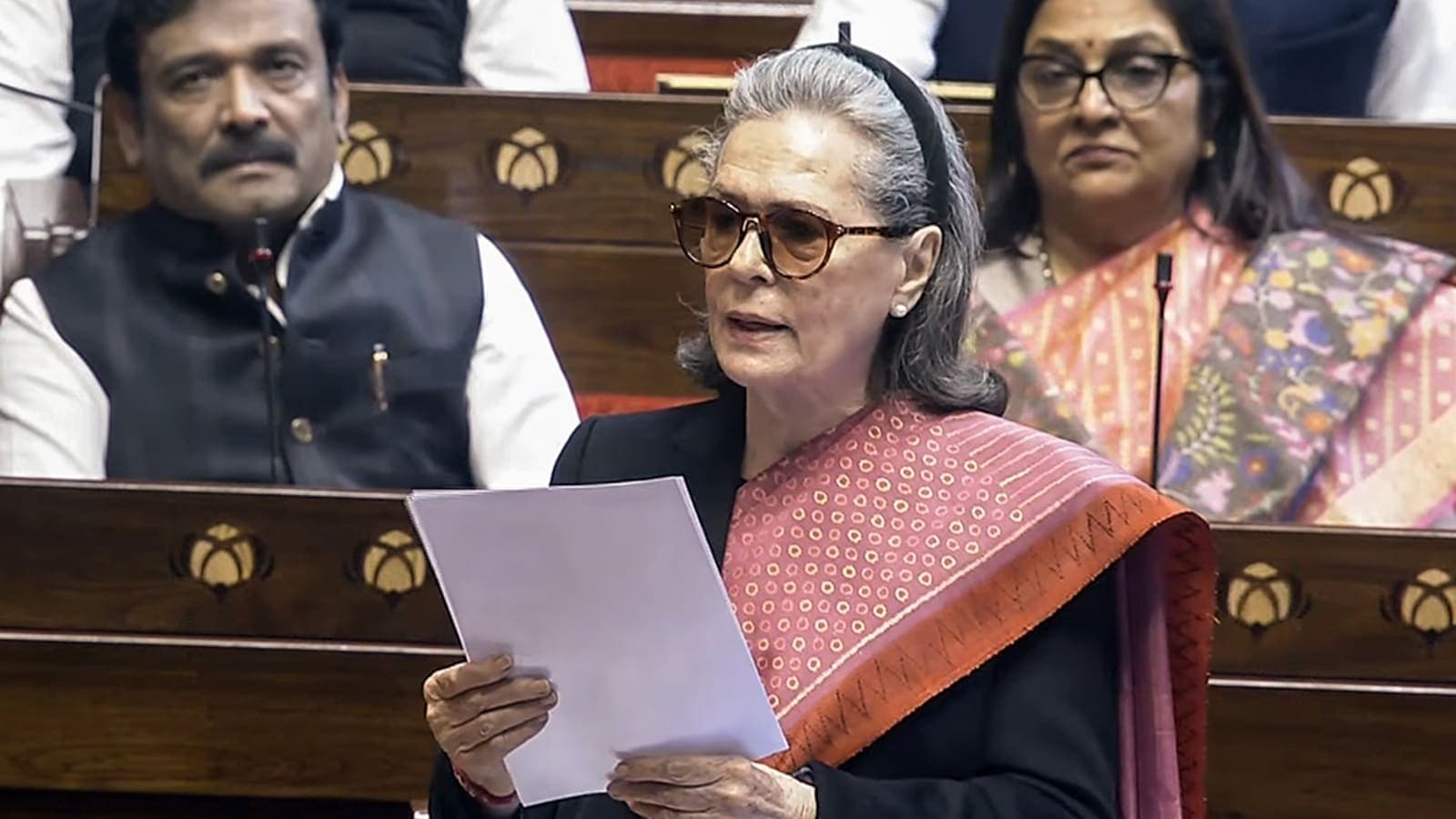
Sonia Gandhi demands Centre double compensation for 'overburdened, underpaid' ASHA and Anganwadi workers.
Summary
Sonia Gandhi has urged the Central Government to double its financial contribution towards the compensation of Accredited Social Health Activists (ASHA) and Anganwadi workers. She highlighted that these frontline workers are overburdened and underpaid, despite their crucial role in public health and child development schemes. This demand underscores ongoing concerns regarding the welfare and remuneration of these essential community service providers, making it relevant for understanding social welfare policies and government initiatives in competitive exams.
Key Points
- 1The demand for increased compensation was made by prominent political figure Sonia Gandhi.
- 2The beneficiaries of the proposed compensation increase are Accredited Social Health Activists (ASHA) and Anganwadi workers.
- 3Sonia Gandhi specifically requested the Central Government to double its contribution to their existing compensation.
- 4The rationale cited for this demand is that ASHA and Anganwadi workers are 'overburdened and underpaid'.
- 5ASHA workers function under the National Health Mission (NHM), and Anganwadi workers are part of the Integrated Child Development Services (ICDS) scheme, both central government initiatives.
In-Depth Analysis
Sonia Gandhi's recent appeal to the Central Government to double its financial contribution towards the compensation of Accredited Social Health Activists (ASHA) and Anganwadi workers brings to the forefront a long-standing issue concerning the welfare of India's frontline community health and child development workers. This demand highlights the critical yet often unacknowledged role these workers play in implementing key social welfare schemes, despite being 'overburdened and underpaid'.
**The Backbone of India's Social Welfare: ASHA and Anganwadi Workers**
To understand the significance of this demand, one must first grasp the indispensable role of ASHA and Anganwadi workers. ASHA workers, introduced under the National Rural Health Mission (NRHM) in 2005 (now part of the National Health Mission or NHM since 2013), are community health volunteers. They act as a crucial link between the community and the public health system, facilitating access to health services, promoting healthy behaviours, assisting in maternal and child health, immunization, and family planning. Their work is pivotal in achieving public health goals, especially in rural and underserved areas. Anganwadi workers, on the other hand, are the cornerstone of the Integrated Child Development Services (ICDS) scheme, launched in 1975. They provide a package of services including supplementary nutrition, pre-school non-formal education, nutrition and health education, immunization, health check-ups, and referral services to children aged 0-6 years, pregnant women, and lactating mothers. Both cadres are primarily women from the local community, making them culturally sensitive and accessible.
**The Core Issue: Underpaid and Overburdened**
The central grievance, articulated by Sonia Gandhi, is that these workers are 'overburdened and underpaid'. Unlike regular government employees, ASHA and Anganwadi workers are classified as 'honorary' workers or 'volunteers' and receive an honorarium, not a fixed salary. This classification allows the government to circumvent minimum wage laws, leading to often meagre and inconsistent payments. For instance, the Central government's fixed component for ASHA workers is typically a few thousand rupees per month, supplemented by performance-based incentives for specific tasks. Anganwadi workers and helpers also receive a fixed honorarium, which has seen some increases over the years but often remains below a living wage. Their workload has expanded significantly over time, encompassing new health programs, surveys, and even duties unrelated to their core mandates, such as election duties or COVID-19 response, without commensurate compensation or benefits like provident fund, gratuity, or pension.
**Sonia Gandhi's Call to Action and Key Stakeholders**
Sonia Gandhi's demand specifically calls for the Central Government to double its contribution. This is crucial because while both Central and State governments contribute to their compensation, a significant portion often comes from the Centre. Key stakeholders involved include: the **Central Government** (specifically the Ministry of Health and Family Welfare for ASHA and the Ministry of Women and Child Development for Anganwadi workers), which sets national policy and allocates funds; **State Governments**, which implement these schemes and often contribute additional funds; the **ASHA and Anganwadi workers themselves**, who are the direct beneficiaries and have frequently agitated for better wages and working conditions; **political parties**, which raise these issues to garner support and influence policy; and most importantly, the **millions of beneficiaries**—women, children, and families—who rely on their services.
**Historical Context and Evolution**
The ICDS scheme, launched on October 2, 1975, was one of India's pioneering efforts in child development. The NRHM (now NHM) in 2005 marked a significant push for strengthening rural healthcare, and ASHA workers were central to this strategy. Over the decades, despite their proven efficacy in improving health and nutrition indicators, the issue of their remuneration and working conditions has remained a constant point of contention. Various committees and reports have highlighted their plight, and workers' unions have regularly organized protests and strikes, demanding status as government employees and fair wages consistent with the Minimum Wages Act, 1948.
**Why This Matters for India**
Addressing the demands of ASHA and Anganwadi workers has profound implications for India. **Socially**, it's a matter of social justice and dignity for a largely female workforce operating at the grassroots. Their improved welfare can significantly boost morale and retention, leading to better service delivery and improved health and nutrition outcomes (e.g., lower infant mortality rates, reduced malnutrition, increased institutional deliveries). **Economically**, investing in these workers is an investment in human capital. A healthier, better-nourished population is more productive. However, doubling compensation would entail substantial **financial implications** for the exchequer, requiring significant budgetary allocations from both Central and State governments. **Politically**, the issue resonates deeply in rural areas, and addressing it can be a major electoral plank, while neglecting it can lead to widespread discontent.
**Constitutional Underpinnings and Policy Framework**
The demand for fair wages and dignified working conditions for ASHA and Anganwadi workers finds resonance in the **Directive Principles of State Policy (DPSP)** under Part IV of the Indian Constitution. **Article 38** mandates the State to secure a social order for the promotion of welfare of the people. **Article 39(d)** advocates for equal pay for equal work for both men and women, and **Article 39(a)** directs the state to secure the right to an adequate means of livelihood. More directly, **Article 42** calls for securing just and humane conditions of work and maternity relief, while **Article 43** mandates the State to endeavour to secure a living wage, conditions of work ensuring a decent standard of life, and full enjoyment of leisure and social and cultural opportunities. The current 'honorarium' model often falls short of these constitutional ideals. Policies like the **National Health Mission (NHM)** and the **Integrated Child Development Services (ICDS)** are the operational frameworks through which these workers function, and any changes to their compensation would be implemented within these schemes. The **National Food Security Act, 2013**, also relies heavily on the ICDS network for its implementation, further underscoring the importance of Anganwadi workers.
**Future Implications**
If the Central Government responds positively to the demand, it could lead to a significant increase in the wages of millions of frontline workers, boosting their morale and potentially improving the quality and reach of health and nutrition services. This would, however, necessitate a substantial increase in budgetary allocations for NHM and ICDS. Conversely, if the demand is not met, it could fuel further protests and disaffection among these critical workers, potentially disrupting essential services and jeopardizing public health and child development goals. The debate also opens up a broader discussion about the contractualization of labour in public services and the need to ensure fair wages and social security for all workers, moving away from an 'honorary' status to a more formal employment framework in line with constitutional principles.
In conclusion, the call to double the compensation for ASHA and Anganwadi workers is not merely a wage demand; it's a call for recognizing the dignity of labour, strengthening India's social safety net, and upholding constitutional principles of social justice and welfare. How the government addresses this will have lasting impacts on public health, child development, and the overall social fabric of the nation.
Exam Tips
This topic falls under GS Paper II (Governance, Social Justice, Welfare Schemes) for UPSC Civil Services Exam. For SSC, Banking, and State PSCs, it's relevant for General Awareness sections covering Government Schemes and Social Issues.
Study the National Health Mission (NHM) and Integrated Child Development Services (ICDS) schemes in detail: their objectives, components, funding patterns, and impact. Also, understand the evolution of these schemes.
Be prepared for questions on the roles and responsibilities of ASHA and Anganwadi workers, their challenges, and policy measures taken for their welfare. Questions often test understanding of 'honorarium vs. salary' and constitutional provisions like DPSPs.
Expect questions comparing different social welfare schemes, identifying key features, and analyzing their effectiveness. For descriptive exams, be ready to write essays on issues related to women empowerment, public health, and child nutrition.
Understand the financial implications and Centre-State relations in funding these schemes, as federalism is a recurring theme in competitive exams.