



Relevant for Exams
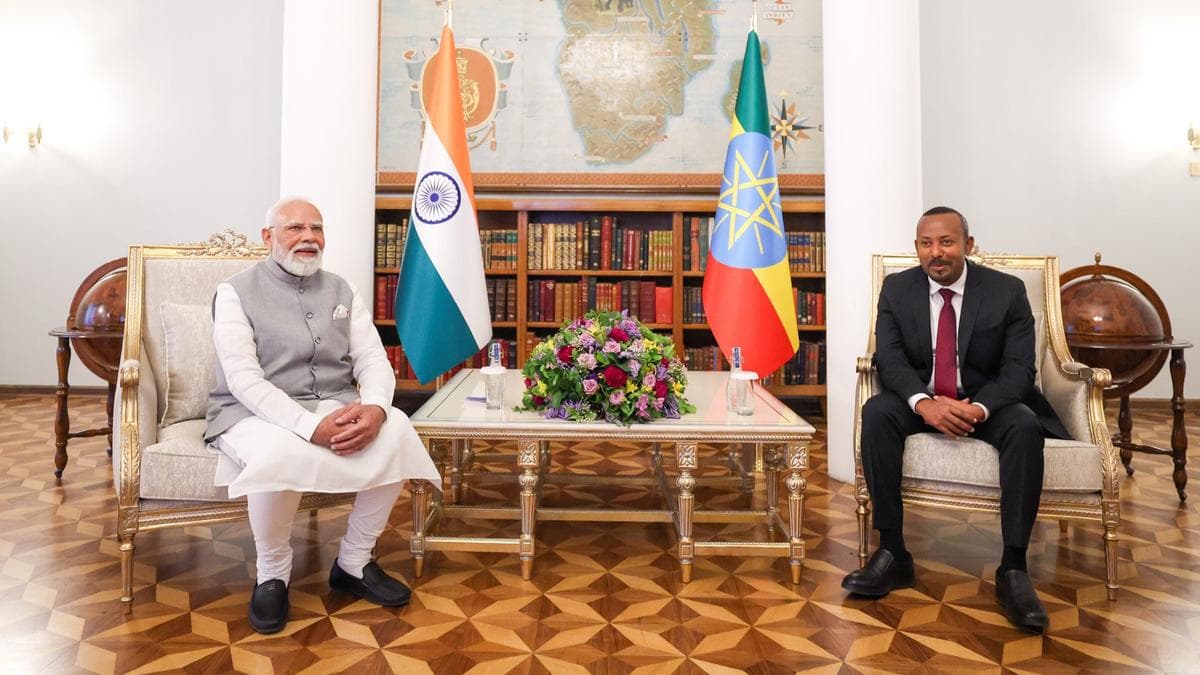
PM Modi receives Ethiopia's highest honour from PM Abiy Ahmed for strengthening bilateral ties.
Summary
Prime Minister Narendra Modi was conferred with Ethiopia's highest honour by Ethiopian PM Abiy Ahmed. This recognition acknowledges PM Modi's significant contributions to strengthening the India-Ethiopia partnership and his visionary global leadership. This event highlights India's growing diplomatic influence and bilateral ties, making it relevant for international relations and current affairs sections in competitive exams.
Key Points
- 1Indian Prime Minister Narendra Modi was conferred with Ethiopia's highest honour.
- 2The award was presented by Ethiopian Prime Minister Abiy Ahmed.
- 3The honour recognizes PM Modi's contribution to strengthening the India-Ethiopia partnership.
- 4It also acknowledges his visionary leadership as a global statesman.
- 5The information was officially released by the Ministry of External Affairs (MEA) in New Delhi.
In-Depth Analysis
Prime Minister Narendra Modi being conferred with Ethiopia's highest honour by Ethiopian Prime Minister Abiy Ahmed is a significant diplomatic event that underscores the deepening ties between India and the African continent. This recognition is not merely a personal accolade but a testament to India's burgeoning influence and its strategic engagement with the Global South, particularly Africa.
**Background Context and Historical Ties:**
India and Ethiopia share a rich historical relationship, dating back centuries through ancient trade routes. In modern times, both nations were instrumental in shaping the Non-Aligned Movement (NAM) during the Cold War era, advocating for sovereignty and self-determination for newly independent nations. Leaders like Jawaharlal Nehru and Emperor Haile Selassie shared a vision for a multipolar world and South-South cooperation. This historical foundation has provided a strong basis for contemporary relations, marked by mutual respect and shared developmental aspirations. In recent decades, India has intensified its 'Look Africa' or 'Act Africa' policy, recognizing the continent's strategic and economic importance. This policy emphasizes capacity building, technology transfer, concessional credit, and people-to-people connections, moving beyond traditional donor-recipient models to a more equitable partnership.
**What Happened and Key Stakeholders:**
The event saw Ethiopian Prime Minister Abiy Ahmed presenting his country's highest civilian honour to PM Modi. The Ministry of External Affairs (MEA) in New Delhi confirmed this, stating the award acknowledged PM Modi's contributions to strengthening the India-Ethiopia partnership and his visionary leadership as a global statesman. The key stakeholders involved are:
* **Prime Minister Narendra Modi (India):** As the recipient, he represents India's foreign policy thrust, which prioritizes engagement with African nations. His leadership has seen a proactive approach to multilateral diplomacy and bilateral relationship building.
* **Prime Minister Abiy Ahmed (Ethiopia):** The presenter of the award, he signifies Ethiopia's appreciation for India's partnership. PM Abiy Ahmed, a Nobel Peace Prize laureate himself (2019), plays a crucial role in regional stability and economic development in the Horn of Africa.
* **India (Ministry of External Affairs):** The official body responsible for India's foreign relations, it orchestrates and implements the diplomatic initiatives that lead to such recognitions.
* **Ethiopia:** A strategically important nation in East Africa, host to the African Union headquarters, and a significant economic partner for India.
**Significance for India:**
This honour carries substantial significance for India. Firstly, it enhances India's diplomatic standing and soft power in Africa. Ethiopia, being a key player in the African Union, makes this recognition particularly potent. It signals India's commitment to fostering genuine partnerships, distinct from the historical colonial models or transactional approaches of some other global powers. Economically, India is one of the largest foreign investors in Ethiopia, with Indian companies investing in diverse sectors like manufacturing, agriculture, and services. This award could further open doors for increased trade, investment, and collaboration in areas such as infrastructure, digital technology, and healthcare. Strategically, strengthening ties with Ethiopia contributes to India's broader objective of building a multipolar world order and diversifying its geopolitical partnerships.
**Constitutional and Policy Frameworks:**
India's foreign policy, which underpins such engagements, is guided by constitutional principles. **Article 51 of the Indian Constitution** is particularly relevant, directing the State to
Exam Tips
This topic falls under 'International Relations' (GS-II for UPSC, General Awareness for SSC/Banking/Railways) and 'Current Affairs'. Focus on India's foreign policy, particularly its engagement with Africa.
Study related topics like India-Africa Forum Summits (IAFS), India's 'Look Africa' policy, the role of South-South Cooperation, and India's economic and strategic interests in Africa. Also, be aware of other major international awards conferred on Indian leaders.
Common question patterns include direct questions (e.g., 'Which country conferred its highest honour on PM Modi?'), analytical questions on the significance of India-Africa relations, match-the-following questions (leader-country-award), and questions on specific initiatives taken by India in Africa (e.g., Lines of Credit, capacity building programs).
Related Topics to Study
Full Article
Prime Minister Modi was conferred with the award for his contribution towards strengthening India-Ethiopia partnership and for his visionary leadership as a global statesman, the Ministry of External Affairs said in a statement in New Delhi.