


Relevant for Exams
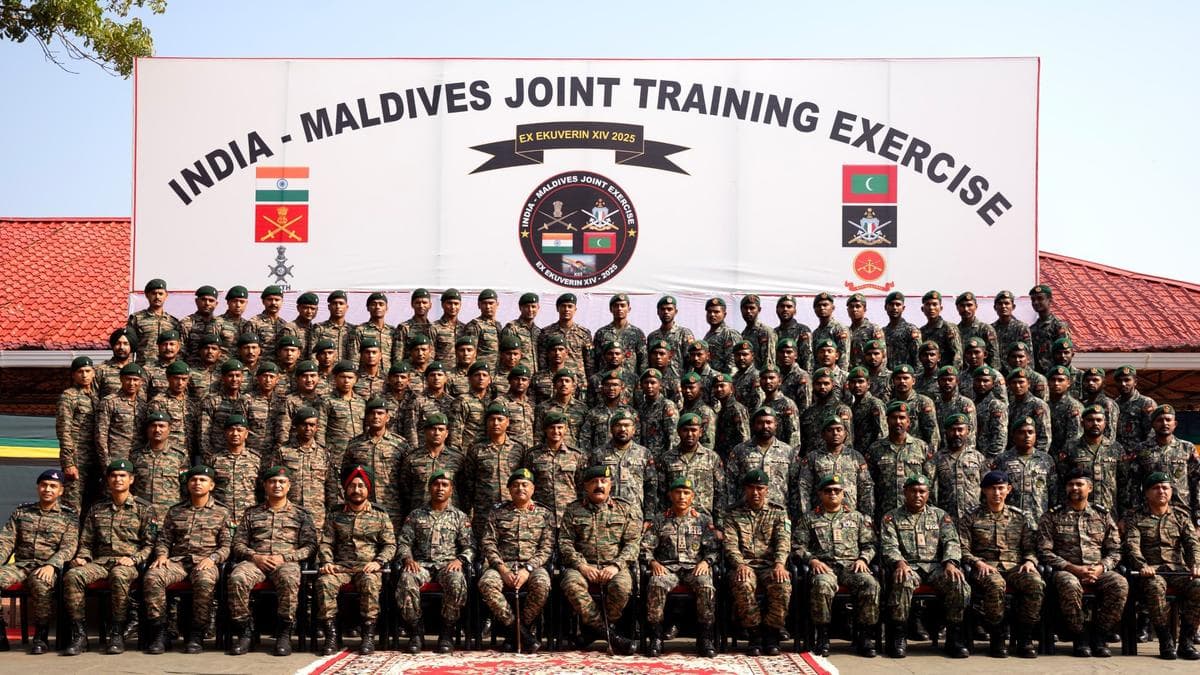
India-Maldives joint military exercise on counter-terror ops concludes in Thiruvananthapuram.
Summary
A joint military exercise between India and Maldives recently concluded in Thiruvananthapuram. This exercise focused on enhancing capabilities in counter-insurgency and counter-terrorist operations within contemporary operational environments. Such bilateral defence collaborations are significant for strengthening regional security ties and interoperability, making it relevant for competitive exams focusing on international relations and defence.
Key Points
- 1The military exercise was conducted jointly between India and Maldives.
- 2The exercise concluded in Thiruvananthapuram, located in Kerala, India.
- 3A primary focus of the exercise was on counter-insurgency operations.
- 4Another key objective was to enhance capabilities in counter-terrorist operations.
- 5The operations were specifically conducted within contemporary operational environments.
In-Depth Analysis
The conclusion of a joint military exercise between India and Maldives in Thiruvananthapuram, focusing on counter-insurgency (CI) and counter-terrorist (CT) operations, underscores the enduring strategic importance of this bilateral relationship despite recent political fluctuations. This exercise, often part of the annual 'Ekuverin' series (meaning 'Friends' in Dhivehi), is more than just a routine drill; it's a testament to the shared security concerns and India's commitment to its 'Neighbourhood First' policy and the broader 'SAGAR' (Security and Growth for All in the Region) vision.
Historically, India and Maldives share deep cultural, economic, and strategic ties. Maldives, an archipelago nation strategically located in the Indian Ocean, is vital for India's maritime security and commercial interests. India has consistently been the first responder to crises in Maldives, most notably during 'Operation Cactus' in November 1988, when the Indian Armed Forces thwarted a coup attempt by mercenaries. This intervention cemented India's role as a reliable security partner and a net security provider in the Indian Ocean Region (IOR). Over the decades, defence cooperation has evolved to include joint exercises, capacity building, training, and surveillance support.
However, the relationship has faced recent challenges, particularly with the rise of the 'India Out' campaign in Maldives. This campaign, which gained significant traction during the 2023 presidential elections, advocated for the removal of Indian military personnel and assets from Maldivian soil, citing concerns over sovereignty and perceived Indian interference. President Mohamed Muizzu, who won the election on this platform, has reiterated his commitment to this policy. Despite this political rhetoric and the ongoing process of withdrawing Indian military personnel operating aviation platforms, the continuation of joint military exercises like the one in Thiruvananthapuram highlights a pragmatic understanding between the defence establishments of both nations regarding shared security imperatives.
Key stakeholders in this exercise include the Indian Ministry of Defence and the Indian Armed Forces, alongside the Maldives National Defence Force (MNDF) and the Maldivian government. For India, the exercise serves multiple purposes: enhancing interoperability with a key maritime neighbour, strengthening regional security architecture against common threats like terrorism and piracy, and projecting its commitment to the stability of the IOR. For Maldives, participation allows its forces to gain valuable experience and training in modern CI/CT tactics from a larger, more experienced military, thereby bolstering its own defence capabilities and addressing internal security challenges.
The significance for India is multi-faceted. Strategically, Maldives lies along crucial shipping lanes, making its stability and security paramount for India's trade and energy security. The joint focus on CI/CT operations directly addresses the growing threat of radicalization and cross-border terrorism, which can destabilize the region. From a diplomatic perspective, the continuation of such exercises, even amidst political friction, demonstrates the resilience of the bilateral relationship and India's consistent engagement. It subtly counters the 'India Out' narrative by showcasing the mutual benefits of defence cooperation, rather than solely focusing on the presence of personnel. Furthermore, it aligns with India's broader geopolitical strategy to maintain its influence in the IOR, especially in the face of increasing Chinese presence and investment in the region, which India views as a strategic challenge.
While direct constitutional articles might not explicitly mention military exercises, India's foreign policy and national security objectives are rooted in its constitutional framework, particularly the Preamble's commitment to 'fraternity' and 'security of the nation.' Defence cooperation agreements fall under the executive power of the Union government, guided by the principles of national interest and international law. The 'SAGAR' vision, articulated by Prime Minister Narendra Modi in 2015, is a key policy framework that guides India's maritime engagement, emphasizing security, capacity building, and economic growth for all regional partners. This exercise directly contributes to the 'Security' pillar of SAGAR.
Looking ahead, these exercises signify that despite political shifts, the underlying strategic logic for India-Maldives defence cooperation remains strong. Future implications include the potential for continued, albeit perhaps recalibrated, defence engagement, focusing more on training, equipment supply, and joint operations rather than a permanent military presence. It also signals India's enduring role as a reliable security partner, capable of adapting to evolving diplomatic landscapes while safeguarding its strategic interests in the critical Indian Ocean Region. The balance between Maldivian sovereignty concerns and shared security imperatives will continue to shape the trajectory of this vital bilateral relationship.
Exam Tips
This topic falls under UPSC GS Paper 2 (International Relations, India and its Neighbourhood Relations, Bilateral Relations) and GS Paper 3 (Internal Security, Defence). For SSC/State PSC, it is relevant for General Awareness (Current Affairs, Defence).
Study related topics such as India's 'Neighbourhood First' policy, the 'SAGAR' doctrine, the geopolitics of the Indian Ocean Region, and the concept of 'Net Security Provider.' Understand the historical context of India-Maldives relations, including 'Operation Cactus' (1988).
Common question patterns include: MCQs on the name of the exercise (e.g., 'Ekuverin'), participating countries, location, and primary focus. For Mains exams, expect analytical questions on the significance of India-Maldives defence cooperation, challenges in the bilateral relationship, and its implications for regional security and India's strategic interests.
Related Topics to Study
Full Article
The exercise focused on counter-insurgency and counter-terrorist operations in contemporary operational environments