



Relevant for Exams
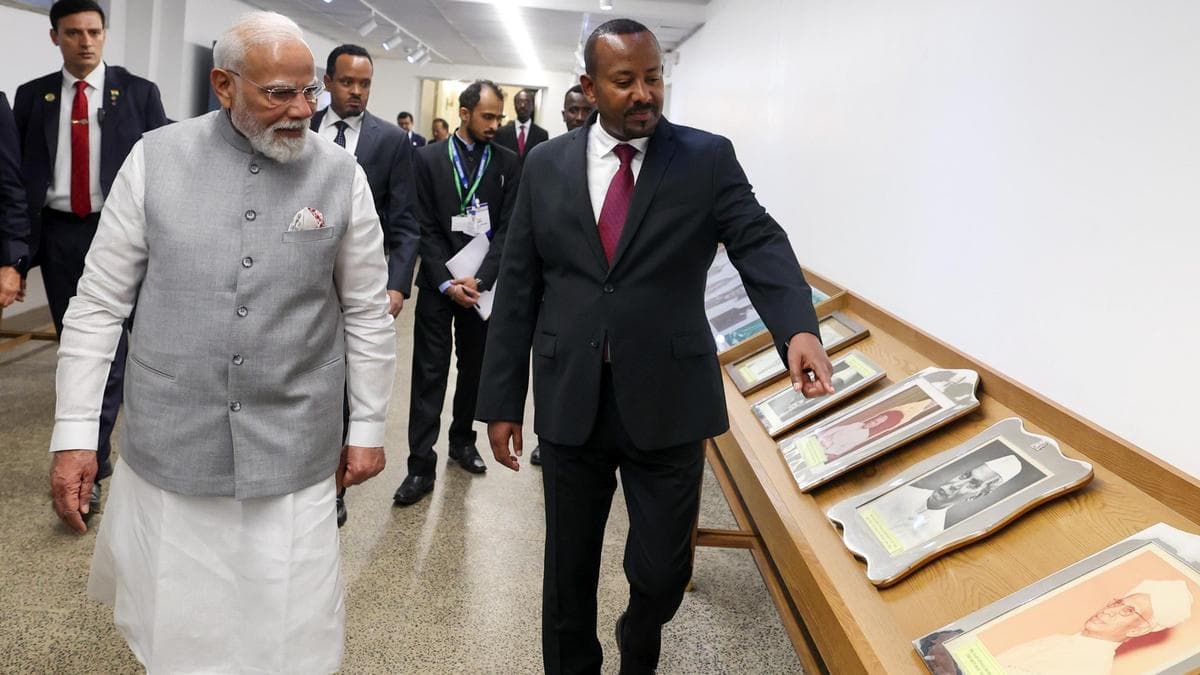
India and Ethiopia elevate bilateral relations to strategic partnership during PM Modi's talks.
Summary
India and Ethiopia have elevated their bilateral relations to a strategic partnership, as announced by PM Modi during delegation-level talks with his Ethiopian counterpart. This significant diplomatic move aims to inject new energy, momentum, and depth into their ties. For competitive exams, this highlights India's expanding foreign policy footprint, particularly in Africa, and the evolving nature of its international alliances, making it crucial for international relations and current affairs sections.
Key Points
- 1India and Ethiopia formally elevated their bilateral relations to a 'strategic partnership'.
- 2The announcement was made by Indian Prime Minister Narendra Modi.
- 3The elevation occurred during delegation-level talks with his Ethiopian counterpart.
- 4PM Modi stated this step would provide "new energy, new momentum and new depth" to the ties.
- 5This move signifies a formal upgrade in the nature of diplomatic engagement between the two countries.
In-Depth Analysis
India's decision to elevate its relationship with Ethiopia to a strategic partnership marks a significant milestone in its foreign policy, particularly in its engagement with the African continent. This move, announced by Prime Minister Narendra Modi during delegation-level talks with his Ethiopian counterpart, underscores a commitment to inject "new energy, new momentum, and new depth" into bilateral ties. For students preparing for competitive exams, understanding this development requires delving into its historical context, current implications, and future trajectory.
**Background Context and Historical Ties:**
India and Ethiopia share a rich history of interaction spanning centuries, characterized by ancient trade routes and cultural exchanges. In modern times, both nations were prominent voices in the Non-Aligned Movement (NAM) during the Cold War era, advocating for self-determination and South-South cooperation. India has consistently supported Ethiopia's development efforts, providing Lines of Credit (LoC) for infrastructure projects, capacity building through the Indian Technical and Economic Cooperation (ITEC) program, and humanitarian assistance. Ethiopia, a major economic and political player in East Africa and host to the African Union (AU) headquarters, has always been a crucial partner in India's broader 'Act Africa' policy, which gained significant momentum with the first India-Africa Forum Summit (IAFS) in 2008, followed by subsequent summits in 2011 and 2015. This long-standing relationship laid the groundwork for the current elevation of ties.
**What Happened and Key Stakeholders:**
The formal elevation to a 'strategic partnership' signifies a qualitative shift from traditional bilateral relations to a more comprehensive and structured engagement across various sectors. It implies a deeper level of commitment, more frequent high-level dialogues, and coordinated efforts on regional and global issues. The key stakeholders involved are the governments of India and Ethiopia, led by their respective Prime Ministers and their foreign ministries. Beyond governmental actors, Indian and Ethiopian businesses, investors, and the Indian diaspora in Ethiopia play a crucial role in fostering economic and cultural ties. The African Union, headquartered in Addis Ababa, Ethiopia, also remains an indirect but significant stakeholder, as India's strengthened ties with Ethiopia often translate into enhanced engagement with the broader African continent.
**Significance for India:**
This strategic partnership holds immense significance for India on multiple fronts. **Economically**, Ethiopia represents a large and growing market in East Africa, offering substantial opportunities for Indian investment in sectors like manufacturing, agriculture, pharmaceuticals, textiles, and IT. India is already among the top investors in Ethiopia, and this partnership will likely boost trade volumes and facilitate easier business operations. **Geopolitically**, strengthening ties with Ethiopia reinforces India's 'Act Africa' policy, positioning India as a reliable development partner and a counterbalance to the influence of other global powers in the region. Ethiopia's stability is vital for the Horn of Africa, and India's engagement can contribute to regional peace and security. Furthermore, Ethiopia's recent inclusion in BRICS alongside India enhances the scope for multilateral cooperation and coordination on global governance issues. This move aligns with India's aspirations to be a leading voice for the Global South and a responsible global power.
**Broader Themes and Constitutional Provisions:**
This development is intricately linked to broader themes of India's foreign policy, including South-South cooperation, economic diplomacy, and multilateralism. India's foreign policy is guided by the Directive Principles of State Policy, specifically **Article 51 of the Constitution**, which mandates the State to promote international peace and security, maintain just and honourable relations between nations, foster respect for international law and treaty obligations, and encourage settlement of international disputes by arbitration. While not directly dictating specific partnerships, Article 51 provides the constitutional bedrock for India's proactive and engagement-oriented foreign policy. The elevation of ties also reflects India's commitment to its policy of 'Vasudhaiva Kutumbakam' (the world is one family), extending its hand of friendship and cooperation to nations across the globe.
**Future Implications:**
Looking ahead, the strategic partnership is expected to diversify cooperation into new areas such as defence and security, space technology, cyber security, climate change, and cultural exchanges. Enhanced policy coordination on global issues, including reforms of international institutions, is also anticipated. For India, this means a deeper footprint in a strategically vital region, access to new markets, and stronger diplomatic leverage. For Ethiopia, it promises continued development assistance, technological transfer, and diversified investment sources. This partnership is a testament to India's evolving diplomatic approach, emphasizing long-term, mutually beneficial relationships with key global partners, especially within the Global South, contributing to a more multipolar world order.
Exam Tips
This topic primarily falls under UPSC GS Paper-II (International Relations – Bilateral, regional and global groupings and agreements involving India and/or affecting India’s interests) and Current Affairs for all competitive exams. For SSC/Banking/Railway exams, expect direct questions on the countries involved or the nature of the partnership.
When studying, connect this development to India's broader 'Act Africa' policy, the significance of the Horn of Africa region, and India's role in South-South cooperation. Also, understand the economic and geopolitical motivations behind such partnerships.
Common question patterns include: 'Analyze the significance of India's strategic partnership with Ethiopia for India's foreign policy objectives.' (UPSC Mains); 'Which constitutional article guides India's foreign policy?' (UPSC Prelims/State PSCs); 'Ethiopia recently elevated its ties to a strategic partnership with which country?' (SSC/Banking/Railway Current Affairs); 'Discuss the economic opportunities for India arising from its strategic partnership with Ethiopia.' (UPSC Mains).
Related Topics to Study
Full Article
“We are elevating India and Ethiopia relations to a strategic partnership. This step will provide new energy, new momentum and new depth to our ties,” PM Modi said during the delegation-level talks