



Relevant for Exams
2025 U.S. National Security Strategy marks major shift from 2005, with clear implications for India.
Summary
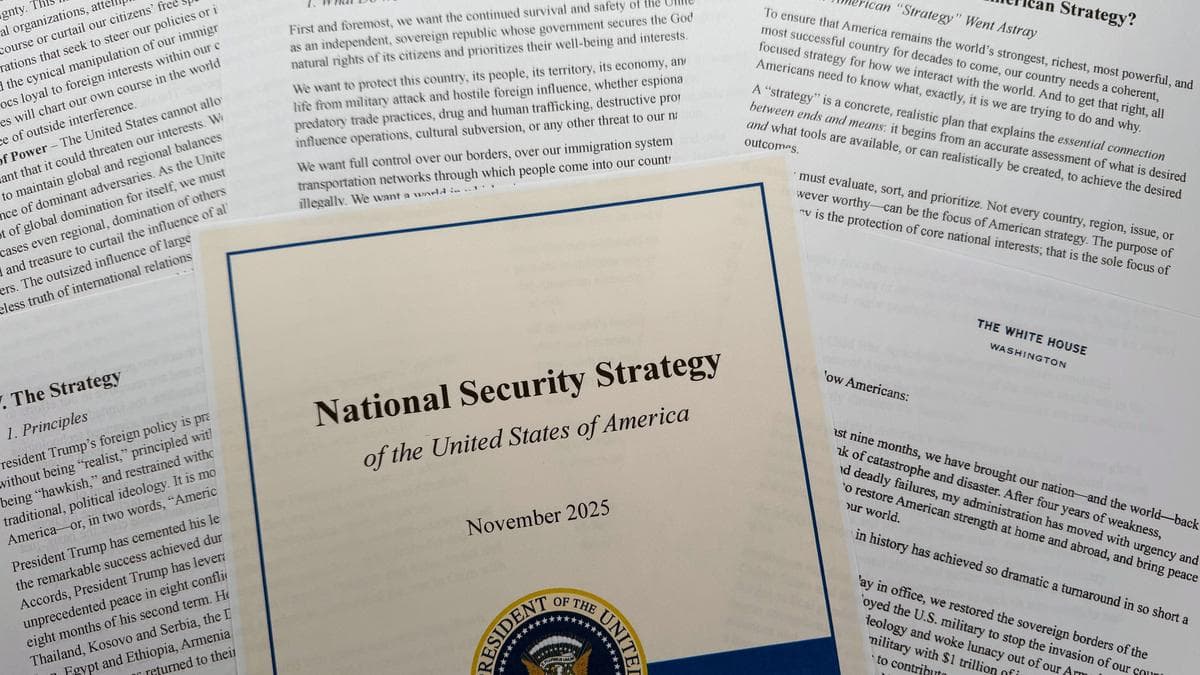
The 2025 U.S. National Security Strategy (NSS) document signifies a major shift from its 2005 predecessor, indicating a profound change in U.S. geopolitical outlook. This strategic reorientation holds clear and significant implications for India's foreign policy and strategic alignment. Understanding this evolution in U.S. strategy and its impact on India-U.S. relations is crucial for competitive exam preparation, especially for international relations and current affairs sections.
Key Points
- 1The analysis focuses on the 2025 U.S. National Security Strategy (NSS) document.
- 2The 2025 U.S. NSS is explicitly compared to the U.S. National Security Strategy articulated in 2005.
- 3A 'profound departure' in strategic logic is identified between the 2005 and 2025 U.S. NSS documents.
- 4The changes within the U.S. National Security Strategy have 'clear implications' for India.
- 5The article underscores the evolving strategic dynamics between India and the United States.
In-Depth Analysis
The strategic landscape of international relations is in constant flux, and understanding shifts in major power doctrines, such as the U.S. National Security Strategy (NSS), is paramount for competitive exam aspirants. The comparison between the 2005 and the projected 2025 U.S. NSS documents reveals a profound reorientation in American foreign policy, with significant implications for India. This shift is not merely academic; it shapes geopolitical alignments, economic partnerships, and security dynamics, directly impacting India's strategic choices and its role on the global stage.
**Background Context: A World Transformed**
The 2005 U.S. National Security Strategy, articulated during George W. Bush's presidency, was heavily shaped by the aftermath of the September 11, 2001 terrorist attacks. Its core tenets revolved around the "War on Terror," pre-emptive strikes against perceived threats, and the promotion of democracy worldwide. The U.S. saw itself in a unipolar moment, the sole superpower, capable of shaping global order. For India, this era marked a significant turning point in bilateral relations. Having shed the baggage of Cold War estrangement, the U.S. began to view India as a natural strategic partner, a fellow democracy, and a potential counterweight in Asia. This period laid the groundwork for the landmark India-U.S. Civil Nuclear Agreement in 2008, which effectively ended India's nuclear isolation and cemented a new phase of strategic partnership.
Fast forward to 2025, and the world looks dramatically different. The unipolar moment has receded, replaced by an increasingly multipolar or even bipolar dynamic, largely driven by the assertive rise of China and the resurgence of Russia. The global order is grappling with challenges far beyond terrorism, including great power competition, climate change, pandemics, cyber warfare, and economic nationalism. The hypothetical 2025 NSS, reflecting current trends under the Biden administration, would likely de-emphasize direct counter-terrorism operations and instead prioritize strategic competition with revisionist powers, particularly China. It would focus on strengthening alliances and partnerships, investing in domestic resilience, leveraging economic statecraft, and competing in critical and emerging technologies. The Indo-Pacific region, rather than the Middle East, would be the primary theater of strategic importance.
**What Happened: The Profound Departure**
The profound departure lies in the shift from a post-9/11 counter-terrorism paradigm to a great power competition framework. The 2005 NSS was characterized by unilateralism, a focus on non-state actors, and the spread of democracy as a panacea. The 2025 strategy, by contrast, emphasizes multilateralism, collective security through alliances (like NATO) and partnerships (like the Quad), and a recognition of systemic challenges posed by state actors. Economic and technological competition, including supply chain resilience and control over critical technologies, would be central, moving beyond purely military dominance.
**Key Stakeholders**
The primary stakeholders include the **United States Government** (President, National Security Council, Departments of State and Defense) in formulating and executing the strategy. On the Indian side, the **Indian Government** (Prime Minister's Office, Ministry of External Affairs, Ministry of Defence) plays a crucial role in responding and adapting. **China** is arguably the most significant external stakeholder, as its rise and assertive actions are a primary driver of the U.S. strategic shift. Other **Indo-Pacific nations** (Japan, Australia, South Korea, ASEAN members) are also key, as they are central to the U.S. strategy of building a network of partners. **Russia** remains a factor, particularly in Europe and its influence on India's defense procurement.
**Why This Matters for India**
This strategic reorientation holds immense significance for India. It presents both opportunities and challenges:
* **Opportunities**: The U.S. focus on the Indo-Pacific and great power competition aligns with India's concerns regarding China's growing assertiveness. This convergence strengthens platforms like the Quad (Quadrilateral Security Dialogue) and I2U2 (India, Israel, UAE, U.S.), fostering deeper cooperation in defense, technology, maritime security, and infrastructure. India can leverage this partnership for technology transfer (especially critical and emerging technologies), enhanced defense capabilities, and economic integration, aiding its 'Make in India' initiative for defense indigenization. The U.S. desire for resilient supply chains offers India a chance to become a manufacturing hub, reducing reliance on single sources.
* **Challenges**: India faces the delicate task of maintaining its strategic autonomy and multi-alignment policy while deepening ties with the U.S. Balancing relations with Russia, a long-standing defense partner, and navigating potential pressures from the U.S. on issues like arms procurement or trade could be complex. India's commitment to non-alignment, enshrined implicitly in the spirit of its foreign policy guided by Directive Principles of State Policy, particularly **Article 51** (promotion of international peace and security, maintenance of just and honorable relations between nations, respect for international law), requires careful calibration. While not a constitutional mandate for non-alignment, it guides India's independent foreign policy choices.
**Future Implications**
The future will likely see a deepening of the India-U.S. strategic partnership, moving beyond transactional ties to a more comprehensive and integrated relationship across defense, technology, trade, and climate change. India's role as a net security provider in the Indian Ocean Region, complementing its 'SAGAR' (Security and Growth for All in the Region) vision, will likely be enhanced through greater interoperability and intelligence sharing with the U.S. and its allies. The shift could accelerate India's integration into global supply chains, boosting its economy. However, India will need to skillfully manage its relationships with other powers, particularly in a multipolar world, ensuring its strategic interests are paramount. The U.S. strategy will inevitably influence the regional security architecture, potentially leading to increased militarization or new security blocs, requiring India to navigate these dynamics carefully while upholding its commitment to a free, open, and inclusive Indo-Pacific.
**Related Constitutional Articles, Acts, or Policies**
While specific constitutional articles don't dictate foreign policy alliances, the **Preamble** of the Indian Constitution, with its emphasis on securing liberty, equality, and fraternity, and **Article 51** of the DPSP, which directs the state to promote international peace and security and foster respect for international law, provide the guiding principles for India's foreign policy. India's 'Act East' policy, 'SAGAR' doctrine, and its participation in multilateral forums like the Quad and I2U2 are direct policy responses to the evolving geopolitical landscape, reflecting its pursuit of national interests in a dynamic global order. The **India-U.S. Civil Nuclear Agreement (2008)** remains a historical touchstone, symbolizing the strategic trust built between the two nations.
Exam Tips
This topic primarily falls under GS Paper 2 (International Relations) and can also touch upon GS Paper 3 (Economy - defense, trade, technology). Focus on understanding the evolution of India's foreign policy and its major partnerships.
Study related topics such as the Quad, I2U2, India's Indo-Pacific strategy, Cold War non-alignment vs. current multi-alignment, and the implications of China's rise for India's security and economic policies. Compare the foreign policies of different U.S. administrations.
Common question patterns include analytical questions on India's strategic autonomy in the context of great power competition, the opportunities and challenges of India-U.S. partnership, the role of India in the Indo-Pacific, and the impact of global power shifts on India's national interests. Be prepared to discuss pros and cons and offer a balanced perspective.
Related Topics to Study
Full Article
The 2025 U.S. National Security Strategy document marks a profound departure from the logic articulated in 2005. For India, the implications are clear.