



Relevant for Exams
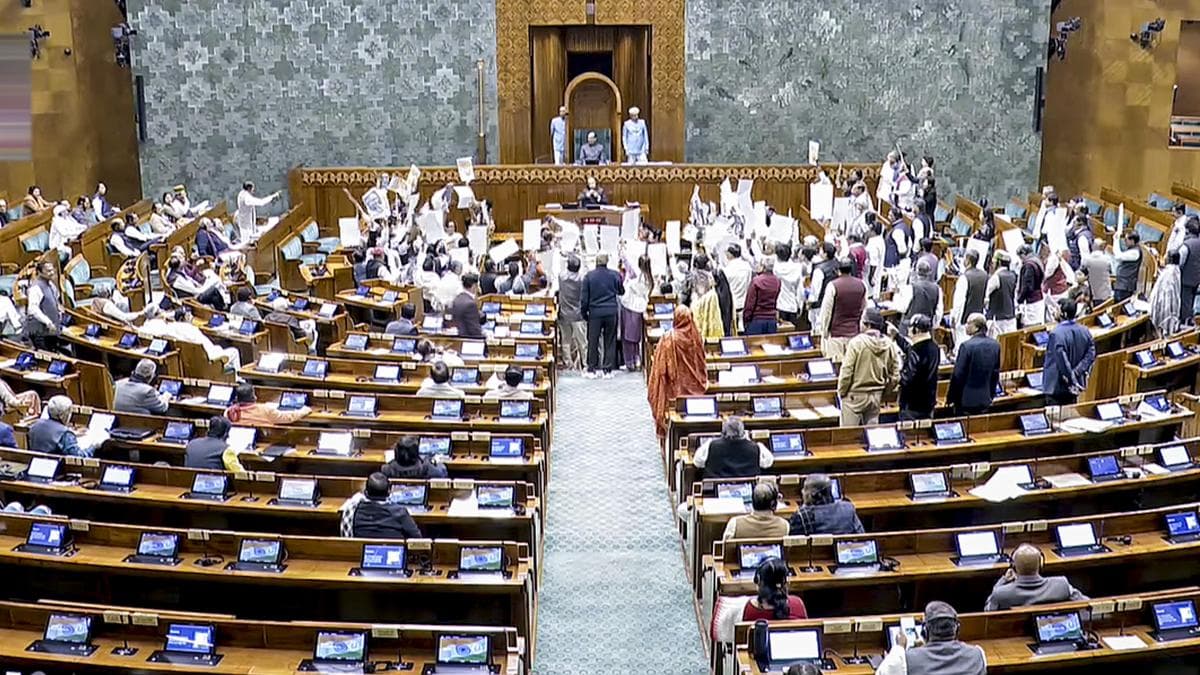
Govt tables Bill to replace MGNREGA, citing 'Gandhiji’s sentiments' for 'Ram Rajya' amid protests.
Summary
The Indian government has tabled a Bill aimed at replacing the Mahatma Gandhi National Rural Employment Guarantee Act (MGNREGA). The Centre asserts this move aligns with 'Gandhiji’s sentiments' and will usher in 'Ram Rajya' in villages. However, the Opposition protests, arguing the new legislation will weaken the employment rights of the poor and demands parliamentary scrutiny. This policy change is crucial for understanding rural employment and welfare schemes.
Key Points
- 1The Indian Government has tabled a Bill in Parliament.
- 2The Bill is intended to replace the existing Mahatma Gandhi National Rural Employment Guarantee Act (MGNREGA).
- 3The Centre claims the Bill is 'in line with Gandhiji’s sentiments' and will bring 'Ram Rajya' to villages.
- 4The Opposition contends that the new legislation will weaken the employment rights of the poor.
- 5The Opposition has demanded that the proposed Bill be sent for detailed Parliamentary scrutiny.
In-Depth Analysis
The news of the government tabling a Bill to replace the Mahatma Gandhi National Rural Employment Guarantee Act (MGNREGA) has sparked significant debate, highlighting a crucial juncture in India's social welfare policy. To truly grasp its implications, let's delve into the background, the current developments, and what it might mean for the nation.
**Background Context: The Genesis and Impact of MGNREGA**
MGNREGA, enacted on August 25, 2005, during the UPA government's tenure, is arguably one of the most ambitious social welfare programs globally. It legally guarantees 100 days of wage employment in a financial year to adult members of any rural household willing to do unskilled manual work. The primary objectives were multifaceted: to enhance livelihood security in rural areas, reduce rural-urban migration, create durable assets (like roads, ponds, wells), and empower local self-governments (Panchayati Raj Institutions) by involving them in planning and implementation. The Act was a paradigm shift, moving from a discretionary welfare scheme to a rights-based entitlement, enshrined in law. Its implementation saw both significant successes, particularly in providing a safety net during economic downturns and droughts, and challenges such as wage delays, corruption, and issues with asset quality.
**What's Happening Now: A Proposed Replacement**
The current government has tabled a Bill to replace MGNREGA. While the specifics of the new Bill are yet to be fully disclosed and debated, the Centre's stated rationale for this move is that it aligns with 'Gandhiji’s sentiments' and aims to bring 'Ram Rajya' to villages. These phrases evoke a vision of self-reliant, prosperous rural communities, free from poverty and distress. However, the Opposition has voiced strong reservations, arguing that the proposed legislation will weaken the employment rights of the poor and demanding that the Bill undergo rigorous Parliamentary scrutiny, possibly by referring it to a Standing Committee. This suggests concerns about potential dilution of the legal guarantee of employment or changes to the scheme's fundamental structure that might reduce its effectiveness as a safety net.
**Key Stakeholders Involved**
1. **The Central Government:** As the proposer of the Bill, it aims to reform or replace MGNREGA, likely citing issues like inefficiency, leakages, or a desire for a more 'productive' or 'skill-oriented' rural employment program. Their objective is to align rural development with their broader policy vision.
2. **Opposition Parties:** They act as a check on the government, raising concerns about potential negative impacts on the rural poor, particularly the erosion of the 'right to work' and the potential for reduced social security. Their demand for parliamentary scrutiny underscores the importance of legislative oversight.
3. **Rural Poor/Workers:** These are the primary beneficiaries of MGNREGA. Any changes directly impact their access to guaranteed employment, income, and livelihood security. Their vulnerability makes them crucial stakeholders.
4. **Civil Society Organizations and Activists:** Groups working on labor rights, rural development, and poverty alleviation are vigilant about changes to MGNREGA. They often advocate for the protection and strengthening of such welfare schemes.
5. **State Governments and Panchayati Raj Institutions (PRIs):** They are the implementers of the scheme. Changes could affect their administrative burden, funding, and autonomy in rural development planning.
**Significance for India**
This policy shift holds immense significance for India. Economically, MGNREGA has been a crucial demand-side intervention, boosting rural consumption and acting as an economic stabilizer. Any replacement will impact rural wage rates, migration patterns, and the overall rural economy. Socially, it has been instrumental in poverty alleviation, women's empowerment (with a high proportion of women workers), and providing a safety net against distress. Politically, it represents a major policy pivot that could redefine the government's approach to welfare, employment, and rural development, potentially impacting Centre-state fiscal relations and electoral outcomes.
**Historical Context and Constitutional Provisions**
MGNREGA itself was built on the constitutional spirit of the Directive Principles of State Policy (DPSP). Specifically, **Article 41** directs the State to make effective provision for securing the right to work, to education and to public assistance in cases of unemployment, old age, sickness and disablement. **Article 43** mandates the State to endeavor to secure a living wage and conditions of work ensuring a decent standard of life. MGNREGA operationalized these principles into a legal right. The current move to replace it will be judged against how well the new Bill upholds or reinterprets these fundamental constitutional aspirations. The parliamentary procedure for reviewing bills, often involving referral to Department-Related Standing Committees, is crucial for detailed examination, public input, and expert consultation, ensuring robust law-making.
**Future Implications**
The future implications are substantial. If the new Bill dilutes the legal guarantee of employment or reduces the scope of work, it could exacerbate rural distress and push more people into informal, precarious labor. Conversely, if the new legislation addresses existing inefficiencies, focuses on skill development, and creates more durable, economically productive assets, it could lead to more sustainable rural development. The debate will also shape the future of India's welfare state model – whether it continues with rights-based entitlements or shifts towards more conditional or market-oriented approaches to employment generation. The outcome will set a precedent for how India balances social security with economic efficiency and fiscal prudence, profoundly impacting the lives of millions in rural India.
Exam Tips
This topic falls under GS-II (Government Policies and Interventions for Development in various sectors and Issues arising out of their Design and Implementation) and GS-III (Indian Economy and issues relating to Planning, Mobilization of Resources, Growth, Development and Employment; Inclusive Growth and issues arising from it; Government Budgeting).
Study MGNREGA's features, objectives, successes, and criticisms in detail. Understand the 'right to work' concept and its relation to Directive Principles of State Policy (DPSP), particularly Articles 41 and 43. Compare the existing Act with the proposed changes once the Bill's details are public.
Common question patterns include: 'Critically analyze the impact of MGNREGA on rural livelihoods and poverty alleviation.' 'Discuss the constitutional basis and significance of the right to work in India.' 'Examine the arguments for and against replacing MGNREGA, considering its socio-economic implications.' Be prepared for questions requiring both factual recall and critical analysis.
Related Topics to Study
Full Article
Centre says Bill is ‘in line with Gandhiji’s sentiments’ and will bring ‘Ram Rajya’ to villages; Opposition says the new legislation will weaken employment rights of the poor and demands that the Bill be sent for Parliamentary scrutiny