



Relevant for Exams
Four killed, 25 injured in Yamuna Expressway pile-up in Mathura due to dense fog.
Summary
A major multi-vehicle pile-up occurred on the Yamuna Expressway near Mathura, Uttar Pradesh, resulting in at least four fatalities and 25 injuries. The incident, involving seven buses and three smaller vehicles, was primarily attributed to dense fog conditions. This event underscores critical issues of road safety and the impact of adverse weather on transportation infrastructure, making it relevant for discussions on disaster management and public safety in competitive exams.
Key Points
- 1At least four people were killed in a multi-vehicle pile-up on the Yamuna Expressway.
- 2The incident occurred at Milestone 127 on the Yamuna Expressway, located in Mathura.
- 3A total of 25 individuals sustained injuries in the accident, none critically.
- 4The pile-up involved seven buses and three smaller vehicles.
- 5Dense fog was identified as the primary cause of the collision.
In-Depth Analysis
The tragic multi-vehicle pile-up on the Yamuna Expressway near Mathura, resulting in four fatalities and twenty-five injuries, serves as a stark reminder of India's persistent challenges in road safety and disaster management. This incident, primarily attributed to dense fog, underscores the complex interplay of environmental factors, human behavior, and infrastructure design.
**Background Context and the Yamuna Expressway:**
Constructed as a 6-lane access-controlled expressway, the Yamuna Expressway, inaugurated in August 2012, is a crucial 165 km link connecting Greater Noida with Agra in Uttar Pradesh. It was developed under a Public-Private Partnership (PPP) model by the Yamuna Expressway Industrial Development Authority (YEIDA) and Jaypee Infratech Ltd. The expressway significantly reduced travel time between Delhi and Agra, boosting tourism and economic activity in the region. However, its design, coupled with high-speed limits and often poor visibility conditions, particularly during winter months due to dense fog, has made it prone to accidents. The stretch near Mathura, like many other sections, frequently experiences such adverse weather, making visibility a critical safety concern.
**What Happened:**
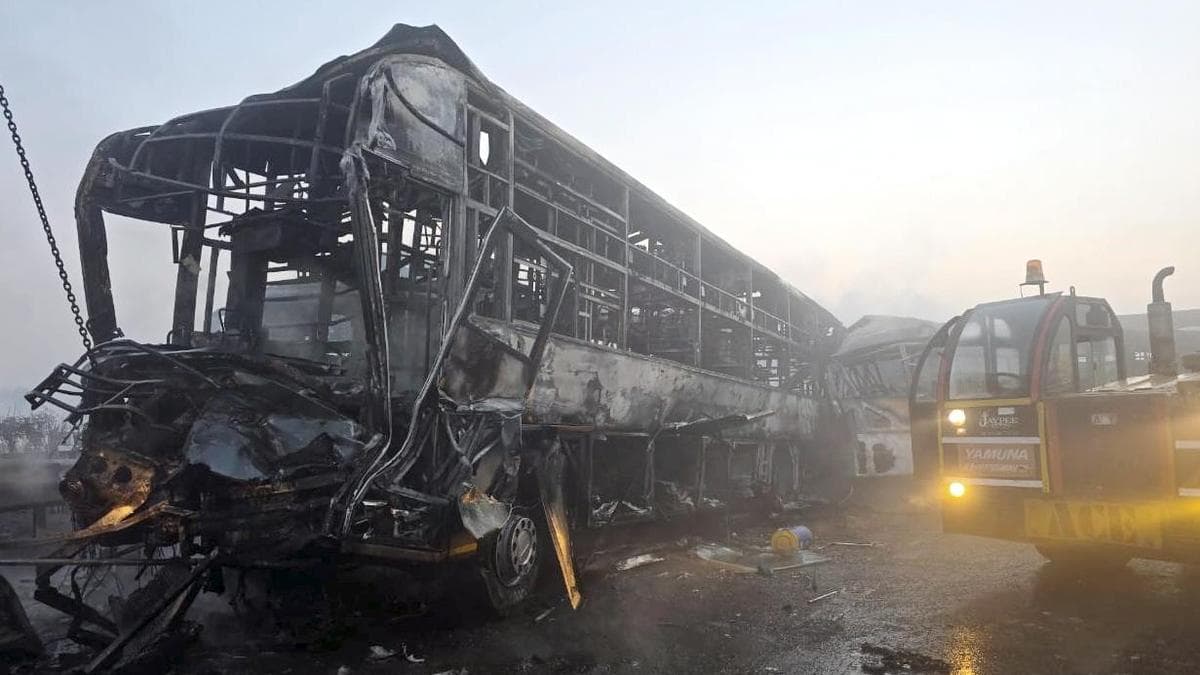
The incident at Milestone 127 on the Yamuna Expressway involved a massive pile-up of ten vehicles – specifically, seven buses and three smaller vehicles. The collision, which also led to some buses catching fire, occurred amidst extremely dense fog, severely limiting visibility for drivers. While four lives were lost, timely intervention ensured that the 25 injured individuals were not in critical condition, highlighting the efforts of emergency services.
**Key Stakeholders Involved:**
* **Victims and Their Families:** The primary sufferers, facing loss of life, injury, and emotional trauma.
* **Mathura Police and Uttar Pradesh State Police:** Key first responders, responsible for rescue operations, traffic management, accident investigation, and maintaining law and order at the site.
* **Yamuna Expressway Industrial Development Authority (YEIDA) and Concessionaire (Jaypee Infratech Ltd.):** As the regulatory body and operator, they are responsible for the expressway's maintenance, safety infrastructure (e.g., adequate signage, fog lights, rumble strips), and implementation of safety protocols.
* **Uttar Pradesh State Government:** Holds overall responsibility for public safety, disaster management, and formulating state-level road safety policies.
* **Ministry of Road Transport and Highways (MoRTH), Government of India:** Responsible for national road safety policies, standards, and data collection. The ministry often provides guidelines for expressway design and safety features.
* **Public Transport Operators/Drivers:** Directly involved in operating the vehicles, their adherence to safety norms, training, and driving practices are crucial.
**Significance for India:**
This incident underscores India's severe road safety crisis. India accounts for approximately 11% of the global road accident fatalities, despite having only 1% of the world's vehicles. Such accidents lead to substantial economic losses, estimated by the World Bank to be between 3-5% of India's GDP annually, due to loss of productivity, healthcare costs, and property damage. Socially, they cause immense suffering and loss of human potential. The Yamuna Expressway pile-up highlights the need for robust **disaster management** strategies, including better early warning systems for adverse weather, rapid response protocols, and coordinated efforts between various agencies. It also brings into focus the imperative for stricter enforcement of traffic laws, driver education, and the deployment of Intelligent Transport Systems (ITS) to prevent such occurrences.
**Historical Context and Policy Framework:**
India has a long history of high road accident rates. Recognizing this, the government enacted the **Motor Vehicles Act, 1988**, which was significantly amended in **2019**. The **Motor Vehicles (Amendment) Act, 2019**, introduced stricter penalties for traffic violations, provisions for electronic monitoring, and enhanced safety standards, aiming to reduce accidents by 50% by 2030. Furthermore, the **National Road Safety Policy, 2010**, outlined strategies for road safety education, engineering, enforcement, and emergency care. The **National Disaster Management Act, 2005**, provides the legal framework for disaster preparedness, mitigation, and response, under which state and district authorities manage incidents like large-scale accidents.
**Related Constitutional Articles and Policies:**
* **Article 21 (Right to Life and Personal Liberty):** The Supreme Court has often interpreted this article to include the right to a safe environment, implicitly extending to safe roads and transportation, placing a duty on the state to ensure public safety.
* **Seventh Schedule (State List, Entry 13 - Communications, that is to say, roads, bridges, ferries, and other means of communication not specified in List I; municipal tramways; ropeways; inland waterways and traffic thereon subject to the provisions of List I and List III with regard to inland waterways):** State governments primarily manage roads and related infrastructure, making road safety a significant state responsibility.
* **Good Samaritan Law (introduced via Motor Vehicles Act, 2019):** Protects individuals who render emergency medical or non-medical help to accident victims from civil or criminal liability, encouraging public assistance.
**Future Implications:**
This incident will likely intensify calls for enhanced safety measures on expressways. Future implications include: increased scrutiny of expressway design and maintenance; mandatory implementation of advanced safety features like anti-fog devices, reflective markers, and variable message signs (VMS) that display real-time warnings; stricter enforcement of speed limits, especially during adverse weather; and investment in driver training programs focusing on defensive driving in challenging conditions. The role of technology, such as AI-powered surveillance and predictive analytics for accident hotspots, will also be crucial. Furthermore, better inter-agency coordination for emergency response and post-accident care will be emphasized to minimize casualties and expedite recovery operations. This event serves as a critical case study for improving India's overall road safety ecosystem and disaster preparedness.
Exam Tips
This topic falls under General Studies Paper I (Geography - Transport, Disaster Management) and General Studies Paper III (Internal Security - Disaster Management; Infrastructure). Students should be prepared for questions on India's road network, geographical factors affecting transport (like fog), and disaster response mechanisms.
Study the Motor Vehicles (Amendment) Act, 2019, in detail, focusing on key provisions related to penalties, road safety, and the Good Samaritan law. Also, understand the structure and role of the National Disaster Management Authority (NDMA) and State Disaster Management Authorities (SDMAs).
Common question patterns include: analytical questions on the causes and consequences of road accidents in India; policy-based questions on government initiatives for road safety; and questions on the role of technology (e.g., Intelligent Transport Systems) in preventing accidents and managing disasters. Case study questions involving ethical dilemmas or administrative challenges in accident response are also possible.
Related Topics to Study
Full Article
According to a Mathura Police statement on X, the pile-up at Milestone 127 involved seven buses and three smaller vehicles. "None of the injured are in critical condition," it said