



Relevant for Exams
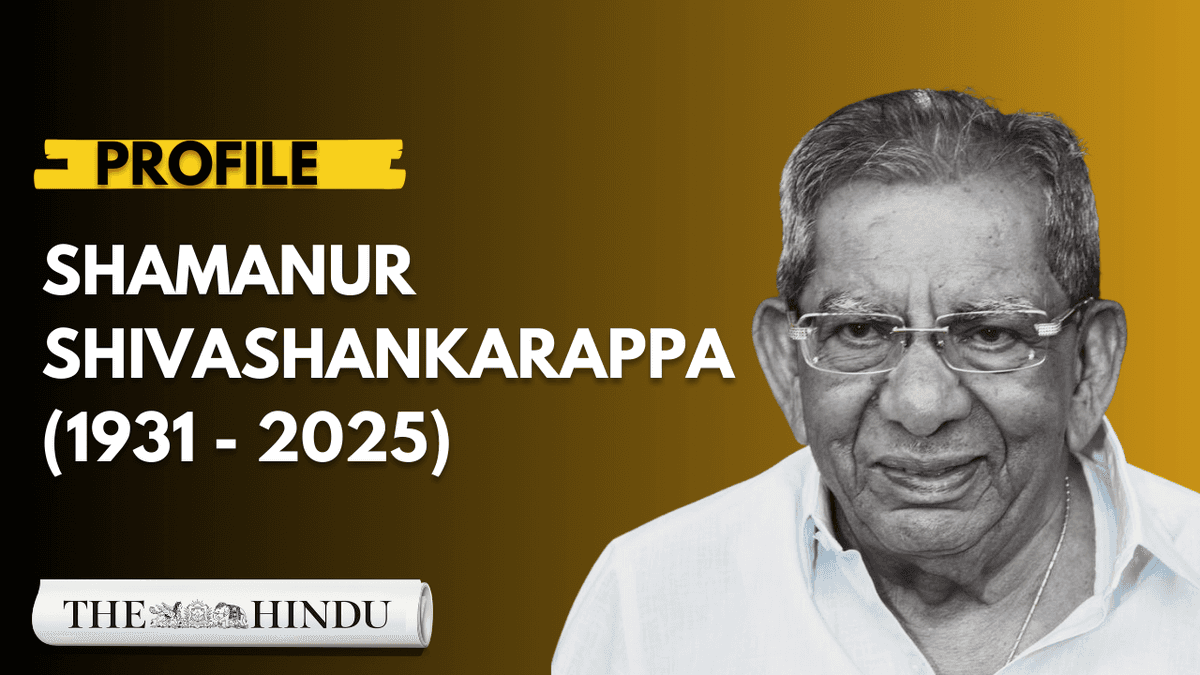
Veteran Congress leader Shamanur Shivashankarappa, Davanagere South MLA, passes away at 94.
Summary
Veteran Congress leader and Davanagere South MLA, Shamanur Shivashankarappa, passed away on December 14, 2025, at the age of 94 due to age-related complications. His demise marks the loss of a significant political figure from Karnataka. This event is relevant for competitive exams, particularly State PSCs, for general awareness about prominent political personalities.
Key Points
- 1Veteran Congress leader Shamanur Shivashankarappa passed away.
- 2He was the sitting Member of Legislative Assembly (MLA) from Davanagere South constituency.
- 3His demise occurred on December 14, 2025.
- 4He was 94 years old at the time of his passing.
- 5The cause of his death was attributed to age-related complications.
In-Depth Analysis
The passing of veteran Congress leader and Davanagere South MLA, Shamanur Shivashankarappa, on December 14, 2025, at the age of 94 due to age-related complications, marks a significant event in Karnataka's political landscape. While seemingly a personal tragedy, the demise of a sitting legislator, especially one of his stature, carries substantial implications for state politics, electoral processes, and the Congress party.
Shamanur Shivashankarappa was not just an MLA; he was a towering figure in Karnataka politics, often referred to as a political stalwart. His career spanned several decades, showcasing immense resilience and influence. Hailing from the dominant Veerashaiva Lingayat community, he commanded significant respect and a strong support base, particularly in the Davanagere region. Throughout his political journey, he held various ministerial portfolios in different Congress governments, contributing to policy-making and governance. His long tenure in public life, including multiple terms as an MLA, made him a repository of institutional memory and a seasoned strategist within his party. He was also known for his contributions to the cooperative sector and education, having founded and managed several educational institutions, further cementing his social and political standing.
His passing creates an immediate political vacuum in the Davanagere South constituency. The primary stakeholders affected are the Congress party, which loses a senior and influential voice; the voters of Davanagere South, who are now without a direct representative in the State Legislative Assembly; and the state government, which must now facilitate the electoral process to fill this vacancy. For the Congress, his absence means the loss of an experienced leader capable of mobilizing votes and navigating complex political scenarios, especially in a region where his influence was paramount.
This event matters significantly for India's democratic functioning, particularly at the state level. The death of a sitting MLA necessitates a by-election. This is governed by constitutional provisions and electoral laws. Article 190 of the Indian Constitution deals with the vacation of seats. While it primarily addresses resignations and disqualifications, the death of a member also leads to a vacancy. The Representation of the People Act, 1951, specifically Section 150, mandates that the Election Commission of India (ECI) must hold a by-election to fill a casual vacancy in a State Legislative Assembly within six months from the date of the vacancy. This ensures continuous representation for the constituency and upholds the democratic principle of elected representatives. The ECI, an independent constitutional body established under Article 324, will be responsible for conducting a free and fair by-election in Davanagere South.
The historical context of such demises often points to the challenges faced by political parties in succession planning and maintaining regional strongholds. Veteran leaders like Shivashankarappa often build personal rapport and loyalty that are hard to transfer. His passing could trigger internal debates within the Congress over who should succeed him, potentially leading to factionalism or a scramble for influence. Often, family members of deceased leaders contest such by-elections, banking on sympathy votes and the legacy of the departed leader, a phenomenon frequently observed in Indian politics.
Looking ahead, the most immediate future implication is the impending by-election in Davanagere South. This by-election will be a litmus test for the Congress party's ability to retain the seat without its stalwart leader and will also be a battleground for opposition parties to gain a foothold. The outcome could subtly alter the numerical strength in the Karnataka Assembly, though unlikely to change the government's stability. More broadly, it will highlight the evolving dynamics of leadership within the Congress in Karnataka and the challenges of transitioning from an era dominated by seasoned veterans to new generations of leaders. The process of the by-election, from candidate selection to campaigning and polling, will be closely watched, offering insights into regional political sentiments and the effectiveness of various party strategies.
Exam Tips
This topic falls under 'Indian Polity and Governance' and 'Current Affairs' for UPSC, State PSC, SSC, and Banking exams. For State PSCs, it's also relevant for 'State-specific General Knowledge' focusing on prominent personalities.
Study related topics such as the structure and functions of the Election Commission of India (ECI), the process of by-elections, constitutional provisions related to State Legislatures (e.g., Article 172, 190), and the Representation of the People Act, 1951.
Common question patterns include: 'Who was Shamanur Shivashankarappa and which constituency did he represent?' (fact-based); 'What constitutional provisions govern the filling of a vacancy in a State Legislative Assembly due to the death of an MLA?' (conceptual); and 'What is the role of the Election Commission in conducting by-elections?' (procedural).
Related Topics to Study
Full Article
Veteran Congress leader and Davanagere South MLA Shamanur Shivashankarappa passed away on December 14, 2025, at the age of 94 due to age-related complications