



Relevant for Exams
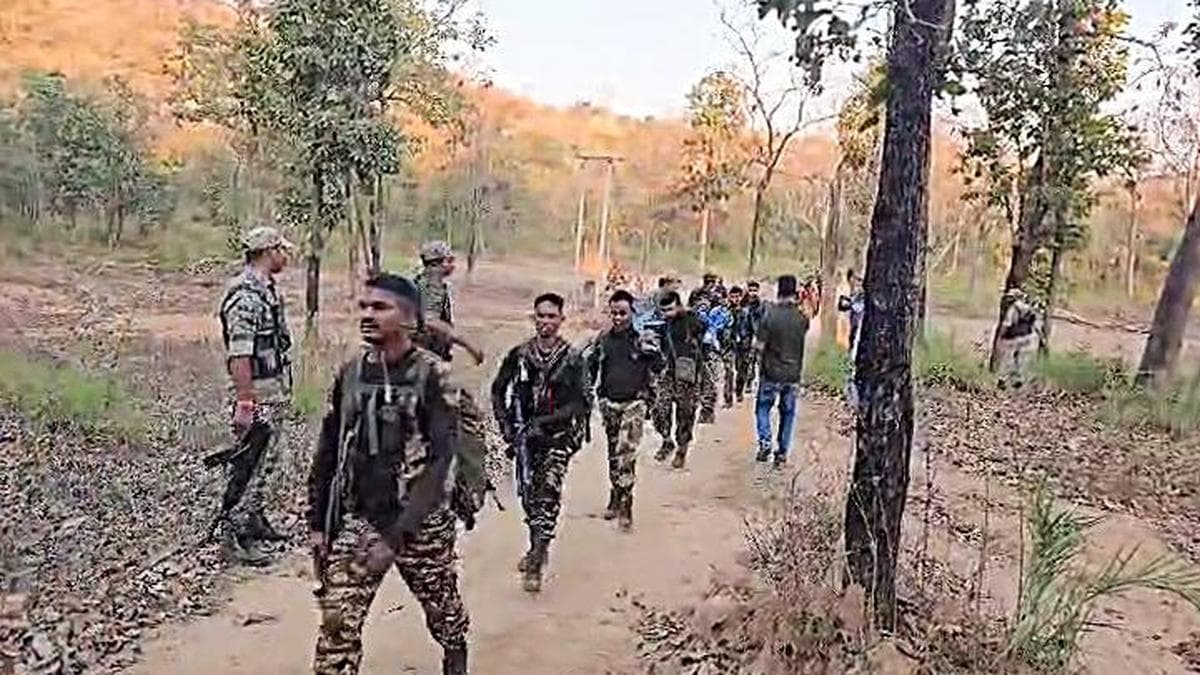
Two Cobra personnel injured in IED blast in Chhattisgarh's Bijapur district.
Summary
An Improvised Explosive Device (IED) blast occurred in Chhattisgarh's Bijapur district, resulting in minor injuries to two Cobra personnel during a security operation. This incident underscores the persistent internal security challenges posed by Naxalite activities in the region. Understanding such events is vital for competitive exams focusing on internal security, geography, and current affairs related to conflict zones.
Key Points
- 1An IED blast occurred in Bijapur district, located in Chhattisgarh.
- 2Two security personnel belonging to the Cobra (Commando Battalion for Resolute Action) unit sustained minor injuries.
- 3The injured personnel were subsequently sent to Raipur for better medical treatment.
- 4The incident took place during an ongoing security operation in the Naxalite-affected region.
- 5Cobra is a specialized unit of the Central Reserve Police Force (CRPF), trained for jungle warfare.
In-Depth Analysis
The recent Improvised Explosive Device (IED) blast in Chhattisgarh's Bijapur district, which injured two Cobra personnel, serves as a stark reminder of India's persistent internal security challenge posed by Left Wing Extremism (LWE), commonly known as Naxalism or Maoism. This incident is not an isolated event but a recurring feature in the 'Red Corridor' – a region spanning several states in central and eastern India, grappling with Maoist insurgency.
**Background Context and Historical Roots:**
Naxalism originated from a peasant uprising in Naxalbari village, West Bengal, in 1967. Driven by agrarian distress, landlessness, and exploitation, it quickly evolved into an armed struggle advocating for the overthrow of the state through protracted people's war, inspired by Maoist ideology. Key groups like the People's War Group (PWG) and the Maoist Communist Centre (MCC) merged in 2004 to form the Communist Party of India (Maoist) – the dominant LWE outfit today. The movement thrives by exploiting socio-economic grievances among marginalized sections, particularly tribal communities, who face displacement, land alienation, lack of basic services, and perceived state neglect.
**What Happened:**
The incident involved an IED blast targeting security forces during an operation in Bijapur, a district notorious for Naxalite activity. IEDs are a preferred tactic of Maoists due to their low cost, ease of deployment, and high potential for inflicting casualties and psychological impact on security personnel. The two injured personnel belong to the Commando Battalion for Resolute Action (CoBRA), a specialized unit of the Central Reserve Police Force (CRPF) specifically trained for jungle warfare and counter-insurgency operations in LWE-affected areas. Their deployment underscores the intensity and specialized nature of operations required in these terrains.
**Key Stakeholders Involved:**
1. **Naxalites/Maoists:** Primarily the CPI (Maoist), they aim to establish a 'people's government' by overthrowing the democratic state. Their tactics include guerrilla warfare, IED attacks, extortion, and targeted killings. They often coerce local populations for support.
2. **Indian State and Security Forces:** This includes the Central Reserve Police Force (CRPF) with its specialized CoBRA unit, the state police forces of Chhattisgarh, and various intelligence agencies. Their primary role is to maintain law and order, conduct counter-insurgency operations, and protect government infrastructure and personnel.
3. **Local Tribal Population:** These communities are often caught in the crossfire. They are vulnerable to exploitation by Naxalites, face displacement due to conflict and development projects, and often lack access to justice, education, and healthcare, fueling their grievances.
4. **Civil Administration and Development Agencies:** Government bodies responsible for implementing development schemes, ensuring governance, and providing essential services. Their efforts are crucial in addressing the root causes of Naxalism but are often hampered by the security situation.
**Significance for India:**
This incident highlights LWE as one of the gravest internal security threats to India. It impedes development in resource-rich but underdeveloped regions, diverting significant national resources towards security operations rather than socio-economic upliftment. The conflict leads to a substantial human cost, including lives lost among security forces, civilians, and Naxalites. Economically, it deters investment, hinders infrastructure projects (roads, schools, hospitals), and disrupts economic activities, perpetuating poverty and underdevelopment. Politically, it challenges the writ of the state and undermines democratic institutions in affected areas.
**Constitutional Provisions and Policies:**
The Indian Constitution's **Seventh Schedule** delineates powers between the Union and States, with 'Public Order' and 'Police' primarily falling under the State List, while 'Defence' and 'Armed Forces of the Union' are in the Union List. This necessitates strong Centre-State cooperation in tackling LWE. **Article 355** mandates the Union to protect every State against external aggression and internal disturbance, providing the constitutional basis for central forces like CRPF to assist states. The **Unlawful Activities (Prevention) Act, 1967 (UAPA)** is a crucial legislative tool used to combat unlawful associations and terrorist activities, including those perpetrated by Maoists. Furthermore, policies like the **Forest Rights Act, 2006 (FRA)**, which recognizes and vests forest rights and occupation in forest dwelling Scheduled Tribes and other traditional forest dwellers, are critical in addressing the historical injustices that often fuel Naxalite recruitment. The government's multi-pronged strategy to combat LWE, known as **'SAMADHAN'**, focuses on Smart Leadership, Aggressive Strategy, Motivation & Training, Actionable Intelligence, Dashboard-based KPIs & KRs, Harnessing Technology, Action plan for each Theatre, and No access to Financing. The Ministry of Home Affairs also implements the **Left Wing Extremism (LWE) Scheme** to fund security-related expenditure and development projects in affected districts.
**Future Implications:**
The persistence of such incidents indicates that LWE remains a formidable challenge. Future strategies will likely involve continued, intelligence-led security operations, coupled with an intensified focus on integrated development of affected regions. This includes improving connectivity, expanding access to education and healthcare, and ensuring better governance. Rehabilitation and surrender policies for Naxalites will also remain crucial. The long-term solution lies in a holistic approach that addresses both the security vacuum and the socio-economic grievances that provide fertile ground for the ideology to flourish, aiming to mainstream the marginalized populations and integrate them into the national development fabric.
Exam Tips
This topic falls under GS Paper III (Internal Security) for UPSC and State PSC exams. Be prepared for questions on the causes, consequences, government strategies (e.g., SAMADHAN), and the role of various security forces (CRPF, CoBRA).
Study related topics like tribal rights, land reforms, socio-economic development indicators in conflict zones, and the federal structure of India in relation to internal security. Questions often link Naxalism to issues of governance and inclusive development.
Common question patterns include direct questions on the evolution of Naxalism, the geographical spread of LWE, the challenges faced by security forces, and analytical questions on balancing security operations with developmental initiatives. Map-based questions identifying LWE-affected districts are also possible.
Related Topics to Study
Full Article
“During the operation, two Cobra personnel sustained minor injuries in an IED blast and have been sent to Raipur for better treatment,” a police said