



Relevant for Exams
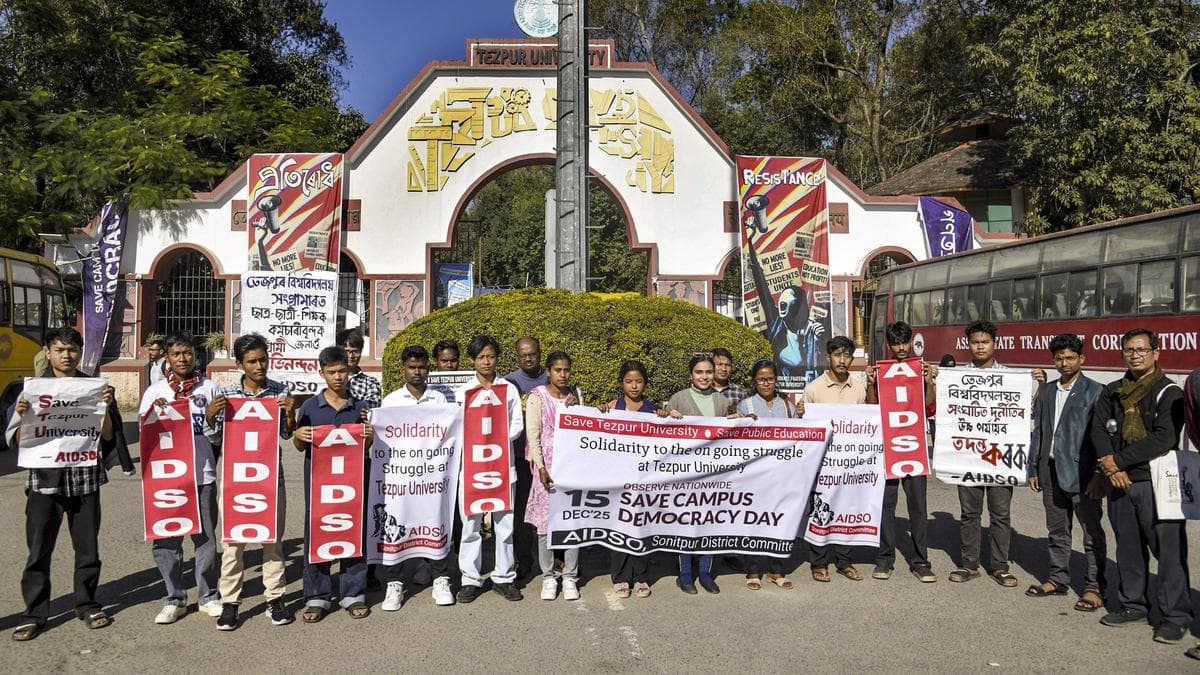
Tezpur University stakeholders observe fast, demand V-C ouster; seek Ministry of Education's intervention.
Summary
Stakeholders at Tezpur University, including teachers, non-teaching staff, and students, observed a fast to demand the ouster of the Vice-Chancellor. They are seeking swift intervention and action from the Ministry of Education regarding this matter. This event highlights internal administrative conflicts within a central university, which, while localized, can occasionally reflect broader issues in university governance relevant for general awareness in competitive exams.
Key Points
- 1The protest occurred at Tezpur University, a central university located in Assam.
- 2The stakeholders involved in the protest included teachers, non-teaching staff, and students.
- 3The primary demand of the protesting groups was the ouster of the university's Vice-Chancellor (V-C).
- 4The method of protest observed by the stakeholders was a fast.
- 5The protesting groups have sought swift action from the Ministry of Education regarding their demand.
In-Depth Analysis
The recent protest at Tezpur University, where teachers, non-teaching staff, and students observed a fast demanding the Vice-Chancellor's ouster, serves as a crucial case study in the dynamics of university governance in India. While seemingly a localized incident, it reflects broader issues concerning accountability, transparency, and administrative efficacy within higher education institutions, particularly central universities.
Tezpur University, established in 1994 by an Act of Parliament (Tezpur University Act, 1993), is one of India's prominent central universities, located in Assam. Central universities are distinct from state universities as they are directly funded and administered by the Union government through the Ministry of Education. This direct oversight means that administrative disputes within these institutions often escalate to the central government, as seen in this instance where stakeholders appealed to the Ministry of Education for swift action.
The background to such demands for a Vice-Chancellor's removal typically involves a range of grievances. Common reasons include allegations of financial mismanagement, arbitrary administrative decisions, lack of consultation with faculty and staff, perceived authoritarian leadership, declining academic standards, or issues related to student welfare and campus environment. Although the specific allegations against the V-C of Tezpur University are not detailed in the summary, the unified protest by all three major stakeholder groups—teachers, non-teaching staff, and students—suggests deep-seated dissatisfaction with the current leadership and administrative practices.
Key stakeholders in this scenario include the **teachers (faculty)**, who are the backbone of academic delivery and research. Their concerns often revolve around academic freedom, research funding, promotion policies, and the overall academic environment. The **non-teaching staff** are vital for the university's daily operations, and their grievances frequently relate to service conditions, promotions, and fair treatment. The **students**, as the primary beneficiaries of the institution, are concerned about the quality of education, timely completion of courses, campus facilities, and a conducive learning environment. The **Vice-Chancellor (V-C)**, as the principal executive and academic officer, is responsible for the overall administration and leadership. V-Cs of central universities are appointed by the Visitor (the President of India) from a panel recommended by a search-cum-selection committee, and their removal, if necessary, also follows a prescribed procedure. Finally, the **Ministry of Education (MoE)** is the ultimate authority, acting on behalf of the Visitor, to address such crises, conduct inquiries, and take corrective measures.
This incident matters significantly for India's higher education landscape. Firstly, it underscores the persistent challenges in university governance, particularly the delicate balance between autonomy and accountability. While universities require autonomy for academic excellence, they must also be accountable to their stakeholders and regulatory bodies. Secondly, administrative instability can severely hamper academic progress, research output, and the overall reputation of an institution, directly impacting the quality of human resources produced for the nation. Thirdly, such protests highlight the critical role of collective action and democratic participation within educational institutions, demonstrating how various groups can unite to demand better governance. Historically, university administration in India has evolved from colonial models, with significant reforms post-independence aimed at fostering academic excellence and administrative efficiency, guided by bodies like the University Grants Commission (UGC) established under the UGC Act, 1956. Despite these efforts, issues of administrative overreach or mismanagement continue to surface.
From a constitutional perspective, **Entry 66 of the Union List** (Seventh Schedule) empowers the Union Parliament to legislate on "Coordination and determination of standards in institutions for higher education or research and scientific and technical institutions." This provision provides the constitutional backing for the establishment and regulation of central universities like Tezpur University and statutory bodies like the UGC. The President of India, as the Visitor of central universities, exercises powers derived from their respective Acts, often acting on the aid and advice of the Union Cabinet (Ministry of Education). While there isn't a direct constitutional article for V-C removal, the process is laid out in the specific University Acts (e.g., Tezpur University Act, 1993 or the Central Universities Act, 2009 for many others), which are parliamentary enactments.
The future implications of this event could range from an inquiry initiated by the Ministry of Education, potentially leading to the V-C's removal or resignation, to the implementation of reforms aimed at strengthening grievance redressal mechanisms and enhancing transparency in university administration. Such incidents also put pressure on policymakers to review existing governance structures and appointment processes for top academic positions to prevent future recurrences and ensure stable, meritocratic leadership. Ultimately, maintaining a harmonious and efficient administrative environment is paramount for India to achieve its aspirations of becoming a global hub for quality higher education, as envisioned by policies like the National Education Policy (NEP) 2020.
Exam Tips
This topic falls under 'Indian Polity & Governance' and 'Social Issues' for UPSC/State PSCs, and 'Higher Education System' for teaching exams. Focus on the roles of the President as Visitor, Ministry of Education, and UGC in central university administration.
Study the structure of university governance in India (Visitor, Chancellor, V-C, Executive Council, Academic Council) and differentiate between central, state, and private universities. Understand the appointment and removal procedures for V-Cs.
Be prepared for questions on challenges in higher education governance, autonomy vs. accountability, and the impact of administrative stability on academic quality. MCQs might test specific Acts (e.g., UGC Act, Central Universities Act) or constitutional provisions like Entry 66 of the Union List.
Related Topics to Study
Full Article
Teachers, non-teaching staff, and students seek swift action from the Ministry of Education