



Relevant for Exams
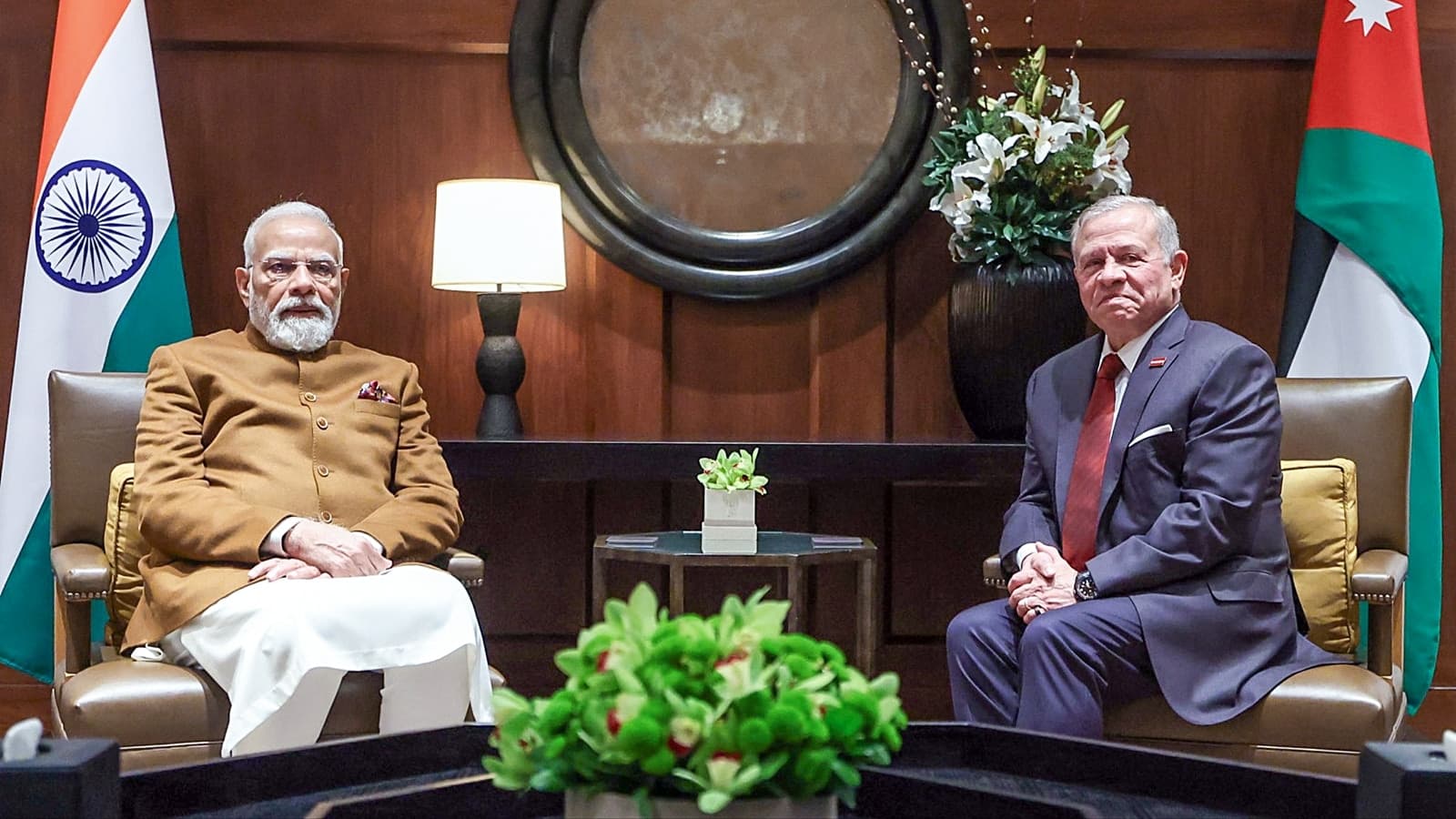
PM Modi and Jordan King affirm shared stance against terror in bilateral meeting.
Summary
Prime Minister Modi held a meeting with the King of Jordan, where both leaders reportedly shared a common stance against terrorism. This high-level bilateral engagement signifies India's ongoing diplomatic efforts in West Asia and its commitment to combating global terrorism. For exams, it highlights India's foreign policy and key international partnerships.
Key Points
- 1Indian Prime Minister Narendra Modi met with the King of Jordan.
- 2The primary agenda mentioned was a "common stance against terror."
- 3This interaction reflects ongoing bilateral engagement between India and Jordan.
- 4The meeting underscores India's foreign policy focus on counter-terrorism efforts.
- 5It highlights India's diplomatic ties with nations in the West Asian region.
In-Depth Analysis
The meeting between Indian Prime Minister Narendra Modi and King Abdullah II of Jordan, where both leaders emphasized a 'common stance against terror,' signifies a crucial aspect of India's evolving foreign policy and its commitment to global security. This high-level engagement is not an isolated event but rather a continuation of deepening bilateral ties and a reflection of India's strategic outreach to the West Asian region.
**Background Context and Historical Ties:**
India and Jordan share a historically warm and cordial relationship, rooted in shared values and mutual respect. Diplomatic ties were established in 1950, and since then, both nations have maintained a consistent trajectory of cooperation. Jordan, a moderate Arab state, holds significant geopolitical importance due to its strategic location bordering conflict-ridden countries like Syria and Iraq, and its historical role in regional stability. India's 'Look West' policy, which has evolved into a more proactive 'Act West' policy under the current government, seeks to deepen engagement with West Asian nations across political, economic, and security dimensions. This policy recognizes the region's importance for India's energy security, trade, and the welfare of its vast diaspora. The increasing threat of global terrorism, epitomized by groups like ISIS (Daesh) and Al-Qaeda, has compelled nations worldwide to forge stronger alliances and develop coordinated strategies to combat this menace. India, having been a victim of cross-border terrorism for decades, has consistently advocated for a zero-tolerance approach to terrorism.
**The Essence of the Meeting and Key Stakeholders:**
While specific details of the discussions were not widely publicized, the core message of a 'common stance against terror' underscores a shared understanding of the existential threat posed by radical ideologies and violent extremism. The primary stakeholders are India, represented by Prime Minister Narendra Modi and the Ministry of External Affairs, and Jordan, led by King Abdullah II. For India, the meeting reinforces its commitment to global counter-terrorism efforts and its diplomatic outreach. For Jordan, maintaining strong alliances with countries like India helps bolster its security and economic stability in a volatile neighborhood. Beyond the two nations, the broader international community, including global counter-terrorism forums and organizations, also stands as an indirect stakeholder, benefiting from enhanced bilateral cooperation against terror.
**Significance for India:**
This bilateral engagement carries multi-faceted significance for India. Firstly, on the **security front**, it strengthens India's counter-terrorism framework. Cooperation with Jordan can involve intelligence sharing, capacity building, and coordinated efforts to counter radicalization and extremist narratives. India has long been a proponent of a Comprehensive Convention on International Terrorism (CCIT) at the United Nations, first proposed in 1996, and such bilateral dialogues help build consensus for global action. Secondly, **economically**, Jordan, though not a major oil producer, offers opportunities for trade and investment. India is keen to diversify its economic partnerships in the region beyond traditional energy suppliers. Thirdly, **diplomatically**, engaging with a moderate voice like Jordan enhances India's soft power and influence in the Arab world. It also demonstrates India's balanced approach to West Asian geopolitics, engaging with all key players. Lastly, it reinforces India's commitment to protecting its significant diaspora in the broader Middle East, whose safety and well-being are paramount.
**Constitutional Provisions and Policy Framework:**
India's foreign policy objectives, including the promotion of international peace and security and fostering respect for international law, are enshrined in **Article 51** of the Directive Principles of State Policy (DPSP) in the Constitution. This article guides the state in its conduct of international relations. Furthermore, India's domestic legal framework, such as the **Unlawful Activities (Prevention) Act, 1967 (UAPA)**, which has been amended multiple times (most recently in 2019) to strengthen anti-terrorism provisions, reflects its robust stance against terrorism. Bilateral and multilateral engagements like this meeting with Jordan are crucial for operationalizing these policy objectives and legal frameworks on a global scale. India's consistent advocacy for the CCIT at the UN also highlights its long-term strategic vision for a unified global approach to terrorism.
**Future Implications:**
The meeting paves the way for deeper cooperation across various sectors. In the immediate future, we can expect enhanced intelligence sharing and potentially joint training programs between security agencies. This could lead to more effective strategies in combating financing of terrorism and preventing radicalization. Economically, discussions might lead to increased trade volumes, particularly in areas where India has expertise, such as IT, pharmaceuticals, and infrastructure. Culturally, continued exchanges can foster greater understanding and counter extremist ideologies. Strategically, India's consistent engagement with Jordan positions it as a reliable partner in West Asia, contributing to regional stability and peace, which is vital for India's own economic and security interests. This also signals India's readiness to play a more proactive role in shaping global counter-terrorism narratives and actions, moving beyond mere condemnation to concrete cooperation.
Exam Tips
This topic falls under GS Paper II (International Relations, Foreign Policy) and GS Paper III (Internal Security, Challenges to Internal Security through external state and non-state actors) for UPSC Civil Services Exam. For State PSCs and SSC, it relates to current affairs and India's foreign policy.
When studying, link this bilateral meeting to broader themes such as India's 'Act West' policy, its energy security concerns, counter-terrorism diplomacy, and the role of moderate Arab states in regional stability. Understand the geopolitical significance of Jordan.
Common question patterns include direct questions on India-Jordan relations, analytical questions on India's counter-terrorism strategy in West Asia, or essay questions on the evolving dynamics of India's foreign policy in the Middle East.
Pay attention to constitutional provisions like DPSP Article 51 and major anti-terrorism legislation like UAPA, and their relevance to India's international commitments and domestic security.
Be prepared to discuss the Comprehensive Convention on International Terrorism (CCIT) – its history, objectives, and India's role in its advocacy.