



Relevant for Exams
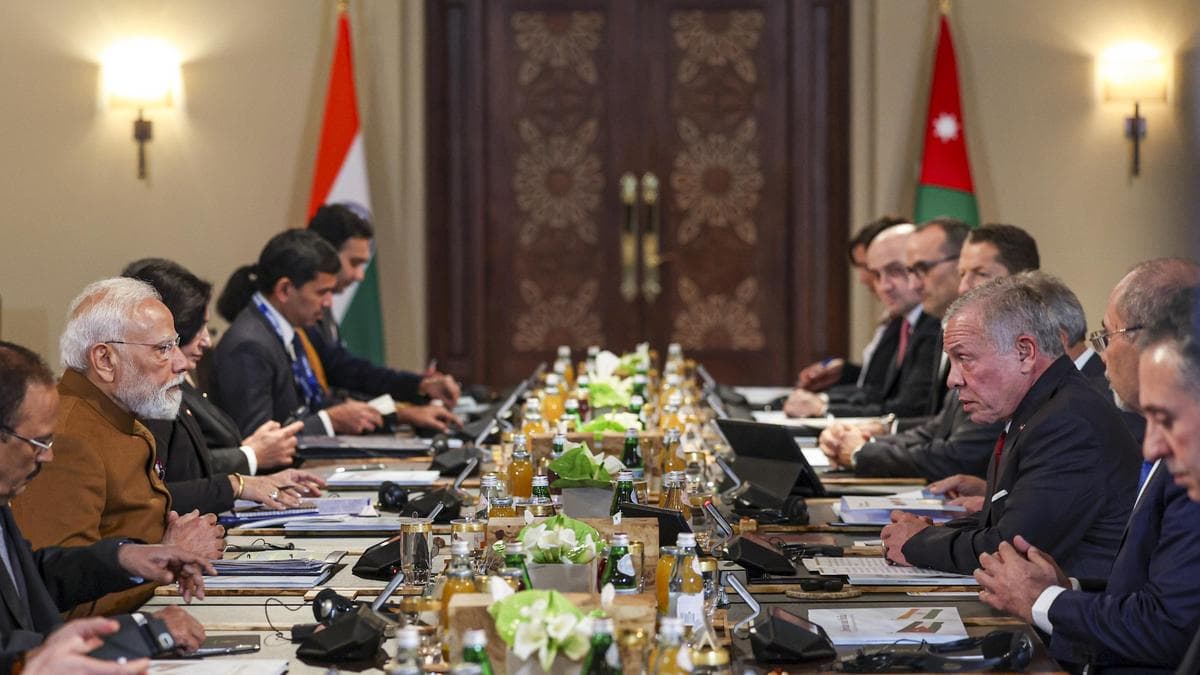
PM Modi meets Jordan's King; historic visit after 37 years, marking 75 years of diplomatic ties.
Summary
Prime Minister Modi and Jordan's King Abdullah II discussed bilateral ties and exchanged perspectives on regional and global issues. This significant meeting marks a full-fledged bilateral visit to Jordan after 37 years, coinciding with the 75th anniversary of diplomatic relations between India and Jordan. This event is crucial for competitive exams, highlighting India's international relations, diplomatic history, and engagement with West Asian nations.
Key Points
- 1Prime Minister Narendra Modi and Jordan's King Abdullah II discussed bilateral ties.
- 2The visit to Jordan was a full-fledged bilateral visit occurring after a gap of 37 years.
- 3The visit coincided with the 75th anniversary of the establishment of diplomatic relations between India and Jordan.
- 4Discussions included bilateral relations and exchange of perspectives on regional and global issues.
- 5The two leaders involved were India's PM Modi and Jordan's King Abdullah II.
In-Depth Analysis
The recent meeting between Prime Minister Narendra Modi and Jordan's King Abdullah II marks a significant milestone in India-Jordan relations, underscoring India's expanding diplomatic outreach and strategic interests in West Asia. This full-fledged bilateral visit to Jordan, occurring after a considerable gap of 37 years, is particularly noteworthy as it coincides with the 75th anniversary of the establishment of diplomatic relations between the two countries. Such high-level engagements are crucial for competitive exam aspirants to understand India's foreign policy dynamics, historical relations, and contemporary geopolitical strategies.
Historically, India and Jordan have maintained cordial relations rooted in shared values and a common commitment to peace and stability. Diplomatic ties were formally established in 1947, immediately after India's independence, reflecting an early recognition of mutual importance. Both nations were prominent members of the Non-Aligned Movement (NAM) during the Cold War era, advocating for sovereign equality and non-interference in internal affairs. High-level visits have occurred sporadically; for instance, King Hussein of Jordan visited India multiple times, and Indian President N. Sanjiva Reddy visited Jordan in 1980, followed by Prime Minister Indira Gandhi in 1981. However, the absence of a full-fledged bilateral visit by an Indian Prime Minister for nearly four decades highlights a period of relative dormancy, making the recent engagement a significant revival.
The key stakeholders in this interaction are primarily India, represented by Prime Minister Modi and the Ministry of External Affairs, and Jordan, led by King Abdullah II and its foreign policy establishment. For India, the visit aligns with its 'Look West' policy, aiming to deepen and diversify engagement with the West Asian region beyond traditional energy-centric relationships. India seeks to enhance cooperation in areas like trade, investment, counter-terrorism, defence, and technology. Jordan, a relatively stable and moderate voice in a volatile region, is crucial for India's strategic interests, offering a valuable partner in regional stability and counter-radicalization efforts. For Jordan, strengthening ties with a rapidly growing economic power like India provides opportunities for economic development, foreign investment, and leveraging India's global influence on regional issues, including the perennial Middle East peace process.
This visit holds immense significance for India across multiple dimensions. Geopolitically, it reinforces India's commitment to a balanced and diversified foreign policy in West Asia, avoiding over-reliance on any single bloc or country. By engaging with Jordan, India demonstrates its capacity to work with diverse partners to promote regional stability and address common challenges like terrorism. Economically, bilateral trade, though modest compared to other Gulf nations, has been steadily growing. Jordan is a key source of phosphates and potash, vital for India's agricultural sector. Enhanced engagement can open new avenues for Indian exports (agricultural products, textiles, machinery) and investments in Jordan's infrastructure and technology sectors. Strategically, cooperation on counter-terrorism and intelligence sharing is paramount, given the shared threat of extremist ideologies. Jordan's pragmatic approach to regional security makes it a valuable partner.
India's foreign policy, as articulated in **Article 51 of the Indian Constitution**, directs the state to "promote international peace and security; maintain just and honourable relations between nations; foster respect for international law and treaty obligations; and encourage settlement of international disputes by arbitration." This constitutional directive forms the bedrock for India's engagement with countries like Jordan, emphasizing peaceful co-existence and cooperation. The discussions on regional and global issues, including the Middle East peace process, resonate with India's long-standing support for a two-state solution and its commitment to a rules-based international order. India's evolving 'Look West' policy is not merely about economic gains but also about projecting India as a responsible global stakeholder contributing to regional peace and development.
Looking ahead, the future implications of this renewed engagement are promising. The visit is expected to pave the way for increased high-level exchanges, leading to concrete agreements in various sectors. Potential areas of future cooperation include renewable energy, pharmaceuticals, IT, and education. India's 'Act East' policy has seen tremendous success, and a similar vigour in its 'Look West' approach, exemplified by this visit, can yield significant strategic dividends. Enhanced collaboration with Jordan can also provide India with a broader perspective and deeper understanding of the complex dynamics of the Arab world, allowing India to play a more constructive role in regional dialogues and multilateral forums. This engagement signifies India's growing confidence and proactive stance in shaping its geopolitical environment.
Exam Tips
This topic falls under UPSC GS Paper II (International Relations - India and its neighborhood- relations; Bilateral, regional and global groupings and agreements involving India and/or affecting India’s interests) and is also relevant for State PSCs and SSC General Awareness sections.
Study India's 'Look West' policy, its evolution, key objectives, and specific initiatives. Connect it with India's energy security, diaspora, and counter-terrorism strategies.
Be prepared for factual questions in Prelims/MCQ exams (e.g., 'Which country did PM Modi visit after a 37-year gap?', 'Which anniversary of diplomatic ties was celebrated between India and Jordan?'). For Mains, expect analytical questions on the significance of such visits for India's foreign policy and regional stability.
Relate India's engagement with Jordan to the broader context of the Middle East Peace Process and India's traditional stance on the Palestinian issue, as Jordan plays a crucial role in these discussions.
Understand the constitutional basis of India's foreign policy, specifically Article 51, and how it guides India's international relations and pursuit of global peace and security.
Related Topics to Study
Full Article
The full-fledged bilateral visit to Jordan is taking place after 37 years, coinciding with the 75th anniversary of the establishment of diplomatic relations between the two countries